


China sets new record with 3,413-meter hot-water drilling in Antarctic subglacial lake
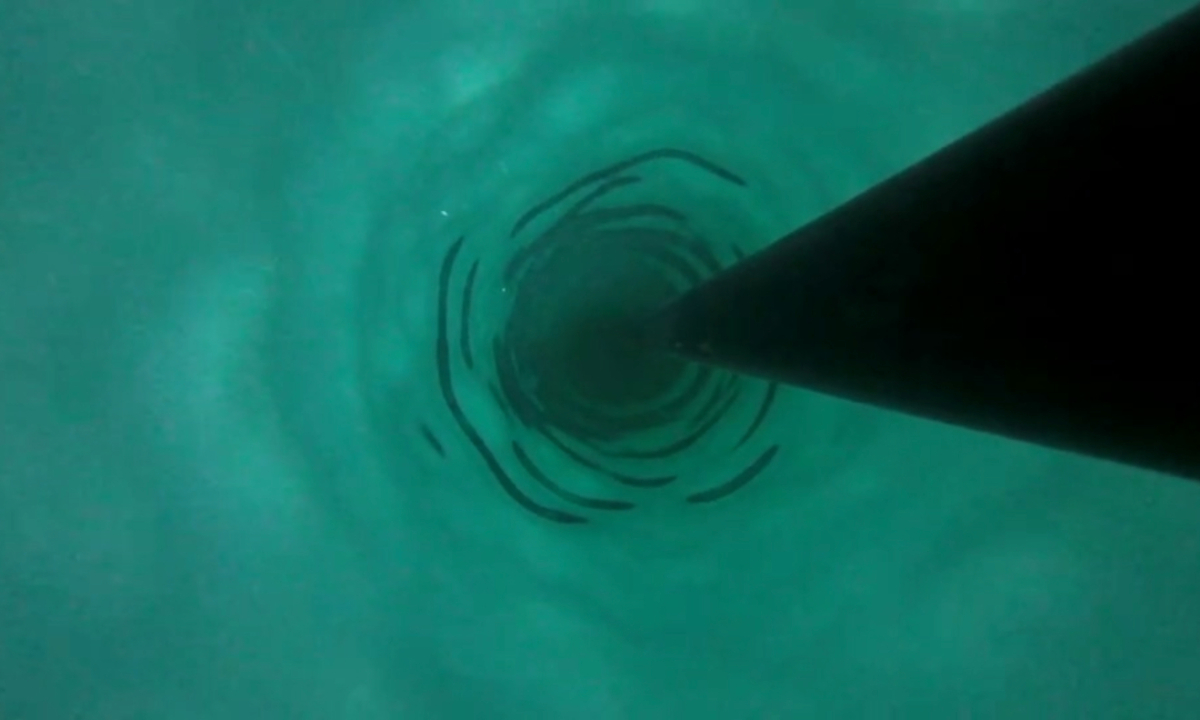
Footage from beneath an ice sheet during China’s first Antarctic hot-water drilling experiment (Photo: Xinhua)
China’s 42nd Antarctic expedition has set a new record with the country’s first hot-water drilling experiment on the Antarctic ice sheet, reaching a depth of 3,413 meters and surpassing the previous global mark of 2,540 meters, Xinhua News Agency reported on Tuesday, citing China’s Ministry of Natural Resources.
The first scientific drilling experiment into the Qilin Subglacial Lake, located beneath the ice sheet in East Antarctica, was completed on February 5. This achievement marks China’s capability to conduct drilling research across more than 90 percent of the Antarctic ice sheet and the entire Arctic ice sheet, according to Xinhua.
Polar hot-water drilling is a cutting-edge research method to study Earth’s ancient environmental changes, predict climate change, explore the limits of life and expand human knowledge, according to Xinhua.
Compared with traditional mechanical ice drilling, hot-water drilling offers greater penetration capability, higher drilling efficiency, less disturbance to the ice, and greater ease in achieving large-diameter, clean operations. It enables efficient access to key interfaces such as subglacial lakes, the underside of ice shelves, and subglacial bedrock, making it the mainstream technology internationally for studying the deep environments of polar ice sheets and ice shelves, Xinhua reported.
The primary objective of this test was to demonstrate the application of a deep ice-sheet hot-water and thermal-melting drilling systems in Antarctica. By drilling through the ice sheet above the Qilin Subglacial Lake, it provided a contamination-free access channel and key technical support for subsequent in situ observations of the subglacial lake, as well as for collecting water and lakebed samples, according to Xinhua.
The experiment targeted an ice sheet more than 3,000 meters thick, integrating multiple types of equipment suited to polar field conditions and meeting the requirements for high-precision, rapid, and clean drilling.
Researchers overcame key technical challenges to achieve efficient, stable, and clean drilling and filled a domestic gap in this field, showcasing China’s “green expedition” and “environmentally friendly technology” concepts, Xinhua reported.