



Photo shows solar panels in Yaoli village, Nanfeng county, Fuzhou, east China's Jiangxi province. (Photo: Xie Dong)
According to rankings released by OpenRouter, a global aggregation platform for large-language models, Chinese large-language models have outperformed their overseas counterparts in usage for a full month.
In the most recent week (March 30 to April 4), Chinese models took the top six spots among the global top 10, with total token calls reaching 12.27 trillion. This is no fleeting spike, but a sustained trend.
Before going further, it is worth unpacking a technical term that has recently entered the public conversation: the token. A token is the smallest unit of information processed by large models. It can be measured, priced, and traded. Every Chinese character input, every line of generated code, and every image recognized, all consume tokens.
If the industrial era was defined by petroleum, and the internet age by traffic, then the AI era is defined by token usage. It serves as a key barometer of the development of the AI industry.
In March this year, China's daily token usage exceeded 140 trillion, equivalent to processing the entire holdings of roughly 250 National Libraries of China in a single day. Even more striking is the growth rate: since early 2024, when token usage stood at 100 billion, China has achieved a thousand-fold increase in just over two years. China has undoubtedly become one of the most active countries in the world for AI applications.

Photo shows the Wuhu Intelligent Computing Economic Industrial Park in east China's Anhui province. (Photo: Tao Haijin)
What fuels this extraordinary growth? Three fundamental pillars stand out.
The first is a solid foundation of power supply. AI development fundamentally depends on electricity. China possesses the world's largest and most advanced power supply system, with total installed capacity reaching 3.95 billion kilowatts and a continuously expanding share of clean energy. Converting watts efficiently into tokens is essential. Without power, AI simply cannot function.
The second is China's strength in computing power. Superior computing infrastructure accelerates token processing and reduces unit costs, while advanced algorithms enhance output quality and increase token utilization frequency.
National initiatives such as "Eastern Data, Western Computing" and coordinated computing-power systems have built a robust computing network. Continued breakthroughs by technology companies in inference chips and model architectures mean that Chinese large models are not only capable, but also more efficient and cost-effective.
The third is a sound application ecosystem. Tokens serve as the bridge between technological supply and real-world demand. From financial risk control and cross-border e-commerce operations to short-video generation, tokens are being transformed into tangible productivity.
Behind a daily token call volume in the hundreds of trillions lies a vast array of high-frequency, large-scale and sustainable commercial applications, forming a virtuous cycle of data supply and value realization.
Some analysts have noted that China is building a competitive advantage in what can be called the "token economy," laying out the entire value chain from energy and computing power to models and applications.
When assessing China's AI competitiveness through the lens of the token economy, it is clear that the country's strength lies not in fleeting competition over scale, but in persistent long-termism.
China has laid out clear targets: by 2027, it aims to promote the in-depth application of 3 to 5 general large models in manufacturing and roll out 1,000 high-level industrial intelligent agents.
The outline of the 15th Five-Year Plan (2026-2030) has explicitly called for the full implementation of the "AI Plus" initiative to empower all industries across the board.
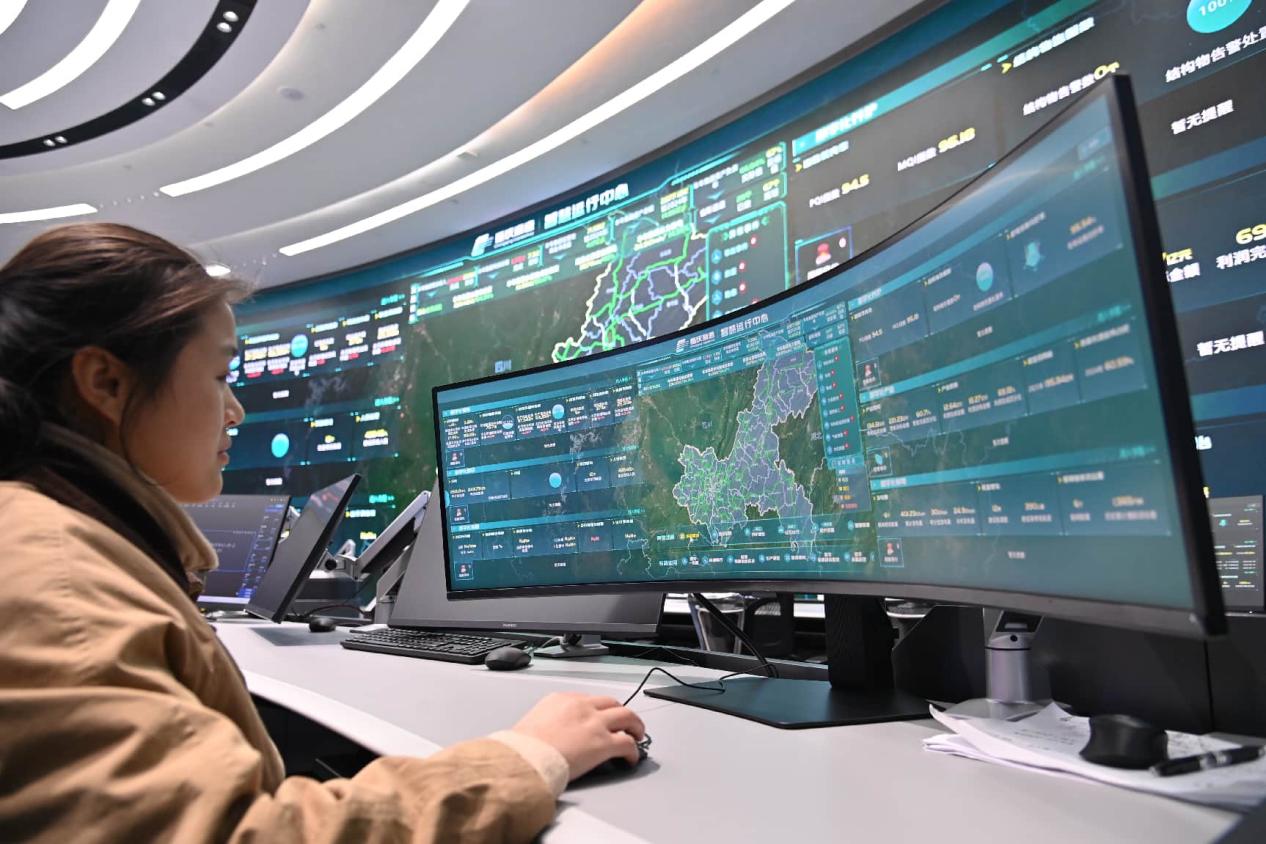
An employee of Chongqing Expressway checks real-time data of expressways in the company's intelligent operations center. (Photo: Sun Kaifang)
Furthermore, the government work report has underscored goals to forge new forms of smart economy and advance the large-scale commercial application of AI in key sectors.
Taken together, these form a cohesive strategic blueprint with sustained policy momentum, painting a broad and promising picture for China's AI development.
Another emerging consensus is that China's approach to open source is becoming an important force in shaping the global AI technology stack. Large models such as DeepSeek have been made open to the world, helping support digital infrastructure development in Africa and providing solutions such as industrial visual inspection for factories in Southeast Asia.
From open-source models to shared capabilities, this collaborative approach not only accelerates the evolution of China's AI industry, but also empowers the global innovation ecosystem and promotes more inclusive access to technology.
In this long run toward the future, China is not developing itself behind closed doors, but is committed to a people-centered, AI-for-good vision featuring fairness, inclusiveness and collaborative governance. China's response to the intelligent era is inscribed in every dynamic, pulsing token.