


JINAN, April 16 (Xinhua) -- At the factory of Aros Information Technology (Shandong) Co., Ltd. in Wulian County, east China's Shandong Province, drones designed for a wide range of applications, including water conservancy, transportation and emergency rescue, are rolling off the assembly line.
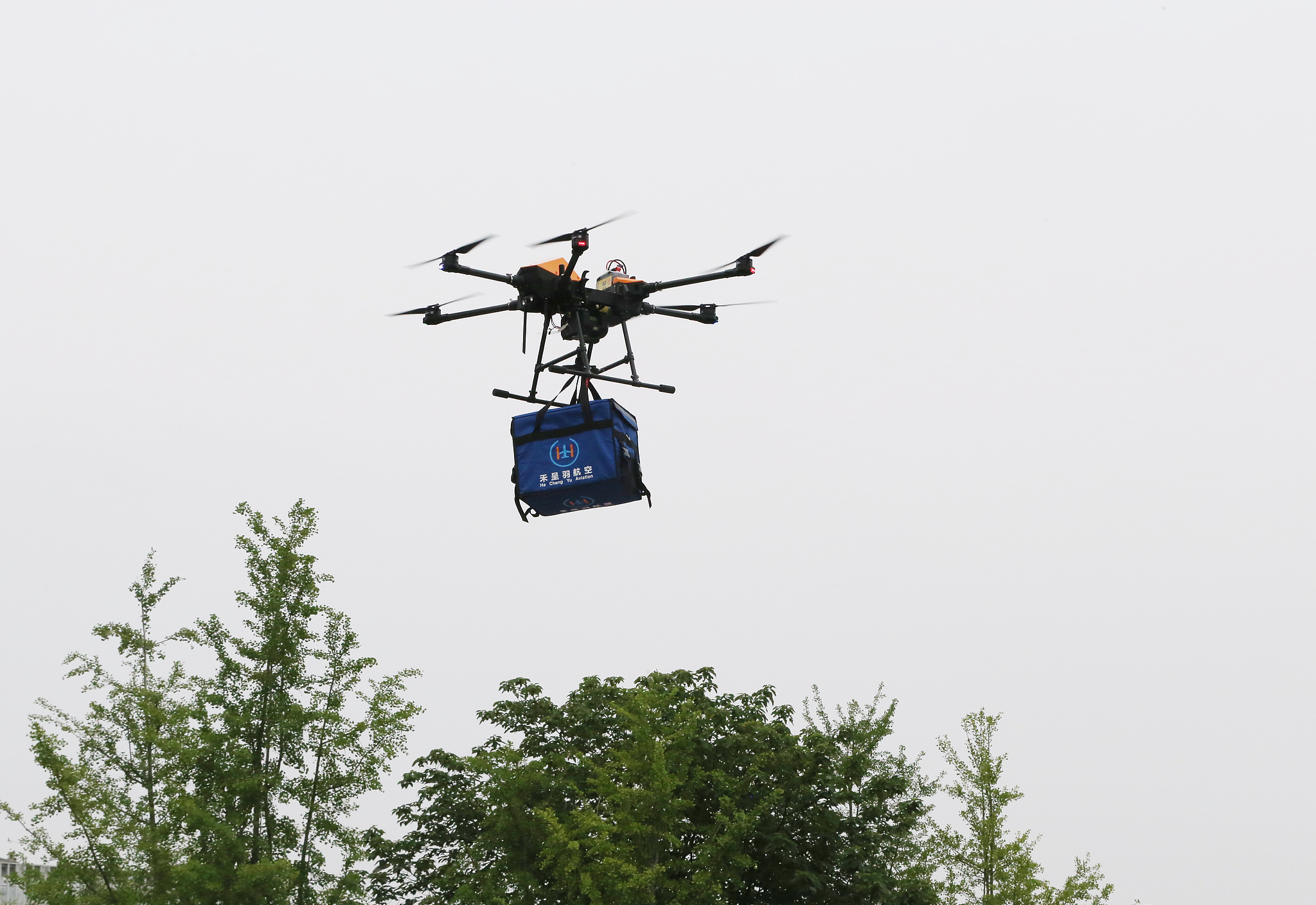
A low-altitude delivery test in Hangzhou, Zhejiang Province, east China, May 28, 2025. (Photo: VCG)
"We integrate technological innovation with real-world applications in our drone products. In agriculture, for instance, drones equipped with multispectral scanning can help farmers diagnose crop diseases and pests, significantly improving the average yield," said Zhang Ziqing, the company's general manager.
Zhang noted that Aros, introduced to the county in 2025 as a key low-altitude economy project, focuses on the development of intelligent unmanned aerial vehicles (UAVs) and supporting equipment. Its products have already achieved large-scale production, with continuous technological upgrades underway.
Via the rapid advancement of digital technologies and smart equipment, China's low-altitude economy is entering a period of fast growth. Across the country, innovation is driving the integration of low-altitude technologies with sectors such as agriculture, logistics and cultural tourism, creating new economic opportunities.
According to Zhang, Aros is increasingly pursuing an integrated development model combining equipment, platforms and algorithms to foster innovation across the industrial chain.
"Our goal is to diversify applications through our 'drone-plus' model and promote the comprehensive development of the industry," he said.
Technological breakthroughs are continuously expanding the application scenarios of the low-altitude economy in China. At the showroom of Lihonsat Communication Co., Ltd. in the city of Zibo in Shandong, a wide range of satellite communication terminals are on display.
The company specializes in developing equipment that addresses communication challenges between low-altitude aircraft and ground systems.
Wang Yong, chairman of the company, said its satellite communication products ensure stable connectivity for low-altitude aircraft in complex environments. In drone applications, they enable the real-time transmission of video, files and other critical data, making tasks like precision delivery and efficient crop protection possible.
On April 4, a 7.5-tonne unmanned transport aircraft equipped with the AEP100 megawatt-class hydrogen-fueled turboprop engine, independently developed by the Aero Engine Corporation of China (AECC), successfully completed its maiden flight in central China's Hunan Province, marking the world's first test flight of a megawatt-class hydrogen-powered aviation turboprop engine.
According to AECC experts, the successful flight signifies that China has established a full technological chain in hydrogen aviation engines -- from core components to complete system integration, laying the groundwork for future industrial applications.
As the cost of green hydrogen continues to decline, such engines are expected to be deployed first in low-altitude sectors such as unmanned cargo transport and island logistics, which are expected to drive coordinated development across the whole hydrogen production, storage and equipment manufacturing supply chain, supporting the green and high-quality development of China's aviation industry.
"Innovation is intrinsic to aviation, and aviation technology drives breakthroughs in materials, electronics and advanced manufacturing," said Fan Huitao, an academician of the Chinese Academy of Engineering, at the 2026 Low-Altitude Industry Development Conference held on April 9.
He noted that a surge of new technologies, products and achievements in drones and aviation in recent years reflects the strong momentum of China's low-altitude economy.
China is positioning the low-altitude economy as a key engine for high-quality growth, with the country's 15th Five-Year Plan outlining the need to promote its sound and orderly development.
According to the Civil Aviation Administration of China, the market size of the low-altitude economy is expected to reach 3.5 trillion yuan (about 510.09 billion U.S. dollars) by 2035.
Industry experts said as application scenarios are rapidly expanding -- from urban aerial delivery and tourism to mountainous logistics, emergency rescue and public services, a diversified low-altitude economic landscape is also taking shape, featuring parallel development of fixed-wing and rotary aircraft, manned and unmanned systems, as well as conventional and new-energy power systems.
"With a more mature industrial ecosystem and deeper application expansion, China's low-altitude economy will enter a crucial stage of large-scale, high-quality development in 2026," said Zhang Xiaolan, a researcher with the Department of Economic Forecasting at the State Information Center.
Future growth in this sector will be driven not only by isolated breakthroughs but also by clustered application scenarios, accelerating deployment in high-value areas, Zhang added.