


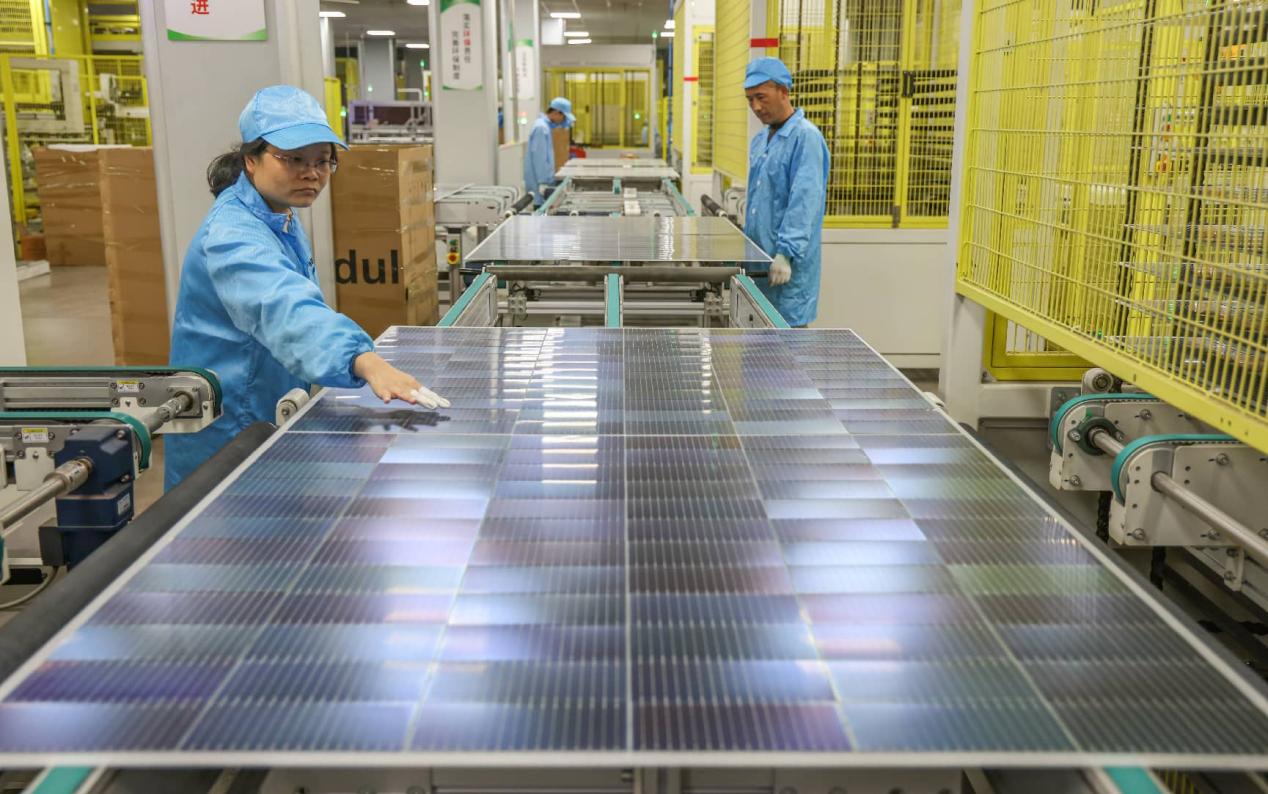
Solar panels ordered by overseas clients are manufactured in a workshop of a solar company in Jinhua, east China's Zhejiang province. (Photos: Global Times)
Carbon emissions are closely tied to everyday life and lie at the heart of global climate governance. For decades, most accounting systems have followed the methodology of the Intergovernmental Panel on Climate Change (IPCC), which attributes emissions to the place of production -- who produces, who accounts for the emissions. However, this production-based approach often overlooks the role of consumption.
"The majority of global carbon accounting systems prioritize the production perspective, overlooking consumption," said Wei Wei, deputy director of the Shanghai Advanced Research Institute under the Chinese Academy of Sciences.
He noted that the field has long faced challenges such as inconsistent data standards, lengthy accounting cycles, delayed updates, and limited transparency. Achieving a more scientific and equitable method for calculating carbon emissions remains a shared global challenge.
On April 8, the Shanghai Advanced Research Institute unveiled a first-of-its-kind artificial intelligence model, "ScienceOne–Yuheng Carbon Accounting Large Model", designed to track carbon emissions across global production-side, consumption-side, and natural sources. It marks a new breakthrough in China's efforts in this field and offers a "China solution" to longstanding global challenges in carbon accounting.
Accurate carbon accounting is fundamental. Greenhouse gas emissions are a major driver of climate change. Accurate carbon accounting serves as a key basis for fulfilling international climate commitments, underpinning global carbon pricing and influencing countries' industrial development and competitiveness.
Traditional systems have notable limitations. For example, in 2024, wind turbines and photovoltaic products exported by China generated about 2 million tons of carbon emissions during the production phase, yet delivered approximately 350 million tons of emission reduction benefits globally during their operational phase.
"Without a full-cycle accounting approach from production to consumption, such significant contributions remain invisible," said Lai Xiaoming, chairman of the Shanghai Environment and Energy Exchange.
"The world urgently needs a more scientific and equitable accounting system, one that not only clarifies 'who emits,' but also 'for whom emissions occur,'" Wei said.
"The new model was developed precisely in response to this need. Rather than overturning existing international frameworks, it builds on the scientific consensus of the IPCC and makes carbon accounting more comprehensive, dynamic, and intelligent," he added.
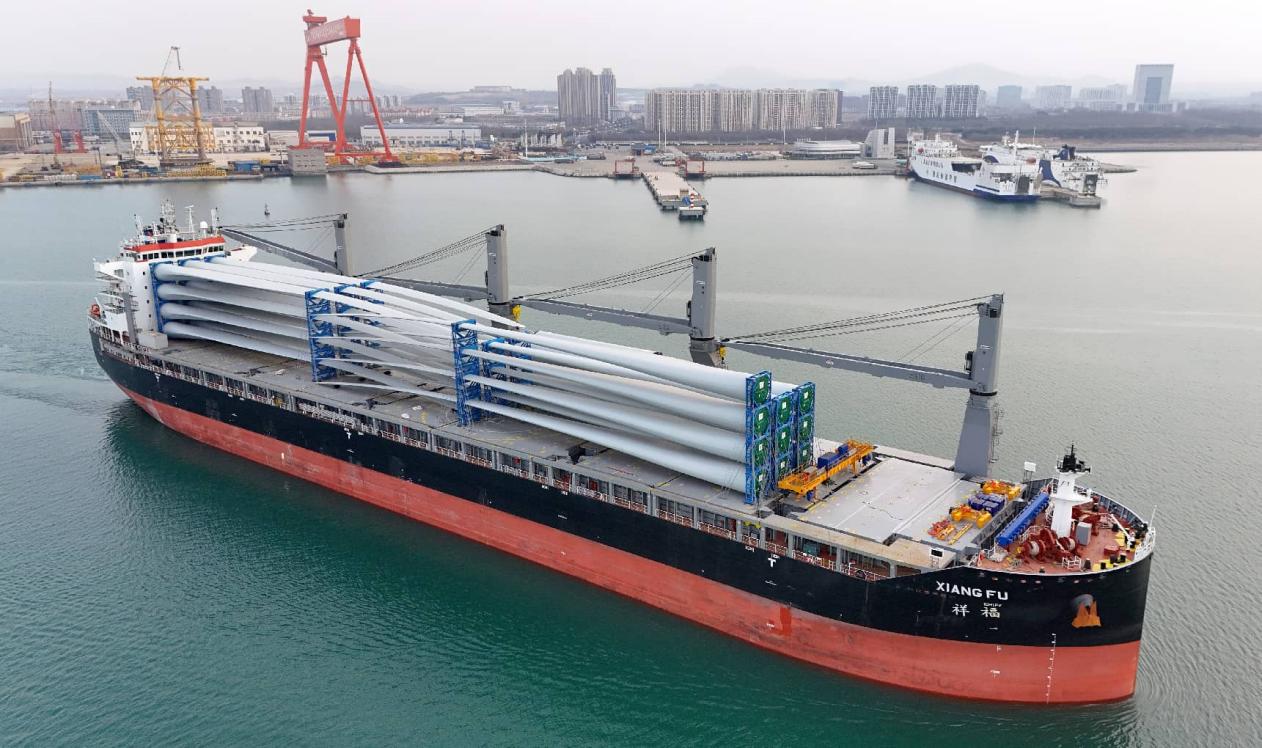
A vessel carrying wind turbine blades departs from Yantai, east China's Shandong province for destination overseas, March 28, 2026.
Yet calculating carbon emissions in such a comprehensive way is no easy task.
Wei identified four major challenges: the complexity of industrial sectors and high technical barriers; diverse and fragmented data sources with varying update frequencies; long accounting cycles and high labor costs in traditional methods; and insufficient precision, spatial-temporal resolution, and coordination across different accounting approaches.
Powered by artificial intelligence, the new model addresses these challenges through an integrated three-level architecture of data, algorithms, and computing power.
At the data level, the research team independently developed eight core datasets covering key dimensions such as production-side, consumption-side, natural sources, and carbon tracing. Through collaboration with government departments, industry organizations, and enterprises, the system enables high-frequency data updates and deep integration. It has already aggregated 208 terabytes of multi-format carbon data, forming a high-quality, multidimensional "carbon knowledge base."
At the algorithm level, the model incorporates a domain-specific large language model with 32 billion parameters, along with conversational and programming interfaces linked to an intelligent database. On this foundation, five specialized intelligent agents have been developed, capable of tasks such as digital simulation and optimization of industrial system processes, trade carbon transfer accounting, life cycle assessment, natural source accounting, and uncertainty analysis.
At the computing level, a high-performance internal server cluster works in coordination with external computing centers to optimize resource allocation and ensure flexible supply. Complex calculations that once took weeks or even months can now be completed in minutes.
According to Wei, the model is the first to integrate production-side, consumption-side, and natural sources into a unified, panoramic framework, enabling systematic and coordinated accounting across multiple methodologies.
The model has already demonstrated its value in several key application scenarios, supporting China's role in global climate governance and its transition toward green and low-carbon development.
Zhang Xian, director of the Division of Global Environment at the Administrative Center for China's Agenda 21, noted that the model's industrial intelligent agent functions like a "digital twin factory," simulating carbon emission scenarios under different production processes and energy structures. This helps enterprises identify key areas for emission reduction and plan their transition pathways.
Based on the new model, recalculations for 2022 show that when consumption and trade-related carbon transfers are taken into account, greenhouse gas emissions of China, the United States, and Japan were adjusted by -17.7 percent, +15.2 percent, and +7.2 percent respectively, compared with traditional production-side accounting under the IPCC framework.
These adjustments more accurately reflect carbon emission responsibilities across global supply chains and provide a scientific basis for building a fairer and more balanced international responsibility-sharing mechanism.
The "global carbon ledger" calls for a more precise and equitable "scientific balance." On that balance, the right to development and the responsibility to protect the planet can be more clearly measured.