


China's humanoid robot training centers multiply as sector gains momentum
At a training facility in Beijing's Shijingshan district, operators put humanoid robots through a simple but highly repetitive drill: pick up a key, line it up with a lock, slide it in and turn.
Across China, similar training facilities are popping up in cities such as Beijing, Shanghai and east China's Shandong Province.
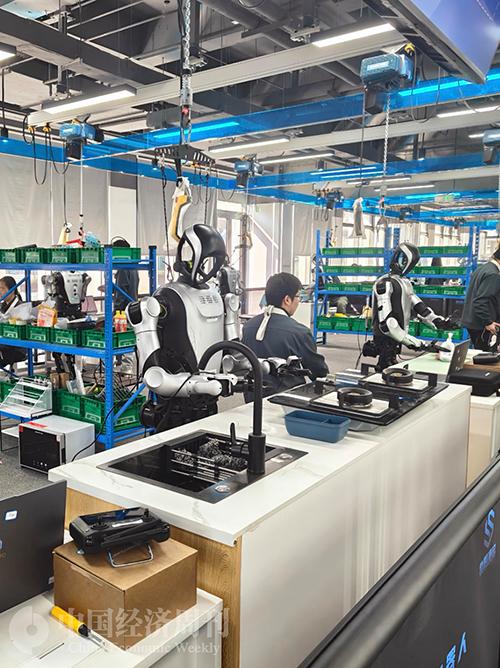
Humanoid robots collect data at a training center in Beijing's Shijingshan district. (Photo: China Economic Weekly)
The facility, covering more than 10,000 square meters, replicates real-life settings such as retail stores and logistics hubs, where robots practice folding clothes, sorting parcels, scanning barcodes and opening locks.
China's largest humanoid robot training center is located in Shijingshan district, where 100 humanoid robots began training in October 2025.
In the logistics setup, a robot must pick up a package, rotate it so the barcode faces a scanner, smooth the surface after scanning and place it onto another conveyor line, mirroring a real warehouse workflow.
Learning for a robot is essentially a cycle of collecting data, processing it, and repeatedly training and improving its AI model. In this training facility, operators guide robots through tasks using teleoperation and hands-on demonstrations while recording raw motion data. The data is then turned into training material for the AI model to learn from. Once trained, the improved model is sent back to the robots.
A single robot can generate about four hours of training data per day. With a two-minute sampling interval, 100 robots can complete at least 12,000 data collection tasks per day, according to Wang Song, technical director at Leju Robotics.
At the 2026 Humanoid and Embodied Intelligence Standardization Annual Meeting, Wang Xingxing, founder of Unitree Robotics, explained that imitation learning, by using real human demonstration data, allows robots to gradually acquire a wide range of human-like actions.
Huang Tiejun, chairman of the Beijing Academy of Artificial Intelligence and a professor at Peking University, noted that the systematic development of training environments for embodied AI has been incorporated into the outline of the 15th Five-Year Plan (2026-2030). He emphasized that this will be key to solving data-related challenges.
In his view, only by training and testing robots in real-world conditions can embodied AI move beyond the lab.
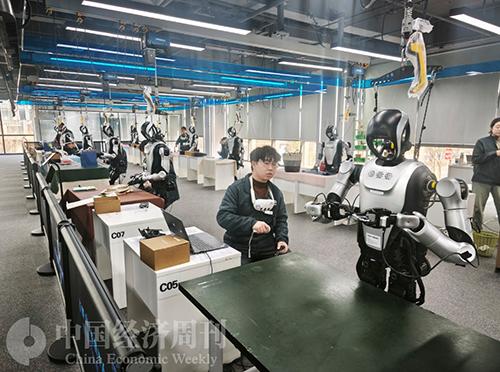
Humanoid robots collect data at a training center in Beijing's Shijingshan district. (Photo: China Economic Weekly)
Zhao Xiaoguang, a researcher at the Institute of Automation under the Chinese Academy of Sciences, described training facilities as "on-the-job training schools" for robots. There, robots start with simple tasks and work their way up to more complex ones.
According to data from business information platform Tianyancha, China now has more than 1.08 million robotics-related companies in operation. Over the past five years, new registrations have steadily increased, reaching a peak in 2025.
With strong policy support at both the national and local levels, the sector continues to gain momentum. At the same time, key technological breakthroughs are accelerating.
Recently, China's first mass-production line for humanoid robots, with an annual capacity of 10,000 units, officially began operation in south China's Guangdong Province, marking a major milestone in scaling up humanoid robot manufacturing.