


Swallowing just one capsule for a complete gastroscopy and performing AI-assisted orthopedic surgeries… Cutting-edge innovations such as surgical robots, brain-computer interface rehab devices, and capsule endoscopes are taking center stage in the intelligent healthcare zone at the third phase of the 139th Canton Fair, which kicked off on May 1.
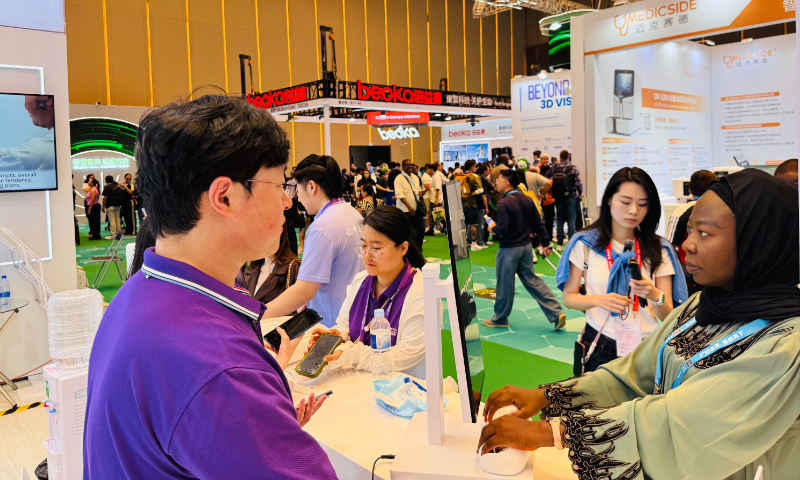
A foreign buyer (first from right) tries AI pulse diagnosis, along with facial and tongue analysis, at the smart healthcare zone of the 139th Canton Fair in Guangzhou, South China’s Guangdong Province, on May 2, 2026. (Photo: GT)
On site, a large number of global buyers gathered to watch live demonstrations of laparoscopic surgical robots and orthopedic robotic arms.
Yuanhua Robotics, Perception and AI Technologies Ltd. showcased its newly launched HX Orthopaedic-Specific Robotic Arm. Li Aili, chairman of the company, told the Global Times that this product represents a milestone in China's push for domestic medical equipment independence.
"From core components and the robotic arm body to the control system, underlying algorithms, and clinical software - the entire chain is 100 percent independently controllable. It has completely broken foreign monopolies and supply chain barriers in this field," said Li.
Peng Tao, a clinical engineer at Yuanhua, told the Global Times that the robotic arm brings AI-powered intelligent assistance to orthopedic surgery, especially helping young doctors rapidly accumulate surgical experience.
Yuanhua's "five-in-one" Kunwu Robotic Surgical System also drew significant attention. Li noted that this globally pioneering product can cover five major procedures - knee, hip, unicompartmental knee, spine, and trauma - filling a worldwide technological gap in multi-indication orthopedic surgical robots. At the previous Canton Fair in October, the Kunwu system was only "three-in-one" - hip, knee, and unicompartmental knee. After six months of upgrades, it has now achieved the "five-in-one" capability.
Shanghai MicroPort MedBot (Group) Co showcased its latest multi-port laparoscopic surgical robot system and vascular intervention robot.
Liu Jiayi, director of overseas marketing at MedBot, told the Global Times that the company has installed approximately 150 surgical robots worldwide, with a cumulative total of 22,000 surgeries completed.
"These robots significantly reduce doctors' repetitive manual labor, shorten operation time by 20 percent, and lower their workload. Remote surgeries have become routine, effectively addressing uneven distribution of medical resources," Liu Jiayi said.
Nearby, the AI-powered traditional Chinese medicine diagnostic device was also popular, with foreign buyers queuing up to experience it.
Liu Yaoyao, a physician at Tianjin Medvalley Technology Co, told the Global Times that the device performs an AI "pulse diagnosis," combined with facial and tongue analysis. In just 30 seconds, it generates a detailed body constitution report.
At the booth of Guangzhou Side Medical Technology Co, engineer Lu Wentong held up a capsule slightly larger than a regular pill.
"Many people fear intubation and anesthesia. This capsule only requires swallowing with water - no intubation needed. This intelligent capsule contains a high-definition camera that can scan the entire stomach in about 15 minutes - the gastroscopy is completed. The procedure is painless and non-invasive, and the capsule is naturally excreted afterward," Lu told the Global Times.
A European buyer, under the engineer's guidance, swallowed a white capsule with water and then stood in front of a tablet screen. Real-time images from inside the stomach appeared clearly, with the AI system marking the examination coverage area.
"According to global experimental data and literature, the probability of the capsule not being excreted is about 0.0002 percent. We have performed around 30,000 procedures worldwide with zero incidents. In Guangzhou, after medical insurance reimbursement at community hospitals, one examination costs only about 600 yuan ($87.9) to 800 yuan," said Lu.
In addition, non-contact cardiac monitoring devices, intelligent moxibustion robots, and other devices also demonstrated their strengths.
Supporting medical AI large models were also on display. Yang Qian, product manager at Hangzhou Diagens Biotechnology Co, told the Global Times that their self-developed medical imaging foundation AI model has won global innovation awards.
"It supports 19 imaging modalities, covers 90 percent of medical imaging scenarios, and adapts to 3,285 types of medical imaging diagnosis projects in China. The solution has already been implemented in over 400 domestic medical institutions. We are now engaging with clients in the UK, Brazil, and other countries," said Yang.
This is the second time that the Canton Fair has set up a specific intelligent healthcare zone. The first was during the 138th session in October 2025 under the "advanced manufacturing" theme. This time, it is featured in phase 3 under the "better life" theme.
Liu Jiayi from MedBot noted that Chinese surgical robot technology has matured and entered the commercialization stage. Li from Yuanhua also stressed that surgical robots are no longer out-of-reach technology but have become practical tools that truly help realize a better life.
From comfortable capsule gastroscopy to precise orthopedic surgical robots and efficient AI diagnostic devices, these smart healthcare products are transforming once complex and painful medical experiences into something simple, comfortable, and efficient, many Canton Fair buyers said.
These technologies are no longer laboratory concepts but practical tools that solve real medical problems and protect public health, making high-quality healthcare truly accessible.