


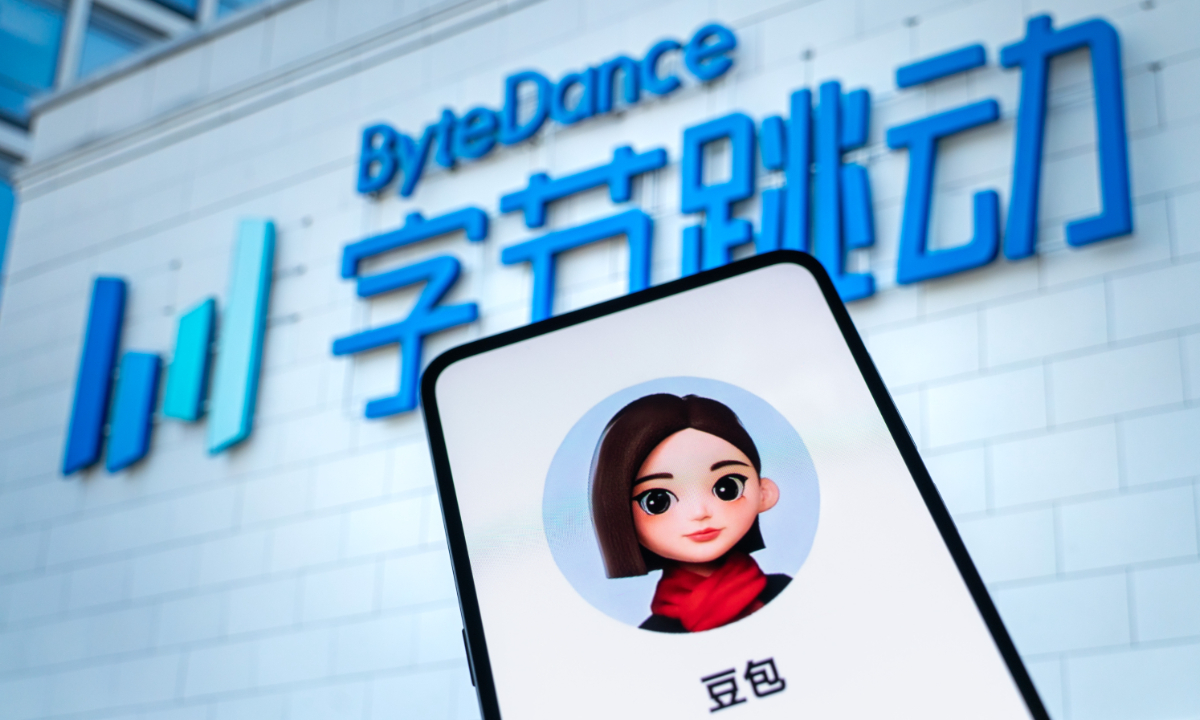
Chinese technology company ByteDance’s artificial intelligence chatbot Doubao (Photo: VCG)
Chinese technology company ByteDance’s artificial intelligence (AI) chatbot Doubao has recently displayed a service statement for paid subscription tiers on its App Store page, drawing broad public attention. The company confirmed the matter to the Global Times on Monday, saying that details of the plan are still being tested.
The topic once topped the trending list on Sina Weibo on Monday and was marked with the label “explosive,” reflecting strong public interest in whether one of China’s most widely used AI applications will move further toward commercialization.
A statement seen on Doubao’s App Store page said that, in order to better serve professional users, Doubao will launch paid versions with more value-added services on top of its free version.
The page also disclosed three subscription tiers: the standard version at 68 yuan ($9.4) per month for a recurring monthly subscription, or 688 yuan per year; the enhanced version at 200 yuan per month, or 2,048 yuan per year; and the professional version at 500 yuan per month, or 5,088 yuan per year.
The company told the Global Times on Monday in response to reports of a paid subscription offering that Doubao will keep providing fully free services. Building on its free offerings, it is exploring additional value-added services to cater to the diverse and differentiated needs of users.
The company added that relevant details of the plan are still in the testing stage, and full information will be released through official channels when it is formally launched.
Paid functions are mainly aimed at professional and heavy users, and could support deeper responses and faster video generation, which have clear market demand, Liu Dingding, a veteran industry observer, told the Global Times on Monday.
For certain users, paying for AI services can bring higher-quality products and more specialized support, such as in-depth article writing, more polished PowerPoint presentations and more diversified AI agent services, Liu said. “Such tasks usually consume more computing power and reasoning time, meaning higher costs for companies.”
The news triggered heated discussions among Chinese netizens on Monday. Some said the proposed prices were too high, while others said they might switch to free alternatives given the wide range of AI tools available in the market. Some users, however, said the move was normal, arguing that no service can remain free forever.
As one of ByteDance’s core large language models (LLMs), Doubao had long been known for its free-access model.
Tan Dai, president of Volcano Engine, the cloud service platform of ByteDance, , said in an interview with thepaper.cn in early April that price increases reflect only the market choices of some companies, while others are still cutting prices. The key difference, he said, lies in how companies judge the value of tokens.
As next-generation models become more powerful, each token may cost more, but it can also create greater economic value, Tan said, adding “Price increases driven by stronger model intelligence are ultimately about delivering greater value to customers.”
Liu said the trial of commercialization is, to a certain extent, one of the future trends for LLM companies as they expand.
“The industry’s business model may evolve toward one in which basic services remain free, while value-added services are paid. This can give companies enough revenue to continue developing and upgrading their products and services,” Liu said.
Volcano Engine announced on April 2 that the average daily token usage of the Doubao LLM had exceeded 120 trillion in March, doubling over the previous three months and rising 1,000-fold from when the model was first made available externally in May 2024, according to Science and Technology Daily.
Token usage is a core indicator for measuring the pace of AI development, and the rapid growth reflects the speed at which AI applications are being implemented in China, per the report.
Globally, leading AI products including OpenAI’s ChatGPT and Anthropic’s Claude have introduced paid subscription tiers at different levels.
Some LLM companies in China have also raised prices this year.
Chinese AI startup Zhipu adjusted the pricing structure for its GLM coding plan, a subscription package for coding-related AI services, on February 12, with an overall increase starting from 30 percent, citing sustained strong market demand and rapid growth in user numbers and usage. It later raised the cost of access to its most advanced AI model twice more in March and April.
However, DeepSeek, another leading Chinese LLM developer, has recently moved in the opposite direction by announcing sharp price cuts for its latest DeepSeek-V4 model.
In late April, DeepSeek said it would significantly reduce API prices, including cutting the input cache-hit price for its full lineup to one-tenth of the launch price, after earlier offering a limited-time 75-percent discount for the DeepSeek-V4-Pro API.
Analysts said the mixed pricing moves suggest that large-model companies are making their own calculations based on market positioning, cost pressures and user demand.
Doubao’s exploration of paid value-added services reflects a broader search for sustainable business models in China’s AI sector, Liu noted, adding that such services could help companies move beyond heavy cash-burning by offsetting rising computing costs and supporting continued investment in model upgrades and product innovation.