


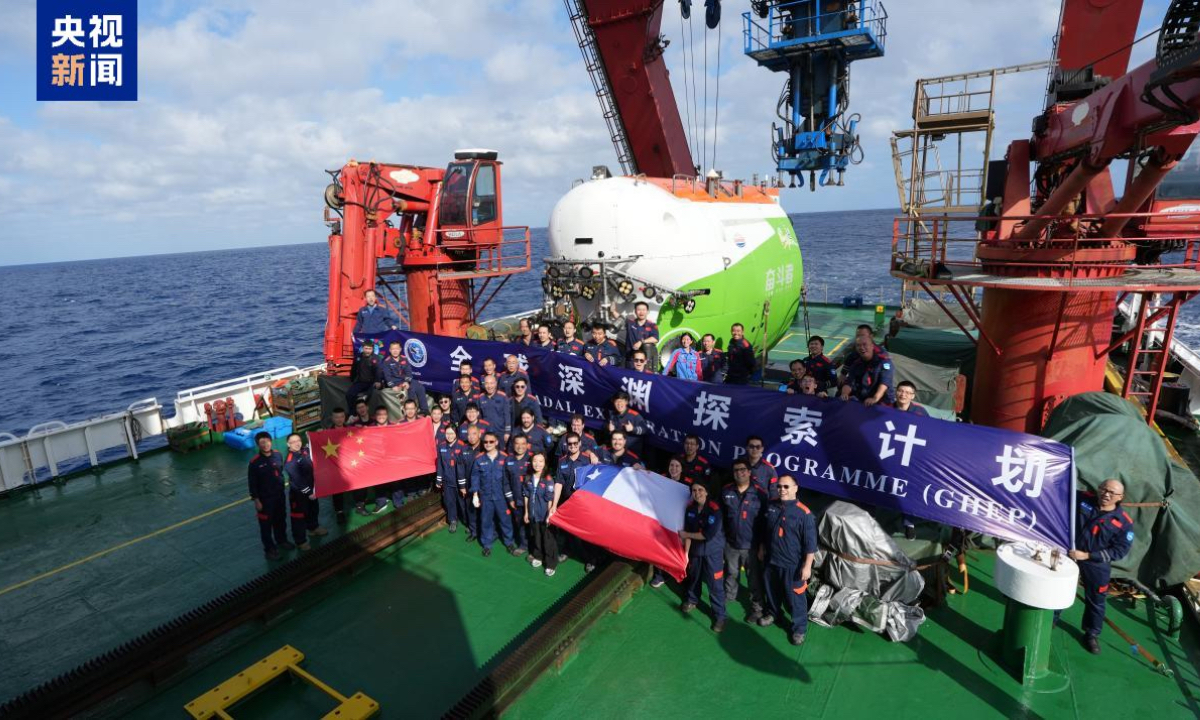
Photo: CMG
China's research vessel Tansuo-1, carrying the manned submersible Fendouzhe, arrived in Guangzhou, South China's Guangdong Province on Sunday after successfully completing the Pacific crossing mission under the Global Hadal Exploration Program and the first China-Chile joint manned deep-diving expedition to the Atacama Trench.
It marks a major step forward in China's deep-sea scientific capabilities and international marine science cooperation, China Media Group (CMG)'s reported.
The mission, led by the State Key Laboratory of Deep-Sea Science and Intelligent Technology under the Chinese Academy of Sciences' Institute of Deep-Sea Science and Engineering, set sail from Sanya on December 6, 2025, lasting 156 days and covering more than 40,000 kilometers — roughly equivalent to one circumnavigation of the Earth along the equator, CMG reported.
A total of 83 researchers from six countries — China, Chile, Germany, Denmark, Canada and Spain — took part in the expedition. The mission focused on the Atacama and Mussau trenches, carrying out systematic research on major frontier scientific topics including hadal biodiversity, chemosynthetic ecosystems, deep-sea fluid activity and plate subduction mechanisms, CMG reported.
During the mission, the manned submersible Fendouzhe completed 63 dives, including 50 at depths exceeding 6,000 meters, collecting a large number of biological and geological samples as well as high-definition underwater imagery, providing key support for interdisciplinary research on hadal geology, life and the deep-sea environment, according to CMG.
The expedition also yielded a series of major scientific discoveries.
Among them, researchers identified the deepest known chemosynthetic ecosystem in the southern hemisphere for the first time, providing fresh key evidence for the "global chemosynthetic life corridor" hypothesis and suggesting that chemosynthesis-based life systems driven by geological fluids may be widely distributed across the world's deepest ocean trenches.
The team also documented a rich variety of hadal organisms, including multiple species of hadal snailfish and large numbers of benthic creatures observed within the same trench, many of which are believed to be previously unknown species.
In addition, researchers have discovered seabed fault-rupture structures linked to historic major earthquakes, offering rare in-situ evidence for understanding how seismic activity shapes deep-sea landforms and affects marine habitats.
Focusing on the hadal zone — regarded as one of the least understood and most extreme frontiers in Earth's ocean system — the mission represents a major step in China's continued efforts to strengthen fundamental scientific research.
The expedition carried out systematic investigations into key global scientific questions, including the origin and adaptation of hadal life, plate subduction and deep-fluid circulation. It is expected to advance theoretical research on the limits of deep-sea life, deep-ocean carbon cycling and deep-Earth material circulation, while providing scientific support for deep-sea resource utilization, disaster mechanism studies and understanding global climate change.
The joint expedition was one of the flagship missions under Global Hadal Exploration Program, which has been selected as part of the UN Decade of Ocean Science for Sustainable Development (2021-30). The program aims to build a systematic understanding of the world's deepest ocean regions through international cooperation, deep-diving technology and interdisciplinary research.
The China-Chile joint mission not only achieved coordinated multinational deep-sea operations, but also accumulated valuable experience in global deep-sea scientific data sharing, talent cultivation and long-term hadal seabed observation, highlighting China's active role in global ocean governance and international large-scale scientific cooperation.
China will further deepen international cooperation in deep-sea science, advancing sustained collaboration in areas including long-term hadal observation, life studies in extreme environments, geological-ecological coupling mechanisms and joint training of young researchers - all aimed at enhancing humanity's understanding and protection of the deep ocean's extreme environments, CMG reported.