


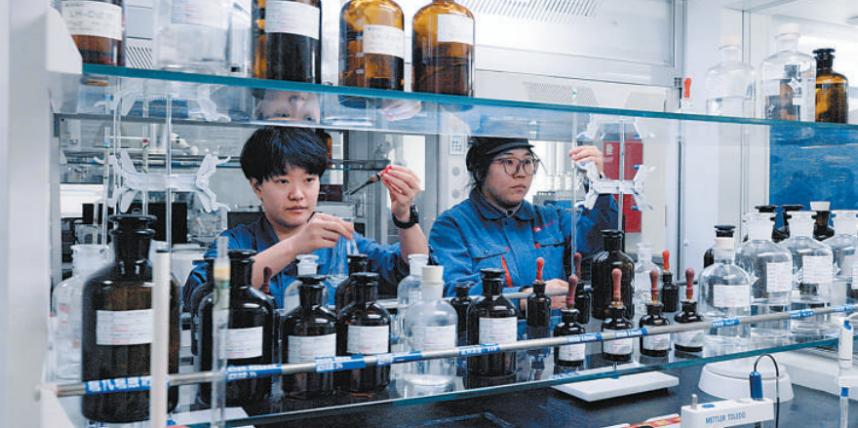
Photo shows technicians of Jilin Carbon Valley Carbon Fiber Co., Ltd., a subsidiary of Jilin Chemical Fiber Group in northeast China's Jilin province, working on site. (Photo provided by Jilin Carbon Valley Carbon Fiber Co., Ltd.)
Inside the production workshops of Jilin Carbon Valley Carbon Fiber Co., Ltd. (Carbon Valley), a subsidiary of Jilin Chemical Fiber Group (JLFiber) in northeast China's Jilin province, silver strands of carbon fiber precursor raced through roaring production lines.
After undergoing a series of processes including pre-washing, humidification, oxidation, low-temperature carbonization, and winding, the material was transformed into carbon fiber.
"The carbon fiber filament is even thinner than a human hair," said Chen Hao, deputy director of the company's high-performance workshop. "Its density is less than a quarter that of steel, yet its strength can reach seven to nine times higher."
In 2025, a major research project jointly developed by JLFiber, Donghua University, and eight other universities, research institutes, and industry-leading enterprises passed technical appraisal. The project, titled Key Technologies for the Large-Scale Manufacturing of Large-Tow Carbon Fiber and Composite Materials and the Industrialization of Large Wind Turbine Blades, marked a key breakthrough in the application of 35K large-tow carbon fiber composites in offshore wind turbine blades.
But what exactly is "35K" carbon fiber?
"K" denotes the unit for carbon fiber tows, where 1K represents 1,000 filaments. A 35K tow thus bundles 35,000 ultra-fine filaments, demanding exceptional uniformity.
"Human hair varies in thickness," explained Yu Jian, a quality management manager. "But for performance, all 35,000 filaments must maintain consistent length, diameter, and properties."
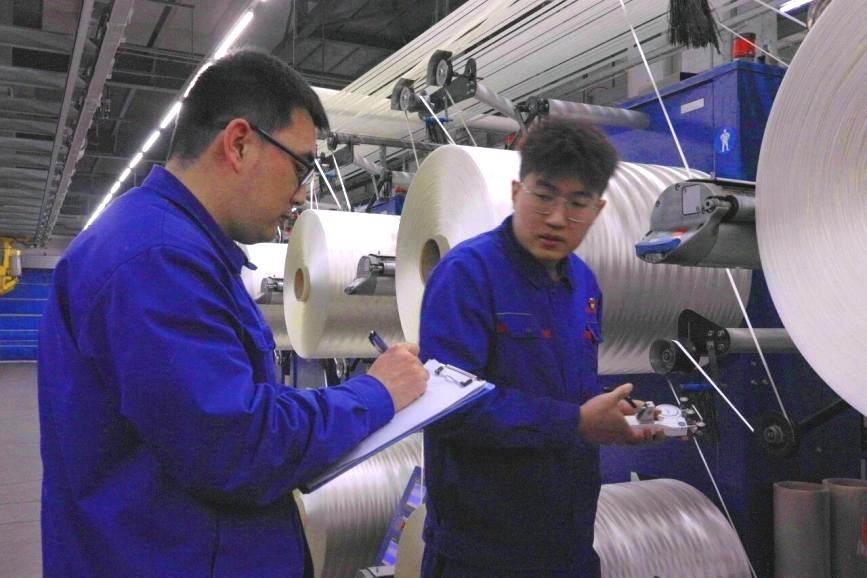
Photo shows technicians of Jilin Carbon Valley Carbon Fiber Co., Ltd., a subsidiary of Jilin Chemical Fiber Group in northeast China's Jilin province, working on site. (Photo provided by Jilin Carbon Valley Carbon Fiber Co., Ltd.)
For years, foreign firms dominated the large-tow carbon fiber market due to proprietary processes and technical complexity.
In 2016, seeking cost efficiency and competitive edge, Carbon Valley formed a youth-driven R&D team. Through rigorous experimentation, they identified 35K carbon fiber as optimal for balancing performance, productivity, and cost.
Chen Haijun, general manager of Carbon Valley, said the team focused on overcoming a series of technological bottlenecks involving process upgrades and equipment innovation. To solve these challenges, the company coordinated with upstream and downstream partners and organized eight specialized technical seminars.
Team members immersed themselves in laboratory work, repeatedly testing and optimizing spare-part materials, process parameters, and channel structures step by step. With each seminar, multiple production indicators for the 35K carbon fiber improved further.
After more than half a year of intensive work, the team successfully produced 35K carbon fiber in 2017 that fully met standards for hardness, strength, and other mechanical properties.
Compared with traditional metal materials, carbon fiber offers clear advantages including high strength, low weight, and strong plasticity. But manufacturing carbon fiber is costly and resource-intensive: producing a ton of finished carbon fiber requires roughly two tons of precursor material. Any production error can therefore result in substantial losses.
To compete in the market, large-scale production and cost-effectiveness became essential.
Although the core research and development work had been largely completed, new problems emerged during mass production.
Unlike laboratory experiments, industrial production requires continuous manufacturing of 100,000-meter-long 35K carbon fiber tows, which must then be wound into cylindrical rolls for transportation and sale. The longer the tow became, the greater the risk of problems such as insufficient strength or broken filaments.
To tackle these issues, Shan Xin, deputy director of the spinning workshop, led his team in upgrading production-line equipment.
The team redesigned transmission roller connections from single- to double-sided support, while continuously testing new materials to improve equipment durability and transmission stability. These changes reduced friction-related filament breakage.
At the same time, the team implemented systematic clean-production upgrades. Starting from the polymerization stage at the source of production, the team introduced layer-by-layer cleaning and filtration processes throughout the entire system and production flow to minimize impurities and improve the stability of the 35K carbon fiber.
"When early testing showed the performance didn't meet standards, I was anxious," Yu recalled, having witnessed the development of 35K carbon fiber from scratch. "But nobody gave up. Everyone kept searching for solutions."
Today, pass rates for key indicators such as strength, modulus, and fineness continue to rise steadily. "We are confident enough to stand up to microscopic-level checks," Yu said.
As evening fell, batches of newly packaged 35K carbon fiber precursor left Carbon Valley and were shipped to downstream carbonization and composite-material manufacturers.
After further processing, these lightweight yet highly durable materials became carbon plates used in the main beams of wind turbine blades.
Carbon Valley has now signed long-term supply agreements with multiple major domestic wind turbine manufacturers in partnership with downstream enterprises. Chinese-made 35K carbon fiber is now being applied on a large scale at wind farms across the country.