


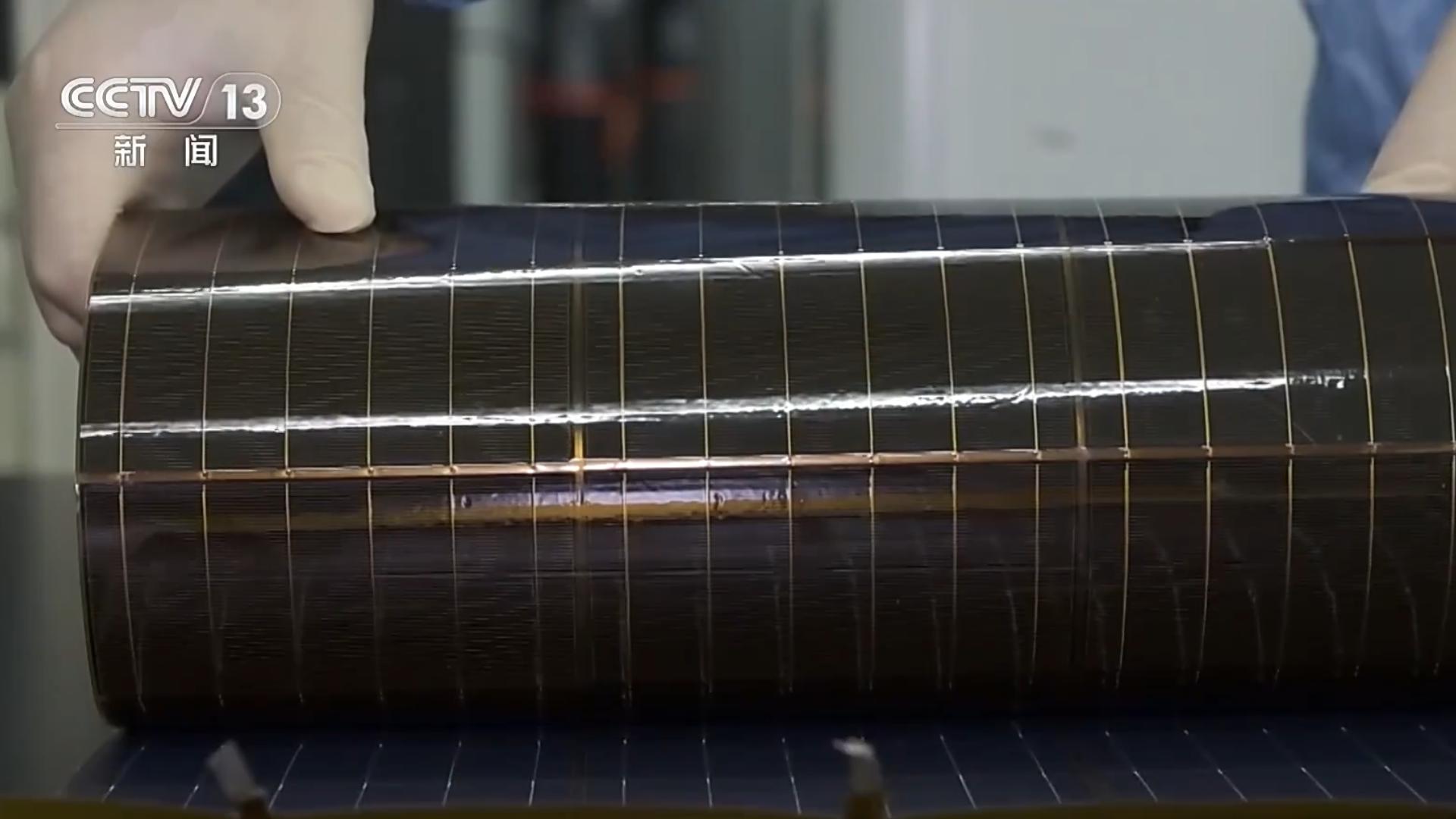
A new flexible mono-crystalline silicon solar cell. (Photo: CMG)
The Tianzhou-10 cargo spacecraft was successfully launched from the Wenchang Spacecraft Launch Site in south China's island province of Hainan on Monday.
Aboard the resupply mission are 41 scientific experiments and a total of 67 pieces of equipment – including experimental payloads, units, samples and consumables.
Once delivered to the China Space Station (CSS), these materials will be transferred and installed to support cutting-edge research in space life sciences, microgravity physical sciences, space application technologies and space astronomy.
A key highlight of this mission is the establishment of a comprehensive "space embryo development" research chain, spanning from lower vertebrates to higher mammals. As humanity sets its sights on long-duration space missions and interplanetary migration, understanding reproduction and development in space has become a critical challenge.
The Tianzhou-10 payload includes five core life science experiments designed to decode how the space environment impacts early embryonic development. Researchers will investigate how microgravity affects bone loss and myocardial changes, and explore the construction and development of human "artificial embryos" using stem cells. By studying zebrafish and mouse embryos in tandem with stem-cell-derived models, scientists aim to unravel the mysteries of life's earliest stages in space, laying a solid foundation for long-term human survival beyond Earth.
Furthermore, Tianzhou-10 is carrying samples of a new flexible mono-crystalline silicon solar cell. Chinese researchers spent three years developing it. It is very thin, light and can be rolled up. It weighs less than 1 kilogram per square meter.
The cells will be placed on the outside of the space station. There, they will face extreme space conditions, including particle radiation, ultraviolet rays and atomic oxygen. This new technology costs much less than traditional ones. It is only one-tenth the price of the gallium arsenide batteries usually used in space. This could greatly reduce launch costs. It will also help expand commercial satellite internet networks and space-based computing power.
A detector created by the Hong Kong University of Science and Technology, which could measure concentrations of carbon dioxide and methane from key emission sources across mid-to-low latitudes, the instrument leverages the inherent advantages of space-based observation: broad coverage, consistent cross-regional accuracy and unrestricted by national borders. The high-frequency data collected will provide a clear picture of global carbon footprints, offering robust support for national emission reduction strategies and contributing valuable Chinese insights to global climate governance.
Beyond these flagship projects, the Tianzhou-10 mission also facilitates numerous other experiments in microgravity fluid physics, combustion science and space material sciences.
By leveraging the unique environment of the CSS, China continues to push the boundaries of space-based research, driving technological innovation that will not only support future deep-space exploration but also yield tangible applications back on Earth.