


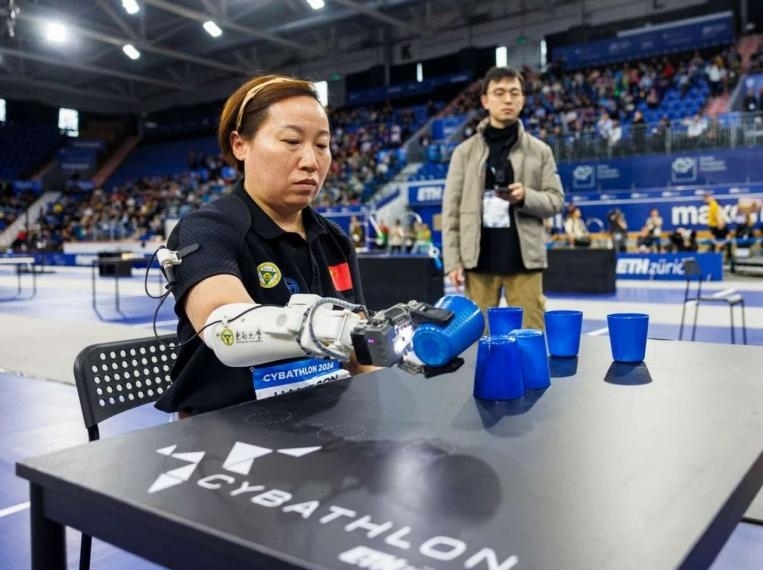
Xu Min competes at the Cybathlon. (Photo provided by Southeast University)
Recent advancements in technologies like artificial intelligence (AI), brain-computer interfaces and bionic engineering are offering renewed hope and expanding possibilities for people living with disabilities.
China's 2025 statistical bulletin on the development of the cause of people with disabilities reported that 1.487 million people with disabilities received basic assistive devices last year.
For 51-year-old Xu Min from Suzhou, east China's Jiangsu province, technology has done more than improve daily life; it has restored her confidence and sense of possibility.
She still feels emotional recalling her victory in the upper-limb prosthetics category at the Cybathlon, often called the "Olympics for bionics."
Xu lost her right hand and wrist in a workplace accident over thirty years ago. "It felt like my whole world had collapsed," she recalled, crediting her family's encouragement for helping her regain the courage to move forward.
In 2019, staff members from the Suzhou Disabled Persons' Federation contacted Xu about a new project being developed by a research team from Southeast University. The team was developing a prosthetic hand capable of movement and asked whether she would be willing to test it. Xu agreed immediately.
"We use sensors attached closely to the skin to collect myoelectric control signals from the residual limb," explained Hu Xuhui, a member of the research team. "In simple terms, the signals convey the user's intended movement to the chip, which then transmits commands to the prosthetic hand, completing the movement loop."
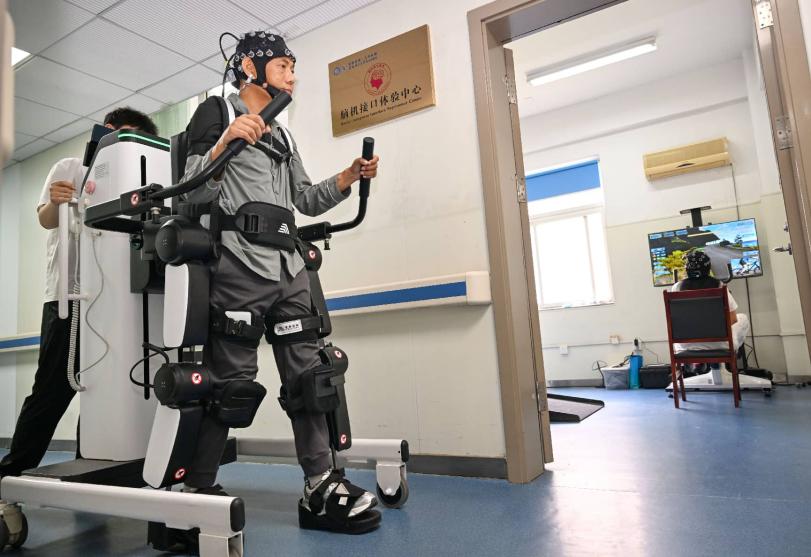
At the brain-computer interface experience center of the Second People's Hospital of Anhui Province, a patient is undergoing rehabilitation training using a brain-computer interface exoskeleton robot system. (Photo/Zhang Dagang)
Xu vividly remembers the first time she saw the prosthetic hand move.
"I cried out in excitement," she said. Initially, success rates were low, but persistent training steadily improved coordination between Xu and the device.
In early 2024, Hu brought another piece of good news: the Cybathlon competition would soon be held. As Xu prepared for the competition, the research team continued refining the prosthetic device and improving its performance.
At the finals in Switzerland, Xu excelled, completing challenging tasks like hammering and nail removal. She was the sole contestant to master the "tactile bag" challenge, identifying and retrieving specific objects by touch alone using the prosthetic.
"Remarkably, the prosthetic allowed me to perceive my environment with precision. It came very close to the functionality of a real human hand," Xu stated proudly after her win. "Technology gave me hope again."
Technology has also helped restore hope to Jin, a resident of Lanxi in Jinhua, east China's Zhejiang province.
Jin suffered complete paraplegia after a nearly 10-meter fall while repairing his roof in October 2024. Even after four months of rehabilitation, he could not lift his legs or regain normal bladder and bowel control.
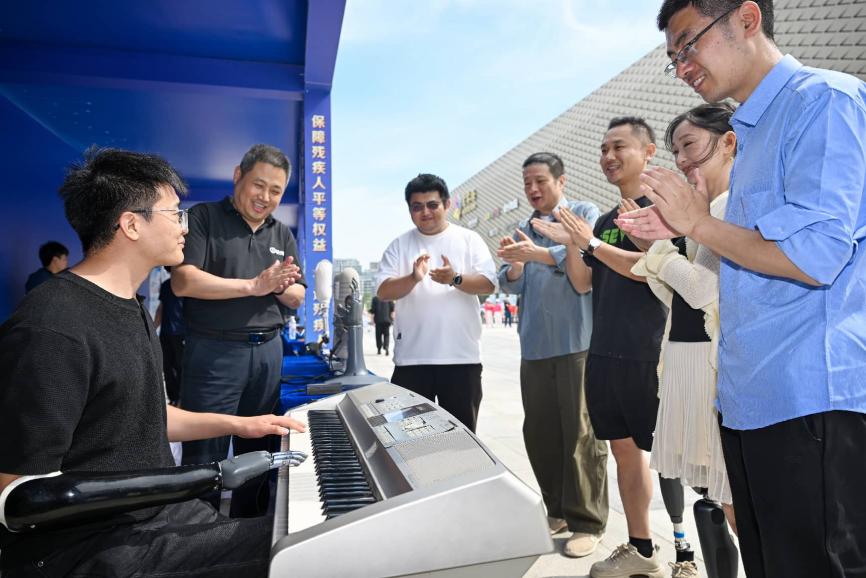
A man plays keyboard with a bionic hand developed by BrainCo. (Photo/Zhang Dagang)
At a time when he had nearly lost hope, his daughter, Jin Xiaofang, learned that the Second Affiliated Hospital of Zhejiang University School of Medicine was recruiting volunteers for a closed-loop spinal neural interface implantation procedure. She immediately took her father there for evaluation.
In March 2025, the medical team successfully implanted spinal stimulation electrodes into Jin's lumbar spine and placed a wireless, rechargeable stimulation controller (roughly matchbox-sized) in his abdomen.
The domestically developed "neural pacemaker" measures just 51 millimeters in length and weighs only 18 grams. Using Bluetooth technology, it receives instructions from external devices and delivers precise electrical stimulation to damaged areas of the spinal cord. Patients can recharge the device simply by placing a charging coil near the abdomen, with a single charge lasting more than a week.
Fifteen days after surgery, Jin successfully achieved standing and walking movements. One month later, he regained the ability to take steps with the assistance of a walker.
The technology not only improved his motor functions, but also demonstrated potential for repairing neural sensory pathways.
So far, the hospital has used the closed-loop spinal neural interface technology to help more than 10 spinal cord injury patients regain varying degrees of physical function, with several progressing from being bedridden to walking again.
Another beneficiary of technological innovation is Qing Jingwen from Mianzhu, southwest China's Sichuan province, a survivor of the 2008 Wenchuan Earthquake.
Trapped beneath rubble for nearly 70 hours during the earthquake, Qing eventually lost her right leg above the knee and suffered severe injuries to her left leg. For years afterward, walking remained one of the greatest challenges in her life.
In spring last year, through a public welfare program supported by the Chengdu Foundation for Disabled Persons, Qing received an intelligent bionic leg developed by BrainCo, a Chinese neurotechnology company that develops brain-computer interface products.
"Ever since I started using the intelligent bionic leg, I haven't fallen once," Qing said with a smile.
According to Wang Yong, sales director for intelligent prosthetics at BrainCo, the device integrates gyroscopes, position sensors and multiple other sensors to collect real-time data. The information is processed through algorithms and converted into instructions that control the prosthetic's hydraulic system, allowing it to adapt instantly to different movements and enabling users to achieve a near-natural gait and walking freedom of movement.
Beyond advanced functionality, this domestically developed intelligent bionic leg is significantly more affordable than comparable imported products. With steadier steps and renewed confidence, Qing has begun exploring new possibilities in life. Last year, she traveled to Yueyang, central China's Hunan province, to work as a volunteer teacher and even helped her students establish a cultural and creative arts club.
"The warmth of technology has made both my steps and my heart steadier," Qing said. "I believe my future will become broader."