


Chinese researchers are exploring an unusual construction material for future lunar bases: fibers made from lunar soil. Recently, samples of these lunar-soil fibers were sent to China's space station aboard a Tianzhou cargo spacecraft, where they will undergo exposure tests in the harsh conditions of outer space, including high vacuum, intense radiation, and extreme temperature fluctuations.
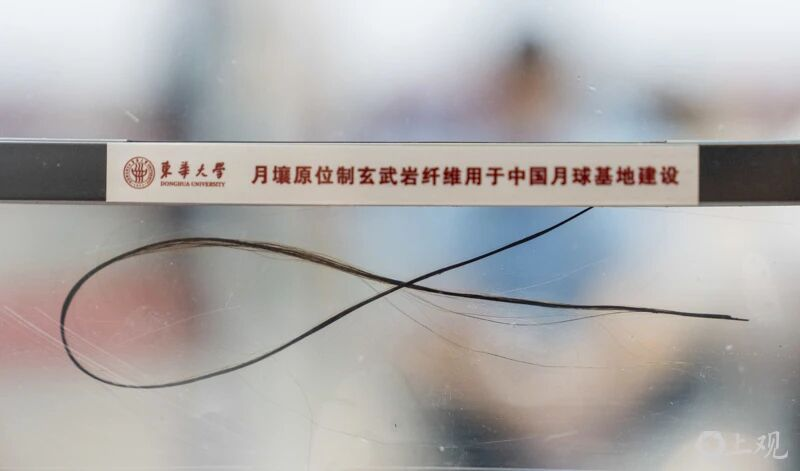
Pictured are fiber samples made from lunar soil. (Photo by the Shanghai Observer)
The lunar-soil fiber was developed by a research team led by Zhu Meifang from the College of Materials Science and Engineering at Donghua University in Shanghai.
The fibers produced from lunar soil are as thin as human hair, said Cheng Yanhua, a researcher on the team. The basic principle is relatively straightforward: lunar soil is heated until it melts, formed into tiny droplets, and then drawn into ultra-fine filaments.
Lunar soil shares a similar chemical and mineral composition with basalt and contains a variety of trace elements. Fibers made from basalt are already widely used in high-end equipment manufacturing.
It is not difficult to produce simulated lunar soil through precise scientific formulation. The real challenge lies in recreating the lunar environment on Earth. According to Cheng, drawing fibers in a lunar environment is akin to making sugar figurines in a vacuum, something that cannot be accomplished with conventional methods.
To tackle this problem, Zhu's team began researching materials for extreme environments in 2016 and independently designed a specialized spinning system capable of simulating lunar high-vacuum and microgravity conditions.
The research made a major breakthrough after the Chang'e-5 mission returned lunar samples to Earth in 2020. Using just 0.5 grams of actual lunar soil, the team successfully produced continuous fibers about three meters long, each strand as fine as a human hair.
In April 2025, the slender but remarkably durable lunar-soil fibers were displayed at the exhibition 20 Years of the Chinese Lunar Exploration Program at the National Museum of China in Beijing. Several months later, in September 2025, the fully homegrown technology won a top award at the China International Industry Fair.
Researchers believe the technology could play an important role in future lunar exploration, as transporting construction materials from Earth to the Moon is extremely expensive.
"In the future, these lunar-soil fibers could potentially be used to build structures directly on the Moon," a team member said, adding that they may be woven into flexible structural materials or used to reinforce lunar concrete, much like steel rebar in construction on Earth.
For now, however, the technology remains in the early experimental stage, and practical applications are still some distance away. The current experiment aboard China's space station aims to determine whether the fibers can withstand the extreme conditions of space over long periods. Every piece of data collected will help support future efforts to build sustainable human habitats on the Moon.