


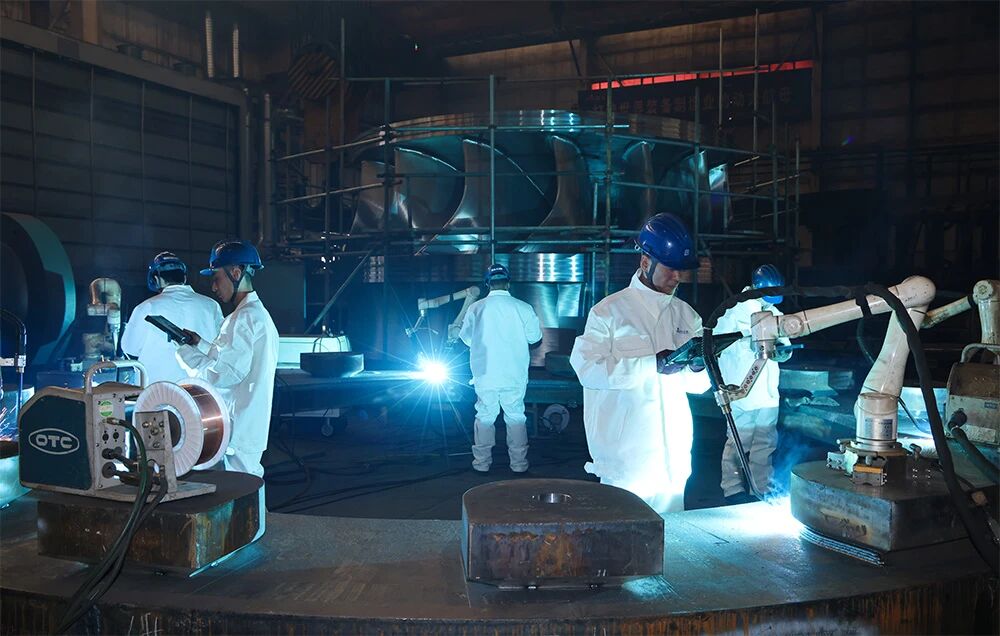
Workers adjust parameters of collaborative robots at Harbin Electric Machinery Works, a subsidiary of Harbin Electric Corporation in northeast China's Heilongjiang province. (Photo/Harbin Electric Machinery Works)
How should traditional manufacturers respond to the rise of intelligent technologies? It is a question they can no longer avoid.
Inside a model workers' innovation studio at the cold working branch of Harbin Electric Machinery Works, a subsidiary of Harbin Electric Corporation in northeast China's Heilongjiang province, a meeting on collaborative robotics was in full swing.
Rather than discussing whether to adopt intelligent manufacturing, participants focused on how to make it work better.
Some pointed out that robots still required too much preparation time before operation. Others suggested expanding their ability to adapt to different production scenarios. Improving coordination among multiple robots was also high on the agenda.
Before the meeting, Liu Zhipeng, head of the intelligent welding team, had walked through the workshop with a notebook in hand, asking welders one by one what they thought about smart manufacturing and what improvements they hoped to see. Their suggestions were carefully recorded and brought directly to the discussion table.
Three years ago, Liu could hardly have imagined such a scene.
The cold working branch is responsible for welding key components used in large hydropower and nuclear power equipment. In the past, all welding work was done manually. Welders had to wear airtight heat-resistant suits and crouch beside workpieces heated to as much as 150 degrees Celsius. The work was physically exhausting, while maintaining consistent quality and efficiency was difficult.
Manual welding depends heavily on both skill and physical condition. After one or two hours of continuous work, fatigue would inevitably set in, making it hard to keep weld seams uniform and consistent.
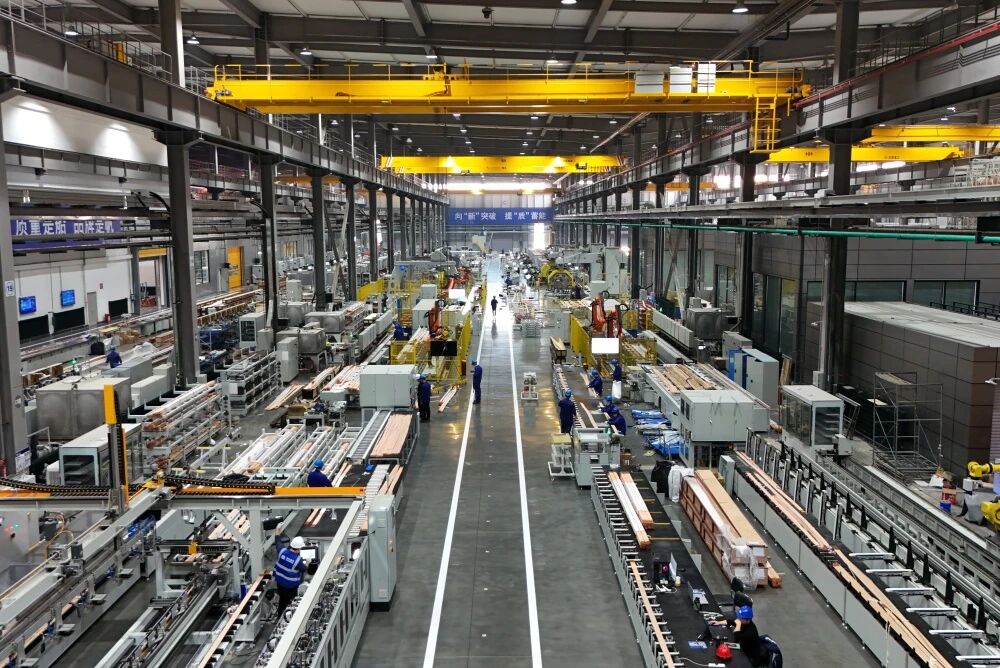
Photo shows a production workshop of Harbin Electric Machinery Works, a subsidiary of Harbin Electric Corporation in northeast China's Heilongjiang province. (Photo/Harbin Electric Machinery Works)
In the autumn of 2023, the branch decided to introduce collaborative robots and embark on the path of intelligent welding.
Getting the robots onto the factory floor, however, proved to be only the beginning. Liu still remembers that programming the robot to complete its first weld seam took him three full days. "The robot simply didn't understand hydropower products," he recalled.
Most hydropower components are non-standardized products. Rivers differ in sediment content, while turbine units vary in structure, size, and materials. There is no universal program that can be applied across all projects.
Working closely with robot manufacturers, frontline production teams gradually translated the welders' craftsmanship, including welding patterns, wire-feed rates, and torch movement speeds, into programming language that the robots could understand. Little by little, the machines became more capable and reliable.
"Intelligent welding has doubled our efficiency," Liu said. "In the past, a welder could use at most 25 to 30 kilograms of welding material a day. Now a single robot can consume more than 50 kilograms in the same period." In a new workshop that began operation this March, 30 welding robots have already been put into service.
Behind the gains in productivity is a new enthusiasm among workers for learning digital skills. "The workers are eager to learn programming and compete for opportunities to operate the robots," Liu said.
To encourage innovation, the company has introduced special incentive programs. Workers who develop welding process packages for different welding positions receive additional rewards. Regular skills competitions are also held, with the five most efficient performers each month receiving both financial bonuses and public commendation.
Liu himself is currently applying for an invention patent for what he calls an "adaptive welding method." The company has provided comprehensive support throughout the process, from training and application guidance to document preparation and revision.
"In the past, patents felt like something for researchers," he said. "After joining training sessions, I realized that good ideas from ordinary workers can become patents too."
In recent years, the Heilongjiang provincial federation of trade unions has introduced a series of initiatives to support industrial workers enhancing their innovative skills. These include a three-year action plan to enhance workforce skills, under which one million workers receive training annually, and an educational advancement program that provides eligible industrial workers with a 1,000-yuan ($147.65) subsidy to pursue further academic qualifications.
For workers like Liu, these policies have opened new opportunities for professional growth.
"In the old days, welders had to hunch over workpieces, and the welding arcs would sting their eyes badly," Liu said. "Today, we operate with just a tablet. Work efficiency has risen, occupational illnesses have dropped, and we can even turn our know-how and skills into patents. This is what industrial workers look like in the new era."