


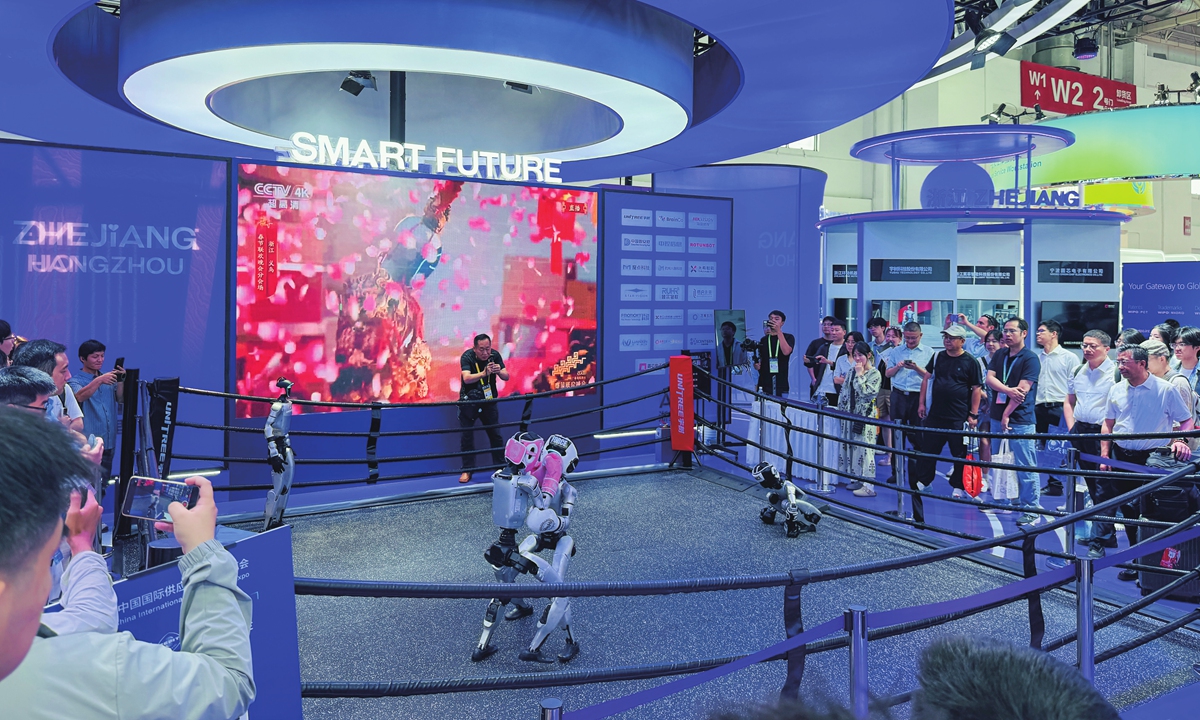
Visitors watch two humanoid robots from Unitree Robotics engage in a boxing match at the 4th China International Supply Chain Expo in Beijing on June 24, 2026. (Photo: Chi Jingyi/GT)
Nearly every high-tech product being displayed at the 4th China International Supply Chain Expo (CISCE) in Beijing is more or less intertwined with artificial intelligence (AI) - either it has an AI brain, or one of its functions is empowered by AI innovations.
A special AI pavilion at the expo - a part of the broad digital technology showing space - signals a profound shift in our time. AI is no longer an optional add-on to industries; it has become the essential infrastructure, flowing like water and electricity into every corner of the supply chain.
At the advanced manufacturing exhibition hall, a logistics company demonstrated an AI-powered scheduling system that instantly recalculates routes based on real-time weather, traffic, and other features, which can reduce response time from hours to mere seconds now, a staff worker of the company told the Global Times.
Across six major chains and more than 670 exhibitors from 85 countries and regions, AI has permeated nearly every booth, application, and discussion, acting as the "common language" of the expo.
As AI is transitioning from "optional" to "standard configuration," the expo vividly illustrates how this epoch transformation is redefining efficiency and pushing the boundaries of what modern supply chains can achieve.
AI drives innovationOne of the most striking features of the 4th CISCE was the prominent role of Chinese enterprises in spearheading AI development and applications.
In the smart vehicle zone, Chinese companies including Dongfeng Motor, XPeng, and BAIC showcased brand-new vehicles equipped with advanced AI features. XPeng displayed its Turing AI chip designed for level-4 autonomous driving, while presenting a full-stack self-developed intelligent ecosystem. Dongfeng Motor has introduced self-developed AI-centered electronic and electrical architecture, company representatives told the Global Times.
Momenta, a Chinese technology provider of intelligent driving, participated in the CISCE aiming to enable AI-empowered autonomous driving services to become real-world applications, according to a corporate statement sent to the Global Times.
At the digital technology zone, many Chinese tech companies made their presence as stars of provincial and municipal delegations, reflecting the role of tech innovation plays in their respective development.
One of the examples is the corporate delegation from Hangzhou, East China's Zhejiang Province, which consists of 17 leading technology companies, including Alibaba, Unitree Robotics, BrainCo, and STAR.VISION. These high-tech companies were brought together to jointly showcase their tech breakthroughs in embodied robotics, AI large models, intelligent computing, and industry applications, a representative of the Hangzhou booth told the Global Times.
STAR.VISION, a leading space intelligence company, is developing two lightweight AI lunar robots, less than 5 kilograms each, with advanced capabilities in multi-robot collaboration, autonomous navigation, and scientific detection.
"The robots are scheduled to land on the Moon around 2030, marking a significant step in extending AI to deep-space exploration," Chen Junrui, a spokesperson for STAR.VISION, told the Global Times.
In the advanced manufacturing zone, Gree Electric Co moved beyond displaying traditional air conditioners to showcase self-developed semiconductor chips and smart manufacturing solutions. Even traditional liquor enterprises like Wuliangye Group Co demonstrated precision manufacturing capabilities powered by AI, the Global Times learned from companies.
In green-agriculture pavilion, China Oil and Foodstuffs Corp unveiled an AI-powered dynamic scheduling system capable of detecting grain mold in milliseconds using digital twins.
"Over the past four years, we have connected with hundreds of upstream and downstream partners, helping multiple digital agriculture and animal husbandry solutions expand across the country," Li Xianlong, deputy general manager of Inner Mongolia Jishuo Technology Co, a supply chain service provider for intelligent animal husbandry, told the Global Times at the CISCE.
In 2025, Jishuo Technology signed contracts worth 120 million yuan ($17.6 million) at the 3rd CISCE, and "we have more deal intentions to sign this year," said Li.
These examples tell that Chinese companies are no longer adopters of AI technology. Instead, they are becoming innovators and system integrators, and in some areas taking the lead in AI applications.
Global collaborationInternational giants also used the expo to highlight their deepening ties with China's AI ecosystem.
Intel showcased an electric vehicle (EV) of Changan Automobile equipped with its AI computing platform. Qualcomm, a four-time participant at the CISCE, showcased an EV by BAIC's ArcFox equipped with its Snapdragon Ride Flex SoC, serving as an AI brain.
Qualcomm also showcased its partnerships with Chinese brands including Honor, Xiaomi, vivo, OPPO, Asus, and Lenovo at its booth to demonstrate a wide range of AI-powered smart devices, robotics, and 6G applications.
Chinese systems are also integrated into products developed by overseas companies. Momenta has established strategic partnerships with leading global mobility platforms such as Uber, Grab and Lumo for AI-empowered robotaxi business.
The active participation by both Chinese and international companies reflects the reality of deep interdependence in the AI supply chain. From chips and algorithms to applications and deployment, China has become an indispensable part of the global AI value chain, industry insiders said.
As AI continues to evolve from a display item into the core infrastructure of modern supply chains, the 4th CISCE has offered the world a window into China's rising capabilities in AI and its commitment to open cooperation.
In an era of rapid technological change, the expo demonstrates that China is not only a massive market but also a vital innovation hub and collaborative partner in building intelligent supply chains of the future, industry analysts said, noting that deepened cooperation in AI is mutually beneficial for all companies.
Ren Hongbin, chairman of the China Council for the Promotion of International Trade, the organizer of the CISCE, noted at the opening ceremony on Monday that China firmly upholds the "public-good nature" of global industrial and supply chains and strongly supports international cooperation in this area.
"As the world's largest application market for the new round of technological revolution and industrial transformation including AI, China will continue to promote global industrial and supply chains to new levels in quality, efficiency, and momentum, achieving mutual success with all parties through openness and connectivity," said Ren.