


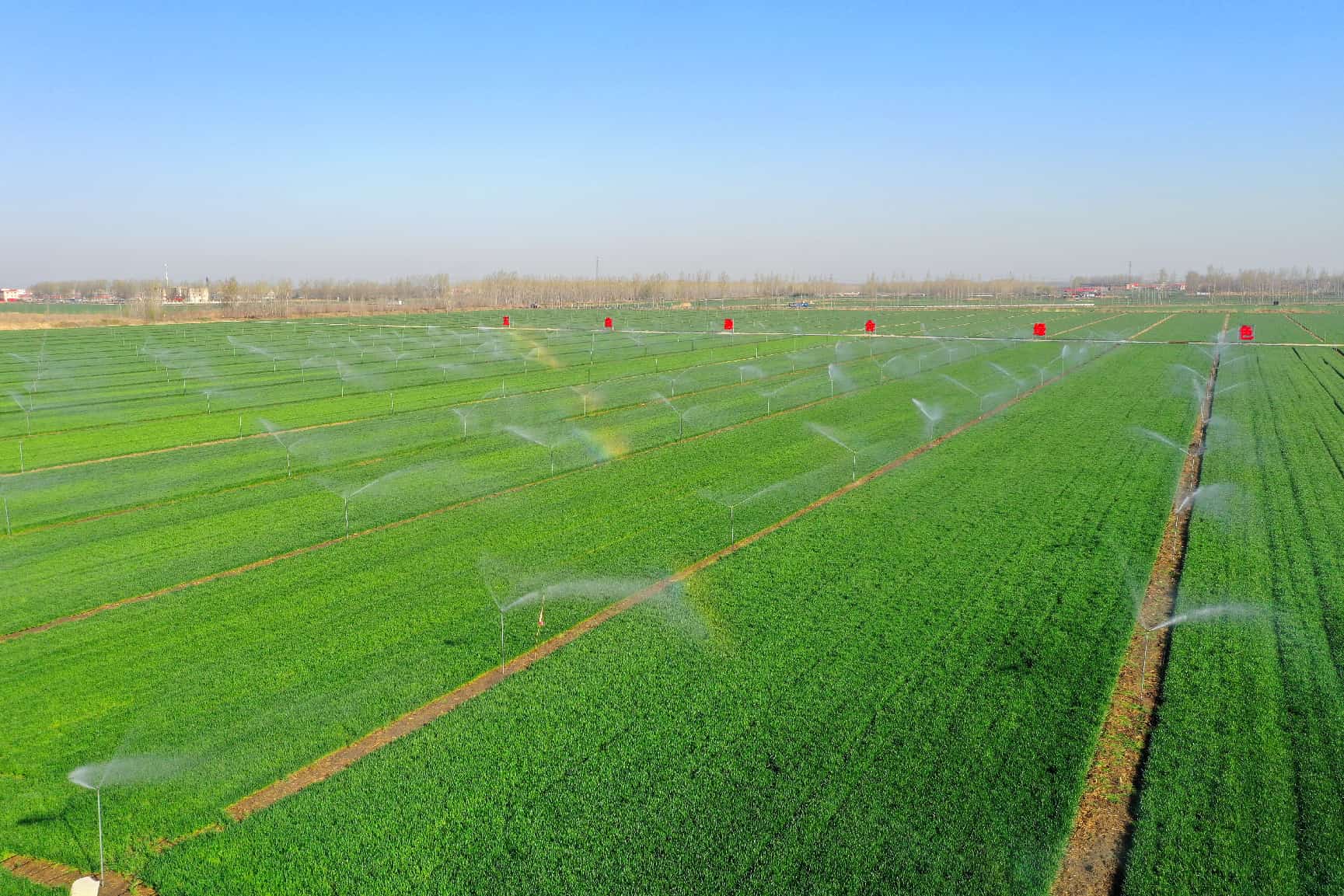
Upright sprinkler irrigation systems water the wheat crops in farmland run by a cooperative in Qingdao, east China's Shandong Province. (Photos provided to the People's Daily)
As summer planting begins in Ningjin county in Dezhou, east China's Shandong province, fields hum with activity -- but beneath this timeless agrarian rhythm lies a technological revolution transforming irrigation, crop management, and cultivation practices.
For Ye Jitao, director of a farming cooperative in Hupizhangxi village, the shift has been radical. "Irrigation was once a logistical nightmare," he recalled beside a new pipeline. "Several households had to share a single well, and we often waited three or four days just for one round of irrigation. Watering land could cost a lot in electricity alone."
"Now the government has built a pipeline network that delivers water from the Yellow River directly to our fields. We simply turn on the irrigation system and the water starts flowing. There's no waiting and no competition for water anymore."
Located at the tail end of Dezhou's Yellow River irrigation system, Ningjin has long struggled with water shortages and the overexploitation of groundwater, problems that once severely constrained agricultural development.
To tackle these challenges, the county has undertaken a major water conservancy project, dredging 114 kilometers of key waterways, building or upgrading 14 culverts and pumping stations, constructing 12 water storage ponds, and increasing the region's river water storage capacity by 5 million cubic meters. The improvements have significantly strengthened the area's irrigation capacity.
But having enough water is only part of the solution; using it efficiently is equally important.
At the Yicang planting cooperative in Ningjin's Shiji township, farmer Wang Yuchi no longer needs to spend hours standing by the fields during irrigation. With a smartphone, he can check real-time data on soil moisture levels and water usage.
In the past, he had to stay beside the fields during irrigation, worried about wasting even a drop of water. But now he can control everything with his phone.
Traditional flood irrigation has given way to drip irrigation and integrated water-and-fertilizer management, enabling farmers to use resources with far greater precision.
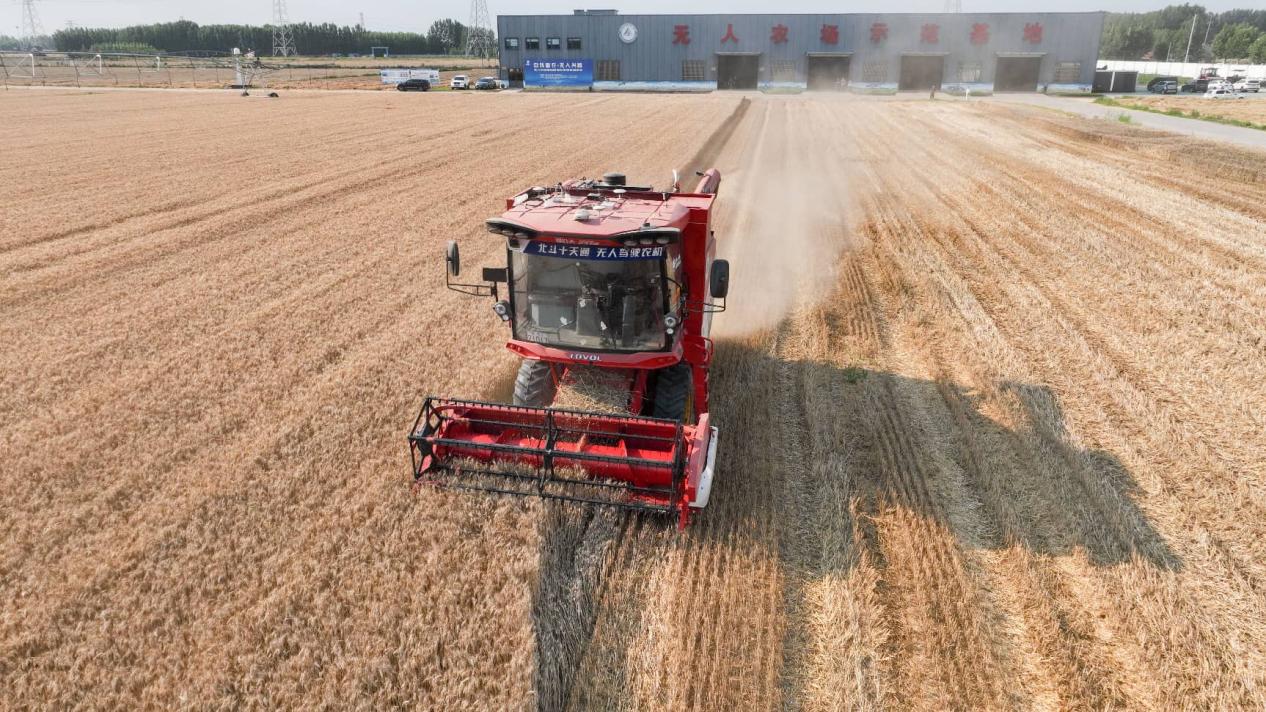
At an unmanned farm in Jiaoqiao township, Zouping, east China's Shandong Province, an autonomous harvester supported by Beidou satellites, Tiantong satellites and remote sensing technology reaps wheat automatically.
The shift from "competing for water" to "precise water management" in Ningjin reflects a broader transformation taking place across Shandong, where technology is redefining field management.
In Wuzhuang village of Kenli subdistrict, Dongying, Shandong province 107 hectares of wheat fields are now lush and green. Few would guess that just four years ago, the area was severely salinized farmland with an average salt content of 16 parts per thousand, where almost nothing could grow.
The turnaround has been driven by a locally developed technology known as the "enclosed dual-layer subsurface drainage system."
The method involves vertically installing plastic barriers to prevent saline water from seeping into the area while laying two underground drainage pipes: the upper layer flushes salt from the soil, and the lower layer blocks the upward movement of saline groundwater. The result is a solution that, according to local experts, can prevent the return of salinity for as long as 50 years after a single treatment.
Within one to two years of applying the technology, soil salinity dropped from 16 to 3 parts per thousand, the pH level returned to near-neutral conditions, and corn yields reached as high as 600 kilograms per mu, turning once-barren land into productive farmland.
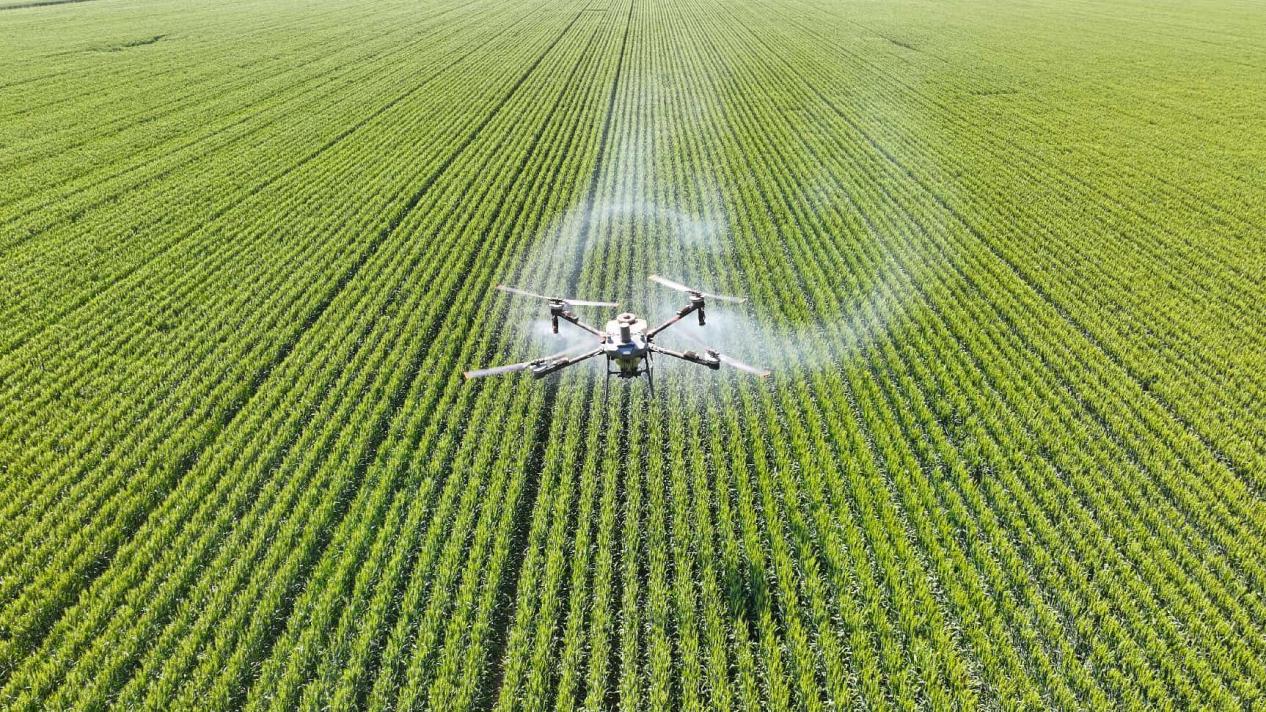
A drone sprays pesticide over farmland in Guangrao county, Dongying, east China's Shandong province.
Technology is also changing everyday farm management.
In a field in Linshu county, Linyi, Shandong, plant-protection drones fly low over the crops, evenly spraying water and nutrients onto wheat seedlings.
"In the past, fertilizing and irrigation were based largely on experience," said Yu Leyi, a 45-year-old grain grower from Diantou township. "Now, with just a tap on my phone, I can see temperature, humidity, and crop conditions in real time. Precision management just makes it easier and more efficient."
This transformation stems from the county's smart agriculture monitoring system.
Since last year, Linshu has established 200 field monitoring stations throughout the county to collect real-time data on soil moisture, temperature, humidity, wind conditions, and other key agricultural indicators. The data are uploaded to a smart agriculture big-data platform that provides farmers and agricultural service providers with precise decision-making support.
"In the past, checking soil moisture meant going out to the fields, and fertilization required repeated inspections to get it right," said Wan Lei, a farm machinery operator with a local agricultural cooperative, as he conducted aerial crop protection operations with a drone.
Using the mobile platform, he can clearly monitor drone flight paths, soil data, and crop growth. Precision fertilization and scientific irrigation have become standard practice. "And the efficiency is remarkable," he said. "A single drone can cover between 53 and 67 hectares in one day."
Similar scenes can be found in an unmanned smart farm in Wali village, Anjiazhuang township, Tai'an of Shandong province.
There, technician Wang Xinwen used a tablet computer to control a robotic pesticide-spraying machine.
"Once you set the route, it moves on its own," he explained. "The screen shows soil moisture levels and even insect damage on the leaves, and it is easy to adjust the spraying angle."
According to Chen Guoqing, an associate professor at Shandong Agricultural University, the robot uses centimeter-level navigation powered by the BeiDou Navigation Satellite System, while a digital management platform processes image data in real time.
The robot delivers a 95 percent targeting precision for pesticide application and cuts chemical usage by 40 percent. It can easily cover over 13 hectares per day, boasting efficiency 10 times higher than experienced farm workers.
"If farmers choose to rent this type of robot, operating costs can be reduced by 60 percent per hectare and labor costs by 40 percent," Chen said.
"Each unit is sold at around 20,000 yuan. Our goal is to develop affordable, reliable, and accessible intelligent farm machinery that ordinary farmers can actually use," he added.
From labor-intensive farming to smart agriculture, a technology-driven transformation is unfolding across the fields of Shandong, fundamentally changing the way farmers cultivate the land.