


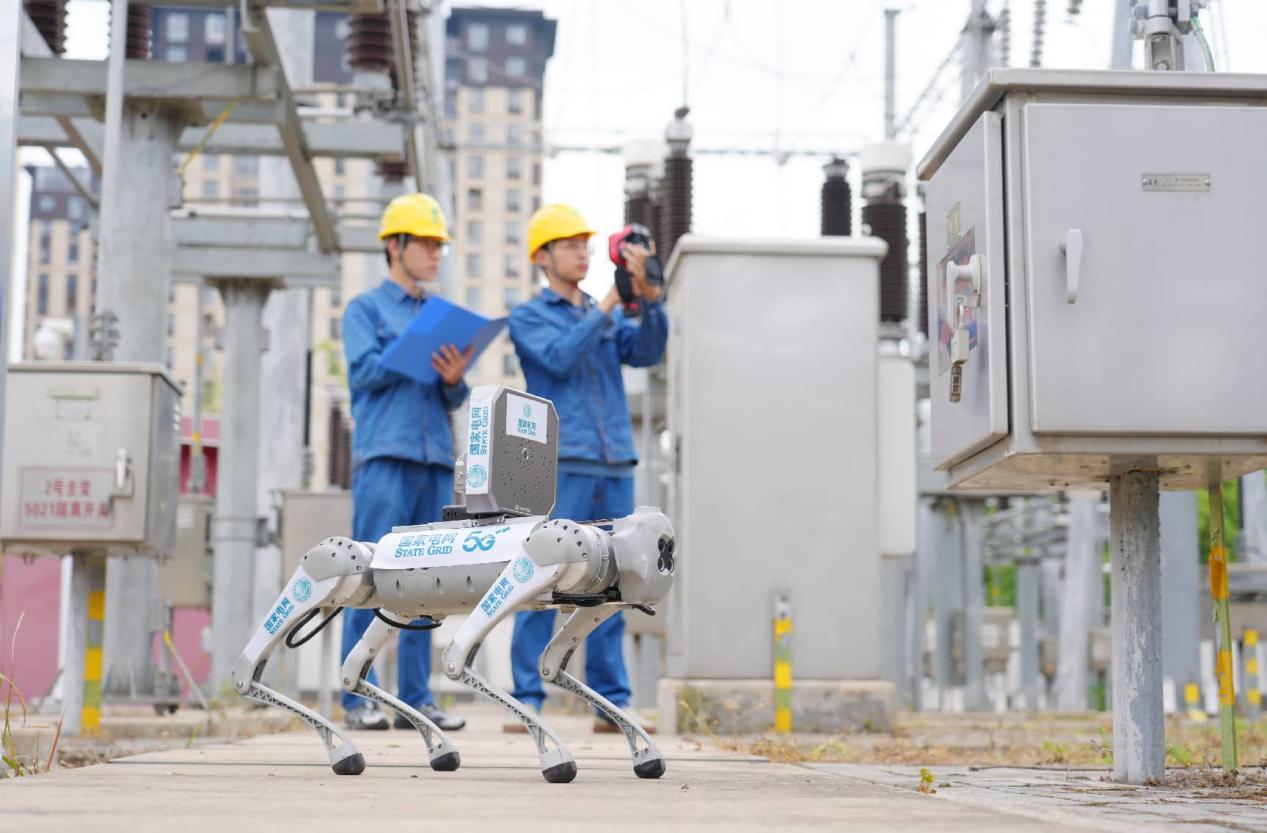
A quadruped inspection robot assists operation and maintenance staff with routine patrols and equipment checks for power facilities at a 110kV substation in Chuzhou, east China's Anhui province. (Photos: People's Daily)
The season 21 premiere of America's Got Talent featured a stunning collaborative performance by Chinese dancer Wu Yufei and eight G1 humanoid robots developed by China's Unitree Robotics.
During the three-minute human-robot dance routine, the silver robots delivered impeccable synchronized movements, nailing precise backflips and steady landings that showcased exceptional agility and coordination.
The spectacular act left judge Simon Cowell deeply impressed by the performers' flawless execution. The unique and brilliant performance earned unanimous approval from all four judges, securing Wu Yufei and the Chinese robots a spot in the show's next round.
Clips of the performance quickly went viral on overseas social media platforms. Many foreign viewers expressed astonishment in the comments section.
"I thought robot dancing was still at the stage of waving their arms from side to side. Who would have imagined that Chinese robots could perform synchronized backflips?"
"I checked the price -- less than $10,000 each? Industrial robotic arms in our country's factories cost much more than that."
The performance on America's Got Talent is only one example of the growing global popularity of Chinese robots.
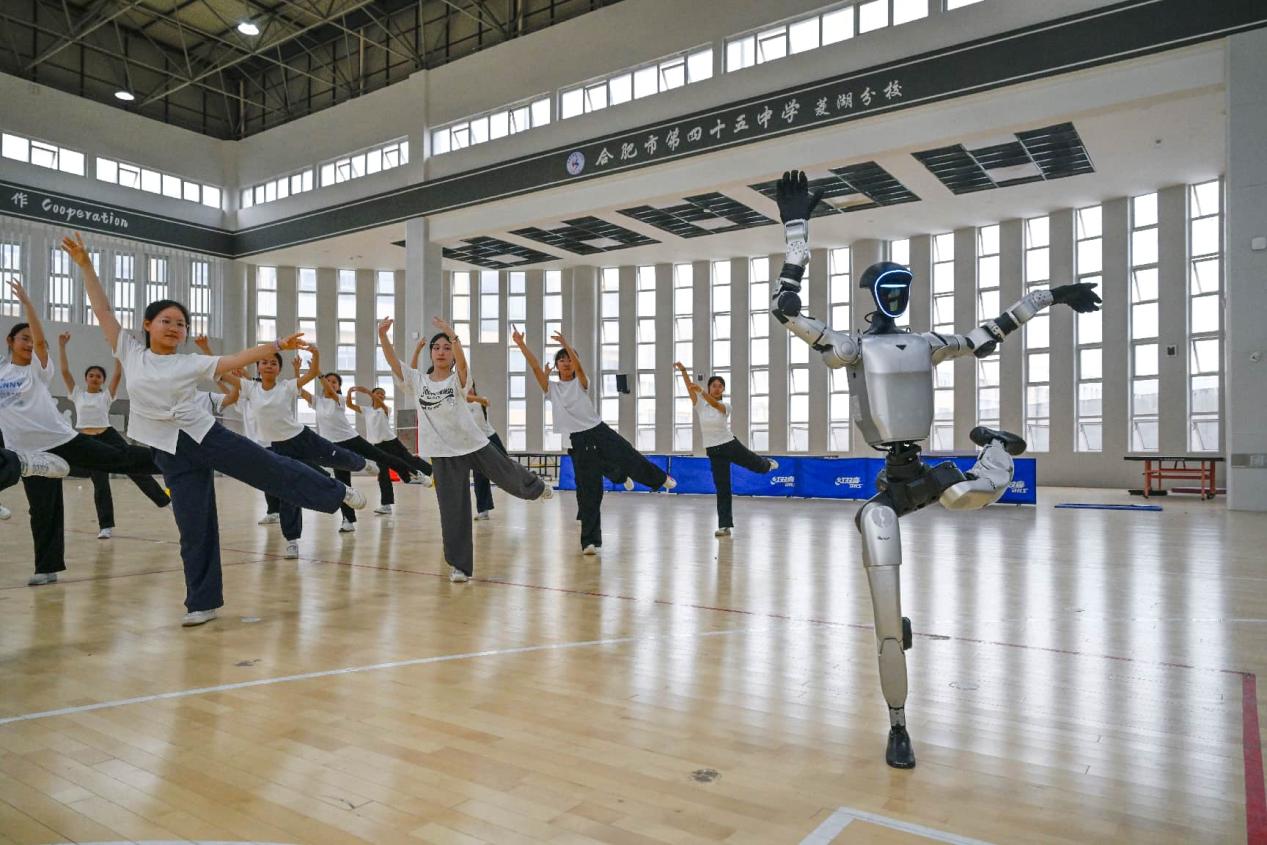
A robot dances with students at a middle school in Hefei, east China's Anhui province.
Market data tell the same story. According to the latest figures from China's General Administration of Customs, exports of various categories of robots totaled 11.32 billion yuan (about $1.67 billion) in the first quarter of 2026, with products reaching 148 countries and regions worldwide.
The humanoid robot segment has been particularly impressive. Global shipments of humanoid robots reached around 13,000 units in 2025, and Chinese manufacturers accounted for the vast majority of them.
Chinese-made humanoid robots are also significantly less expensive than their Western counterparts. Entry-level models from Unitree Robotics sell for less than $6,000, while smaller models produced by AgiBot are priced at around $14,000.
One overseas netizen joked: "I used to think robots were a luxury of the future. Now I realize China has turned them into a mass-market product."
From television stages abroad to social media platforms, from factory production lines in Europe and North America to consumer markets around the world, Chinese robots are making a striking impression with performance that exceeds expectations and prices that surprise consumers. This has led many people around the world to ask the same question: Why are Chinese robots consistently both affordable and highly capable?
A key reason lies in China's comprehensive industrial ecosystem and ability to control supply-chain costs.
China is the world's only country that possesses all industrial categories defined by the United Nations. This "full-spectrum" manufacturing capability allows the robotics industry to develop a highly integrated, modular production system in which everything from upstream raw materials to downstream assembly can be seamlessly connected.
The ability to manage supply-chain costs through a fully developed industrial chain is the fundamental reason why Chinese robots can deliver both quality and affordability.
Another key factor is the technological and manufacturing capabilities developed by China's new energy vehicle industry.
Many of the core technologies used in humanoid robots, including motors, reducers, batteries, sensors and electronic control systems, closely overlap with those used in electric vehicles.
China has ranked first globally in both the production and sales of new energy vehicles for several consecutive years. The mature, efficient and cost-competitive supply chain that has emerged from this industry has effectively provided ready-made infrastructure for the robotics sector.
Moreover, the cost reductions brought about by large-scale manufacturing have been dramatic.
After a decade of technological breakthroughs and capacity expansion, the price of a basic domestically produced six-axis industrial robot has fallen to between 70,000 and 150,000 yuan. The procurement cost of complete robot systems has dropped sharply compared with a decade ago, with some domestic models selling for only 1/3 the price of imported products with similar specifications.
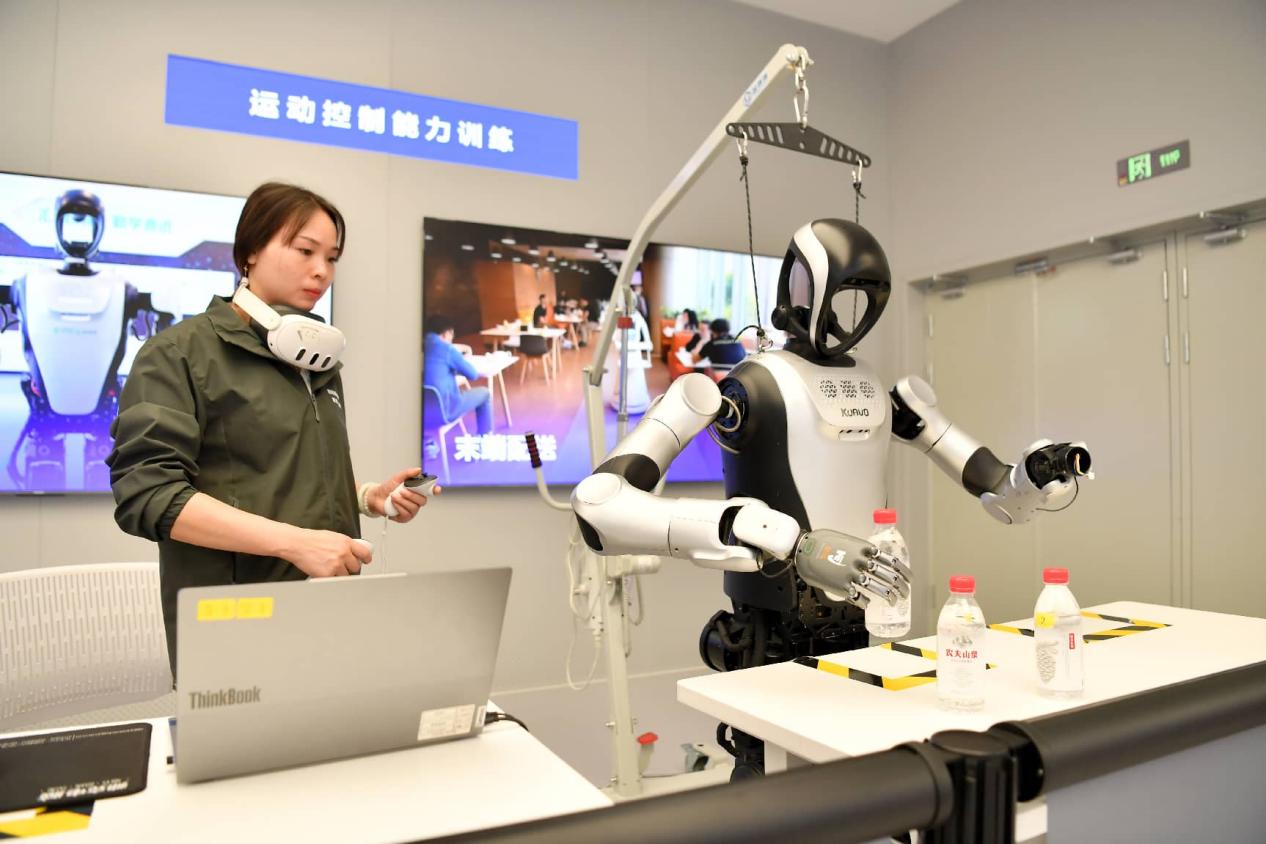
A trainer conducts motion control training for a robot at an embodied intelligence robot training base in southwest China's Sichuan province.
The industry has thus charted a path of falling prices and rising quality, achieving industrial upgrading without sacrificing performance.
If supply chains and manufacturing are the "hard foundations" of China's robotics industry, then the country's talent pool and vast application scenarios are the "soft drivers" that keep the industry evolving.
According to statistics, China has the world's largest pool of talent resources, science and technology personnel, and research and development staff. The country produces more than five million graduates in science, technology, engineering and mathematics (STEM) every year, continuously supplying talent for the entire robotics value chain.
With abundant engineering talent in areas such as algorithms, mechanical design, electronic control, intelligent manufacturing and production-line development, Chinese robotics companies can pursue multiple technological pathways simultaneously. This helps average down R&D costs, shorten product iteration cycles and create a dual advantage in both development costs and deployment speed to market.
Perhaps even more importantly, China's robotics industry benefits enormously from feedback generated by real-world applications.
China possesses a complete and independent modern industrial system, along with an exceptionally rich array of application scenarios. Robots are used for handling, sorting and welding in factories; palletizing and inspections in warehouses; coffee making and food preparation in restaurants; and last-mile delivery in logistics. These countless real-world applications provide invaluable training data and opportunities for continuous improvement.
By leveraging a complete industrial system, drawing on massive application scenarios, reducing costs through large-scale manufacturing and improving quality through rapid iteration, China's robotics industry has forged a development path of its own.
As a result, robotics technology is increasingly becoming an accessible and practical tool, one that consumers around the world can both afford and benefit from.