


PARIS, July 17 (Xinhua) -- Chinese scientist Pan Jianwei on Friday became the first Chinese recipient of the UNESCO-Russia Mendeleev International Prize in the Basic Sciences for his pioneering contributions to large-scale secure quantum communications and scalable quantum computation.
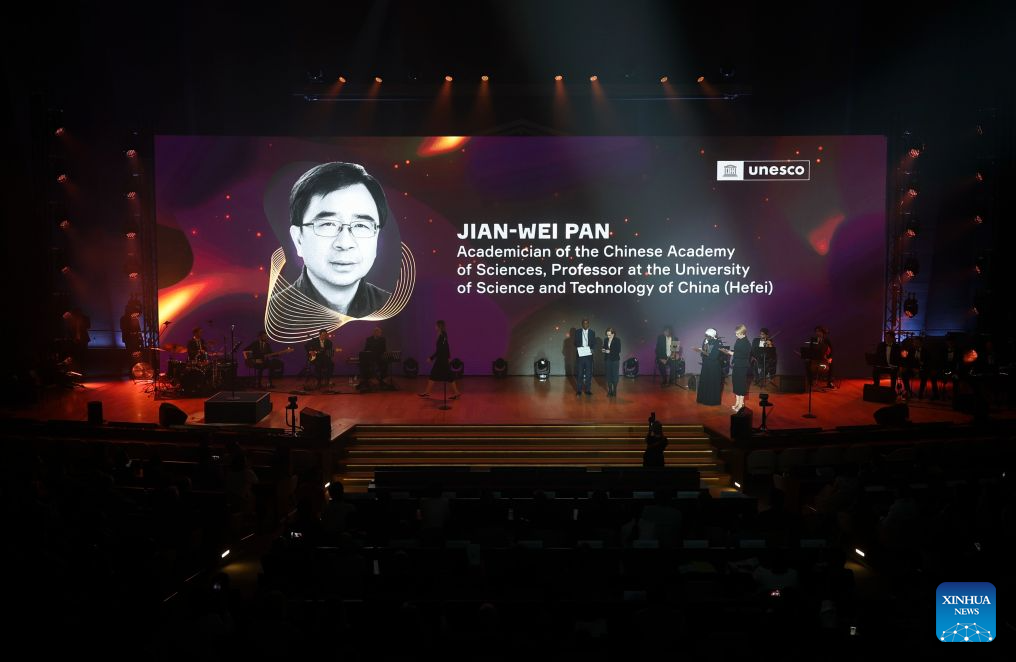
Pan Jianwei's photo is displayed during the awarding ceremony for the UNESCO-Russia Mendeleev International Prize in the Basic Sciences in Paris, France, July 17, 2026. (Photo: Xinhua)
The honoring ceremony was held at UNESCO headquarters in Paris.
According to UNESCO, Pan is a world-leading expert in quantum optics, quantum communications and quantum computing at the University of Science and Technology of China. His team developed the Micius satellite, enabling quantum key distribution and quantum teleportation over thousands of kilometers, and has demonstrated quantum computational advantage, bringing the prospect of a global quantum network from theory to reality.
China launched the world's first quantum satellite, the Quantum Experiments at Space Scale (QUESS), nicknamed "Micius" after an ancient Chinese philosopher, in August 2016.
Building on the satellite's successful deployment, Chinese scientists achieved satellite-to-ground quantum key distribution and ground-to-satellite quantum teleportation in the following years.
The other laureate this year is Professor Sergei S. Sheiko, George A. Bush Jr. Distinguished Professor of Chemistry at the University of North Carolina at Chapel Hill. He was recognized for his outstanding contributions to fundamental polymer physics and materials science.
Established in 2019, the UNESCO-Russia Mendeleev International Prize in the Basic Sciences promotes scientific progress, science education and international cooperation.
Named after Dimitri Mendeleev, the father of the periodic table, the prize is awarded annually to two individuals in recognition of breakthrough discoveries or outstanding innovations in the basic sciences with significant societal and economic impact, based on the recommendation of an international jury of seven eminent scientists.