


"Attention, villagers. Please go immediately to the village resettlement center." Starting at 10 p.m. on July 10, a meteorological drone patrolled the riverbanks, tidal flats, and residential areas of Jiangfeng village, Fenglin town, Yongjia county, Wenzhou, in East China's Zhejiang Province. The drone scanned for safety hazards along the river while broadcasting evacuation alerts to residents.
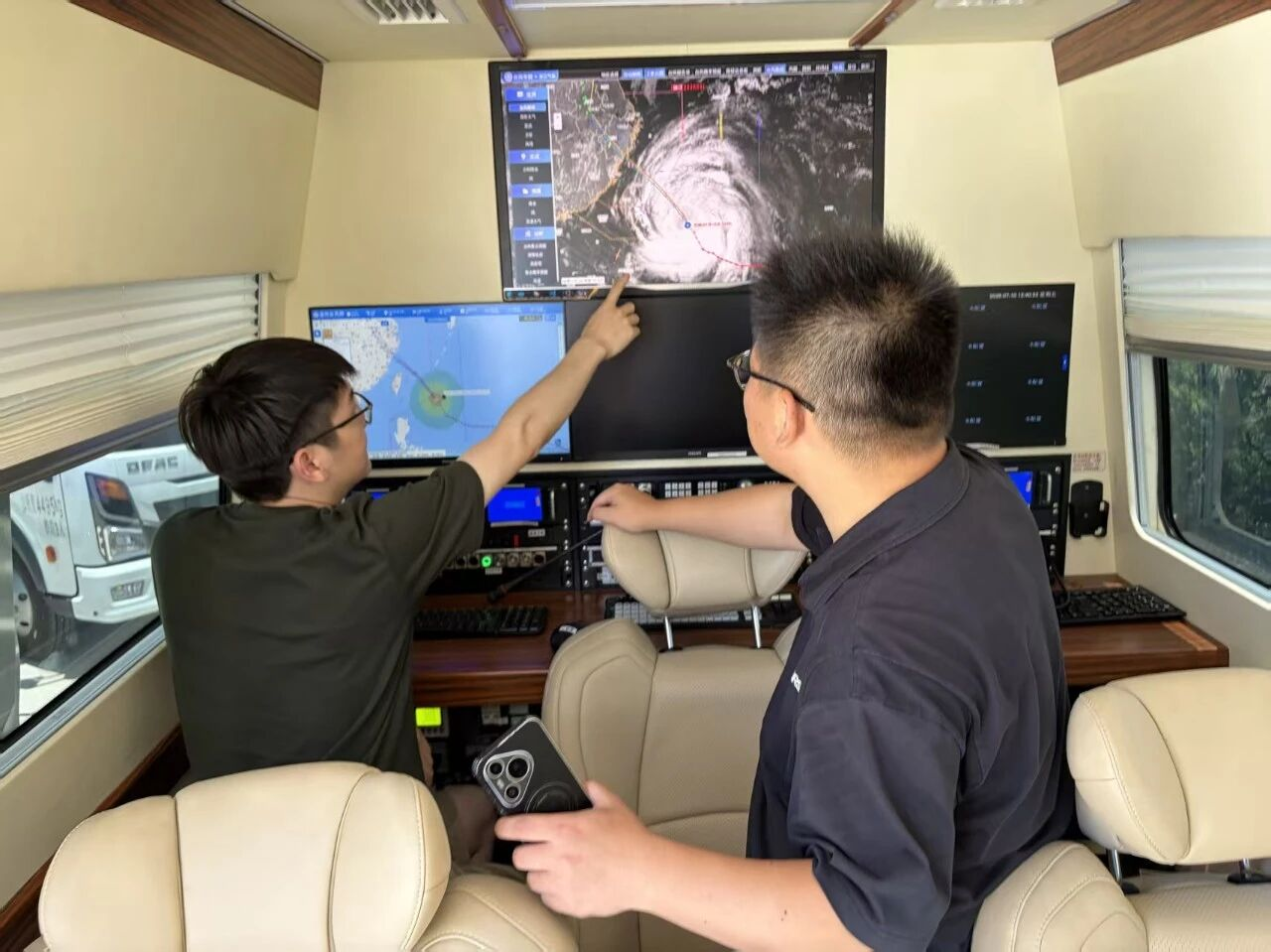
Technicians from the Zhejiang Provincial Meteorological Bureau analyze and assess the path and impact of Typhoon Bavi on July 10. (Photo: Gao Zhuyu)
At the command center, staff monitored live footage and coordinated with the village Party branch and the villagers' committee to manage the evacuation. By 10 a.m. on July 11, all 765 villagers had been safely relocated within 12 hours. Thanks to the timely evacuation, no casualties were reported in Jiangfeng village, even as floodwaters rose more than 2 meters at the peak.
In recent days, as Zhejiang responded to Typhoon Bavi, local governments have deployed new technologies, including drones, AI applications, and digital platforms, to transform the traditional flood and typhoon response model. The old approach relied on manual patrols, visual inspections, and phone reporting. Today, it has been replaced by a modern defense system featuring smart monitoring, data-driven decision-making, and region-wide coordinated response.
At a fishing port in Daishan county, Zhoushan, drones equipped with high-definition cameras and remote loudspeakers patrolled the area. They transmitted real-time information on stranded personnel and vessel conditions, conducting coordinated aerial and maritime inspections of more than 400 vessels moored at the port.
In Cangnan county, Wenzhou, drones act as "eyes in the sky," detecting a breach in a seawall with precision. "The seawall is so long that manual inspections alone would have taken all night. Thanks to drones, we were able to complete repairs in time," said Yan Hai, head of the Mazhan Water Resources Management Office under the Water Resources Bureau of Cangnan.
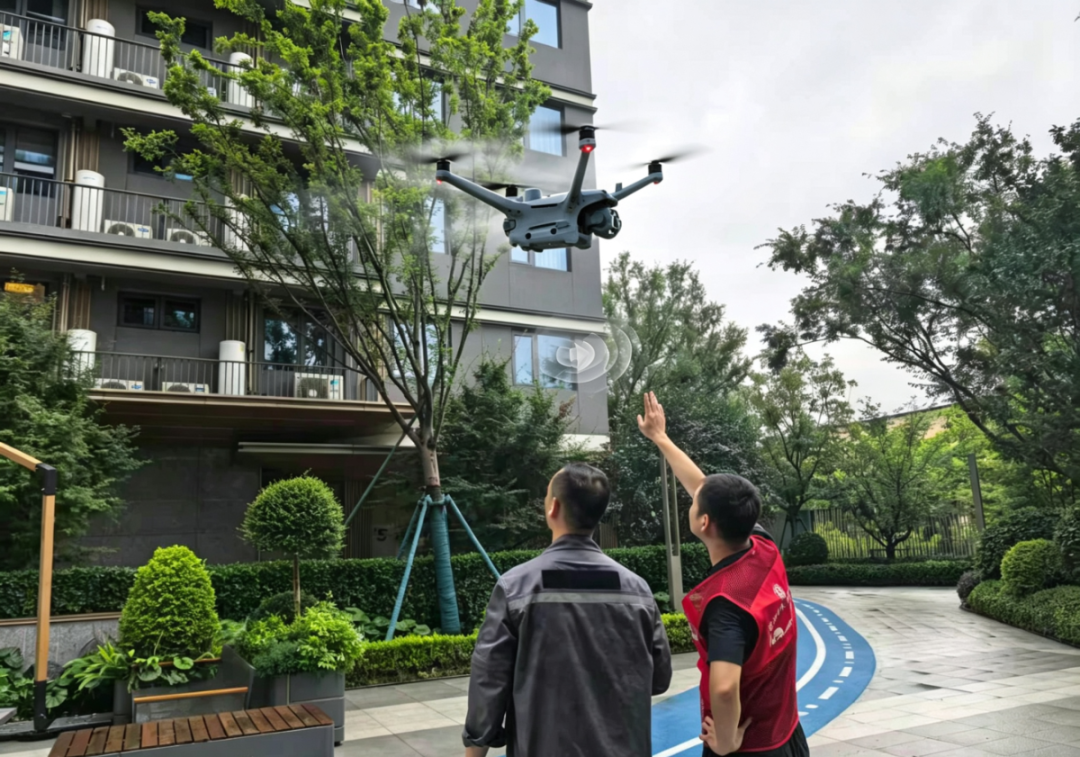
Before Typhoon Bavi arrives, staff members operate a drone to patrol the area and identify safety hazards in Gongshu district, Hangzhou, East China's Zhejiang Province. (Photo courtesy of the convergence media center in Gongshu district)
From coastlines and mountains to highways and embankments, intelligent defense systems are working in concert to create a modern typhoon response framework featuring early warning, rapid response, and full coverage. These technologies are shifting flood control from reactive emergency response to proactive risk prevention, improving the precision of disaster management.
As the typhoon moved inland, the Xixian embankment in Hangzhou's Yuhang district, which protects the Hangjiahu Plain, launched an air-ground integrated intelligent patrol system. Drones equipped with infrared thermal imaging cameras flew along the embankment at low altitudes, using AI algorithms to automatically detect hazards such as seepage and slope collapses. Risk locations were immediately sent to ground inspectors' handheld terminals.
"In the past, it took three days to patrol the entire embankment on foot, with much of the time spent traveling. Now drones can complete a full inspection in just two hours. Hard-to-reach areas such as dense forests and steep slopes are no longer blind spots, allowing us to focus more on analysis and response," said Sun Long, a staff member with the Forestry and Water Resources Bureau of Yuhang district.
The Huizhou-Hangzhou Expressway uses an integrated smart management platform to break down regional data barriers by incorporating real-time weather, water, and traffic information along the route. Rainfall, road conditions, and water levels are displayed on a single screen. Based on risk levels, the platform automatically issues alerts and dispatches nearby rescue resources to quickly address road hazards, enabling efficient cross-provincial coordination to ensure smooth traffic flow.
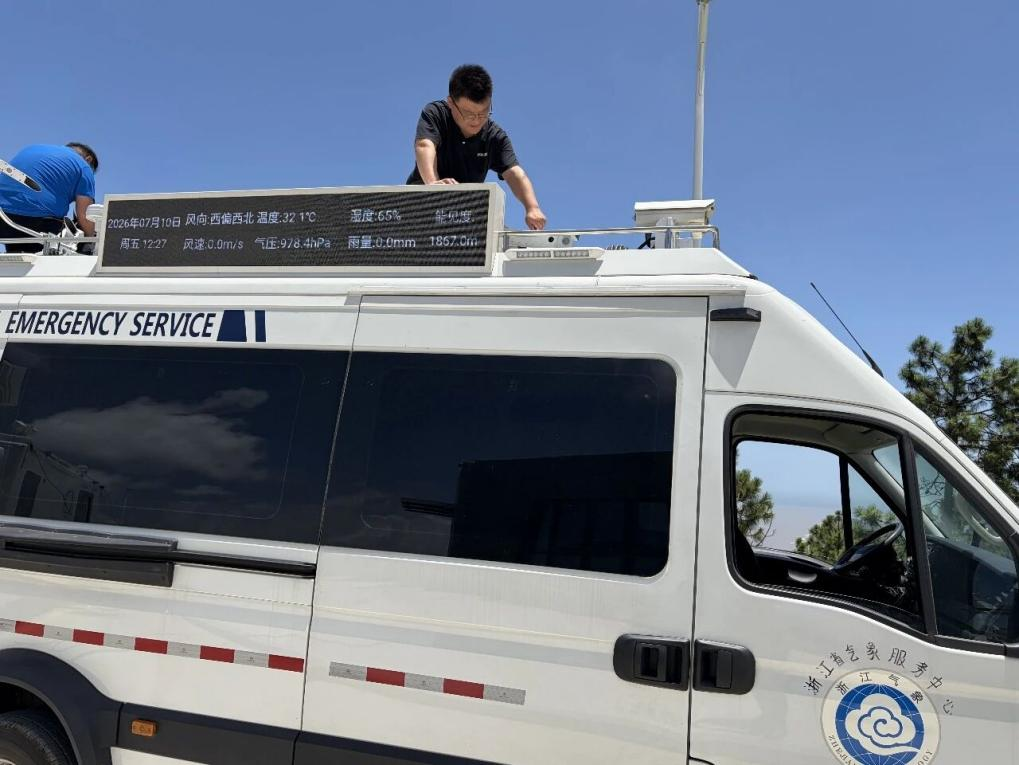
Meteorological staff members inspect the transmission lines of temperature, humidity and rainfall sensors on a mobile emergency response vehicle before the typhoon arrives in Wenzhou, East China's Zhejiang Province, on July 10. (Photo: Zhang Yunbiao)
On sections of the Lin'an-Jiande Expressway, including Tianmuxi Bridge and Fenshuijiang Bridge, an intelligent adverse-weather guidance system can collect real-time data on visibility, wind speed, and road surface conditions and switch among six operating modes as needed.
As the typhoon battered the waters off Dongtou, Wenzhou, more than 500,000 kilograms of large yellow croaker at a parent-and-child cage aquaculture base in Luxi township successfully weathered the storm.
"In recent years, with government support, we have built a large-scale parent-and-child cage aquaculture base. It provides a high-quality offshore natural environment while effectively reducing the impact of massive waves. This minimizes damage to juvenile and adult fish and greatly improves the cages' resistance to currents and storms," said Zheng Xiangwu, head of Huangyudao Marine Fishery Group Co., Ltd. He added that with increasingly advanced technologies, aquaculture risks continue to decline.