


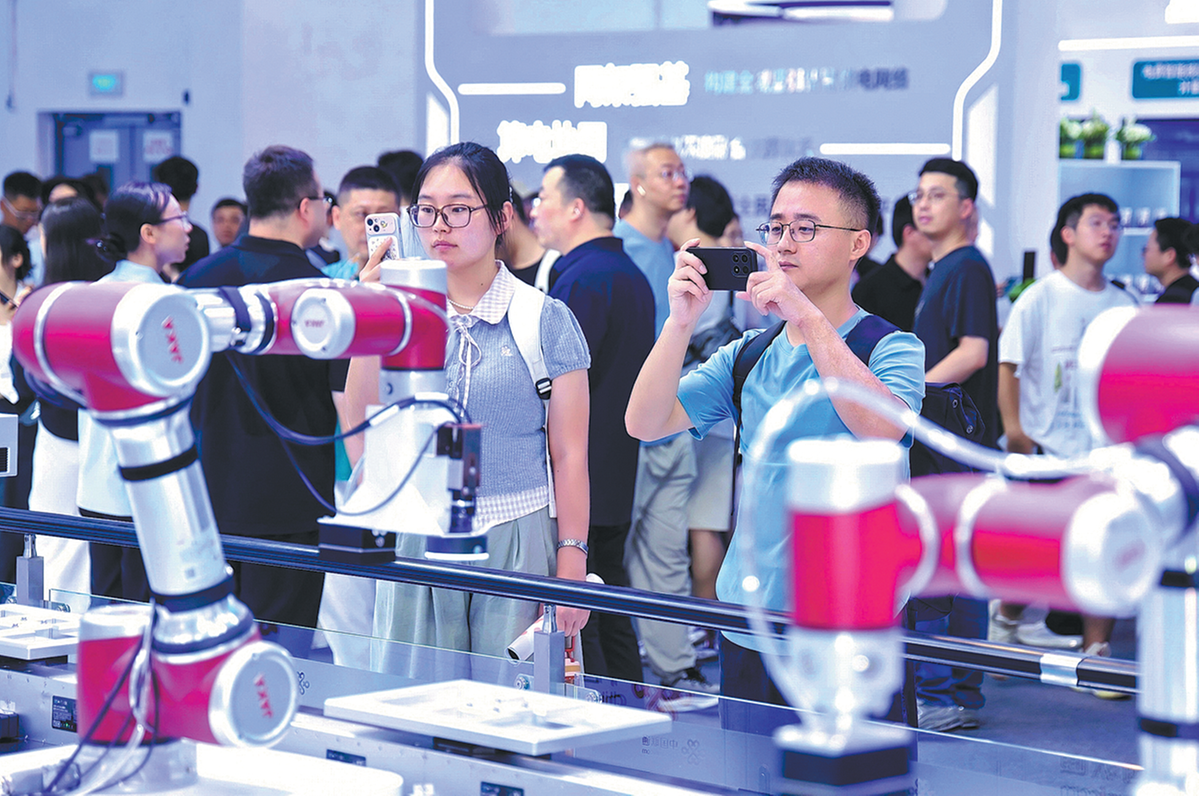
Visitors take photos at China Unicom's exhibition area during the 2026 World Artificial Intelligence Conference in Shanghai in July. (Photo: China Daily)
The midsummer heat is stifling, yet inside the exhibition halls of the 2026 World Artificial Intelligence Conference — which recently concluded in Shanghai — the temperature also feels high due to a flurry of activity.
The whir of featured technology in operation, the narration of product launches and the cacophony of conversations in multiple tongues weave together into a constant hum that reverberates through the vast space. Industry professionals, academic researchers and ordinary citizens weave from booth to booth, checking out futuristic tech and experiencing AI agents firsthand. The packed halls, buzzing with energy, paint a vivid portrait of a burgeoning AI sector charging forward at full throttle.
This year's WAIC has broken its own records: the total exhibition area exceeded 100,000 square meters for the first time, with more than 1,100 companies showcasing over 3,000 exhibits and over 300 products making their global debut. More than 1,400 Chinese and foreign special guests gathered together, with the on-site excitement unmistakable.
Yet beyond the sheer scale, what truly stands out is the message emanating from displays across the AI industry chain: AI is moving from code on screens to factories, pharmacies and office desks. Robots and large models are not only finding specific applications, but have also entered a moment of "getting things done", officials, corporate executives and experts said.
Moreover, the computing power exhibition area — which undergirds AI — also offered plenty of highlights, with multiple domestically produced computing products making a collective appearance, they added.
Outside the venue, AI has already crossed the boundaries of the laboratory, surging as a powerful wave across the globe. Many visitors still recall that the 2024 WAIC featured just 25 humanoid robots; this year, the embodied intelligence sector alone brought together over 200 companies. In just two years, the field has leapfrogged from "looking at appearance" to "looking at capability" and then to "looking at real-world deployment".
The Ministry of Industry and Information Technology said China has taken the lead in achieving mass production of humanoid robots, with its global shipment share reaching as high as 90 percent in 2025, with humanoid robot production seen topping 100,000 units in China this year.
"This leap is no accident," said Wei Liang, vice-president of the China Academy of Information and Communications Technology. "Behind the transition from small-batch trial production to large-scale mass production lies a combination of improved domestic large language model capabilities, falling costs for core components and the continuous accumulation of scenario-based data."
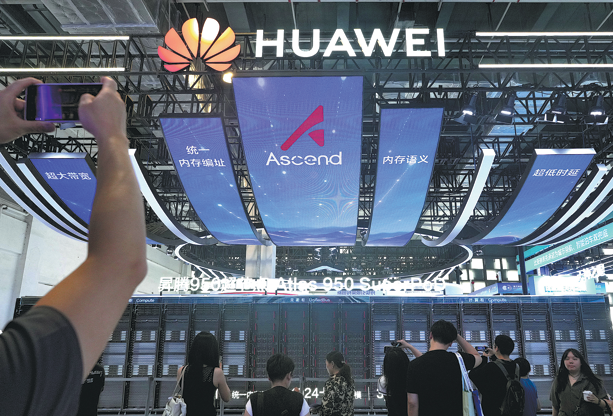
People take pictures of Huawei's screen flags during the 2026 WAIC in Shanghai on July 20. (Photo: China Daily)
This year, Huawei brought the industry's largest super-node architecture to the conference, enabling 1,024 Ascend computing cards to "work together like a single computer". Honor demonstrated its Robot Phone, which uses a single voice command to have AI execute complex tasks across multiple applications. Zhang Jianzhong, founder of Chinese AI chip maker Moore Threads, has proposed building three "AI factories" — a model-training factory, a token-production factory and an agent-production factory.
"Whether it is cutting-edge tech or innovative concepts, they all illustrate that AI is not just a discipline or an emerging industry, but a core tool and intelligent partner that empowers every sector," said Tang Wenkan, director of the Shanghai Municipal Commission of Economy and Informatization. Benefiting from this shift, Tang said the scale of Shanghai's AI sector has grown nearly fourfold in the seven years since the first WAIC was held.
The broader statistics underscore such momentum. MIIT data show that China's core AI industry exceeded 1.2 trillion yuan ($176.8 billion) in 2025, with more than 6,200 enterprises operating in the field. Currently, China holds 60 percent of the world's AI patents, and daily AI token calls have reached hundreds of trillions.
Huo Fupeng, director of the innovation-driven development center under the National Development and Reform Commission, said that cutting-edge technological concepts combined with massive application scenarios will continue to spawn breakthrough innovations, making China a key launchpad, testing ground and source of global AI innovation.
Yet as machines begin to think, a fundamental question arises: how should humans interact with them? Industry players feel deeply that the faster AI develops, the more urgent it becomes to answer the basic questions of whom the technology serves, how it can be made universally beneficial, and how safety and security can be guaranteed.
Nicholas Dirks, co-chair of the International Advisory Board of the Center for Global AI Innovative Governance and president of the New York Academy of Sciences, said at a sub-forum: "The real world is far more complex than theoretical models. When we ask how AI can move forward, we need not only scientists, but also humanists and sociologists. Looking back at history, human societies have often built corresponding social systems and regulations only after risks emerged from technological change. But the speed of AI development no longer allows us to lag too far behind."
Zhou Bowen, director of the Shanghai Artificial Intelligence Laboratory, has observed through multiple global dialogues on AI governance and standards that without China's participation, it is difficult to reach substantive and actionable consensus on international technical standards and ethical rules.
Jack Chan, chairman of EY China and regional managing partner of EY Greater China, said: "The world is undergoing a new round of technological and industrial revolution. AI tech continues to upgrade iteratively, moving from theoretical concepts to large-scale industrial deployment, bringing new opportunities to all industries. At the same time, the construction of governance systems still faces many challenges that require joint efforts across the sector."
Chan said EY has always believed that AI development cannot be pursued in isolation. "Only by breaking through the implementation chain across fields, industries and scenarios, bridging the digital-intelligent divide and upholding the bottom line of responsible intelligence can we ensure that the dividends of intelligence widely benefit all sectors."
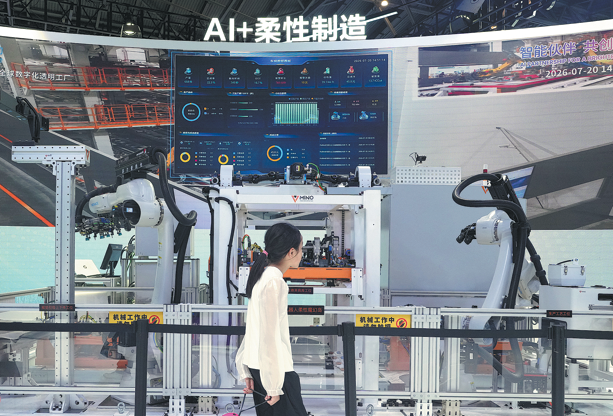
A visitor walks past a product from China Mobile at its booth during the 2026 WAIC in Shanghai on July 20. (Photo: China Daily)
Alongside these broader reflections, China's major telecom operators have also been active at the WAIC. China Unicom hosted a forum, where chairman Dong Xin outlined the telecom giant's threefold role: supplier of computing-network infrastructure, practitioner of application scenarios and builder of industrial ecosystems. Under its "six networks" strategy, Unicom is advancing a new "Agent+Token+AI Cloud" model, strengthening next-generation communication and computing networks.
In Shanghai, it has deployed 5G private networks in manufacturing sites and operates the Lingang 10,000-card intelligent computing center. Through its Gewu industrial internet platform and Yuanjing MaaS platform, Unicom has connected more than 14 million devices, accumulated over 100 terabytes of industrial datasets, cultivated more than 75 industrial large models, and launched over 150 intelligent agents.
China Telecom, at its own forum, had chairman Ke Ruiwen state that the company will take a moderately forward-looking approach to building computing infrastructure and accelerate the development of next-generation AI data centers. These new AIDCs will meet high power density, high IT output, flexible construction and flexible expansion standards. China Telecom is optimizing its AIDC footprint around the country's eight hub nodes and has already built over 900 data centers with a total power capacity approaching 8 gigawatts, making it the country's largest AIDC services provider.
China Mobile has been building a secure, trustworthy, efficient and inclusive next-generation AI infrastructure. It has expanded its AI Infra layout, promoting a national integrated computing network with multiple super-computing clusters of over 10,000 cards, 12 regional AI computing centers and 1,500 edge computing nodes, with a total AI computing scale exceeding 107 EFLOPS. Its JiuTian 35B LLM ranks second globally in the lightweight model category on international benchmarks. The company has also upgraded its MoMA platform and built a large-scale "token supermarket".