


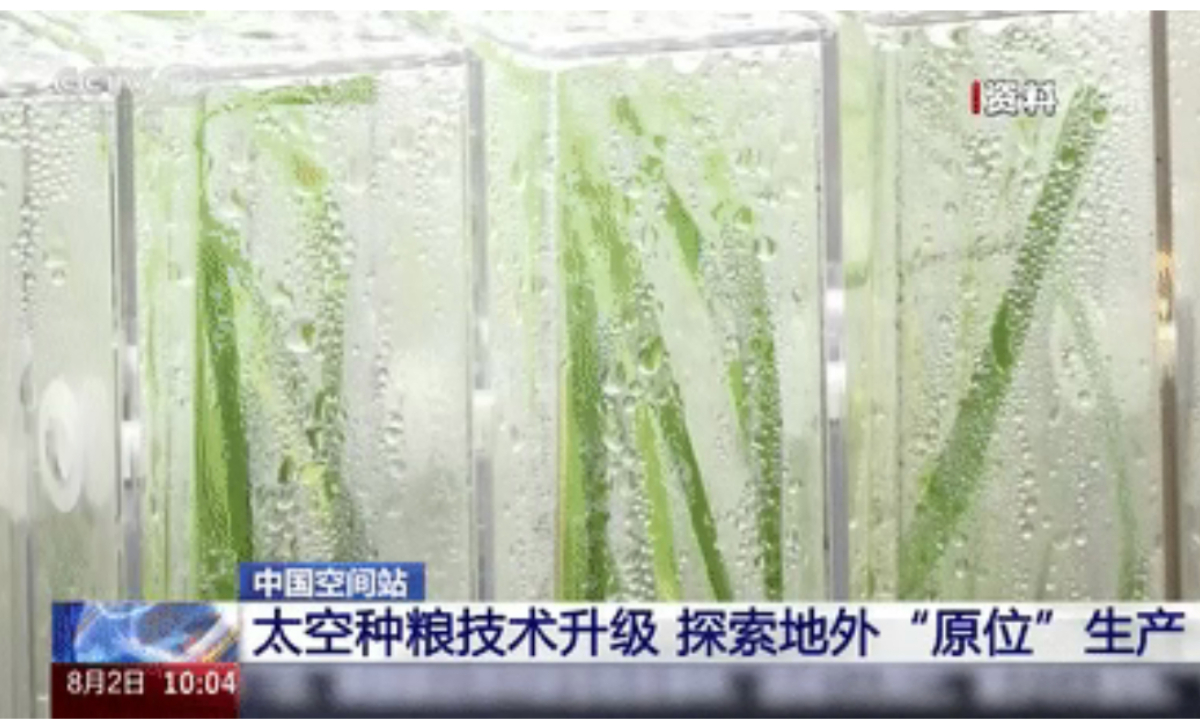
Photo: Screenshot from CCTV
The Shenzhou-23 crew has successfully harvested the first batch of rice samples grown from seeds brought to China Space Station in May, a study that could support future in situ food production beyond Earth, China Central Television (CCTV) reported on Sunday.
In situ production refers to growing food and sustaining a self-sufficient life-support cycle directly in space without relying on resupply from Earth. The capability is expected to provide critical life-support for humanity’s exploration of deeper space, according to the report.
The Shenzhou-23 crewed spacecraft was successfully launched on May 24, carrying rice seeds and other experimental materials to China’s space station. Since entering China’s space station, the three astronauts of the Shenzhou-23 spaceflight mission, Zhu Yangzhu, Zhang Zhiyuan and Lai Ka-ying, have been carrying out a series of space science experiments. They have completed the collection and storage of the first batch of rice samples for the mission’s first experiment on the molecular mechanisms of multi-generational genetic stability and environmental adaptability in space-grown rice.
The experiment aims to cultivate, for the first time, two consecutive generations of rice in orbit – from seed to seed to seed – enabling scientists to investigate how prolonged exposure to microgravity influences the crop’s genetic stability.
In 2022, the world's first seed-to-seed rice cultivation experiment in orbit was completed in China’s space station, with six rice seeds cultivated in orbit and producing 59 first-generation space-grown seeds over 120 days before returning to Earth with the Shenzhou-14 crew.
The rice seeds carried into space aboard the Shenzhou-23 manned spacecraft are varieties of japonica rice developed in China, known for their strong adaptability and a growth cycle of three to four months. One group consists of ordinary seeds that have never left the Earth’s surface, while the other group comes from the descendants of a “space rice family” – seeds harvested in orbit in 2022 and subsequently bred for three generations on Earth.
The experiment consists of four units, with six seeds planted in each unit. The four units are divided into two groups, corresponding respectively to the two reproduction methods of rice.
One group will undergo sexual reproduction. After the seeds mature, the rice ears will be harvested and transferred to new cultivation boxes for the growth of the second generation. The experiment will examine the “transgenerational memory” formed through sexual reproduction – specifically, whether seeds that have previously been exposed to space are more adaptable to the space environment than seeds that have never left Earth.
The other group will adopt a ratooning rice cultivation model. After the rice matures, only the root system will be retained, allowing new shoots to regenerate from the remaining stubble and produce another crop. The experiment will compare the differences in adaptability between vegetative reproduction and sexual reproduction under the space environment.
The astronauts will return rice ears, seeds, and frozen plant samples to Earth for research, helping inform the selection of future space agriculture models.