


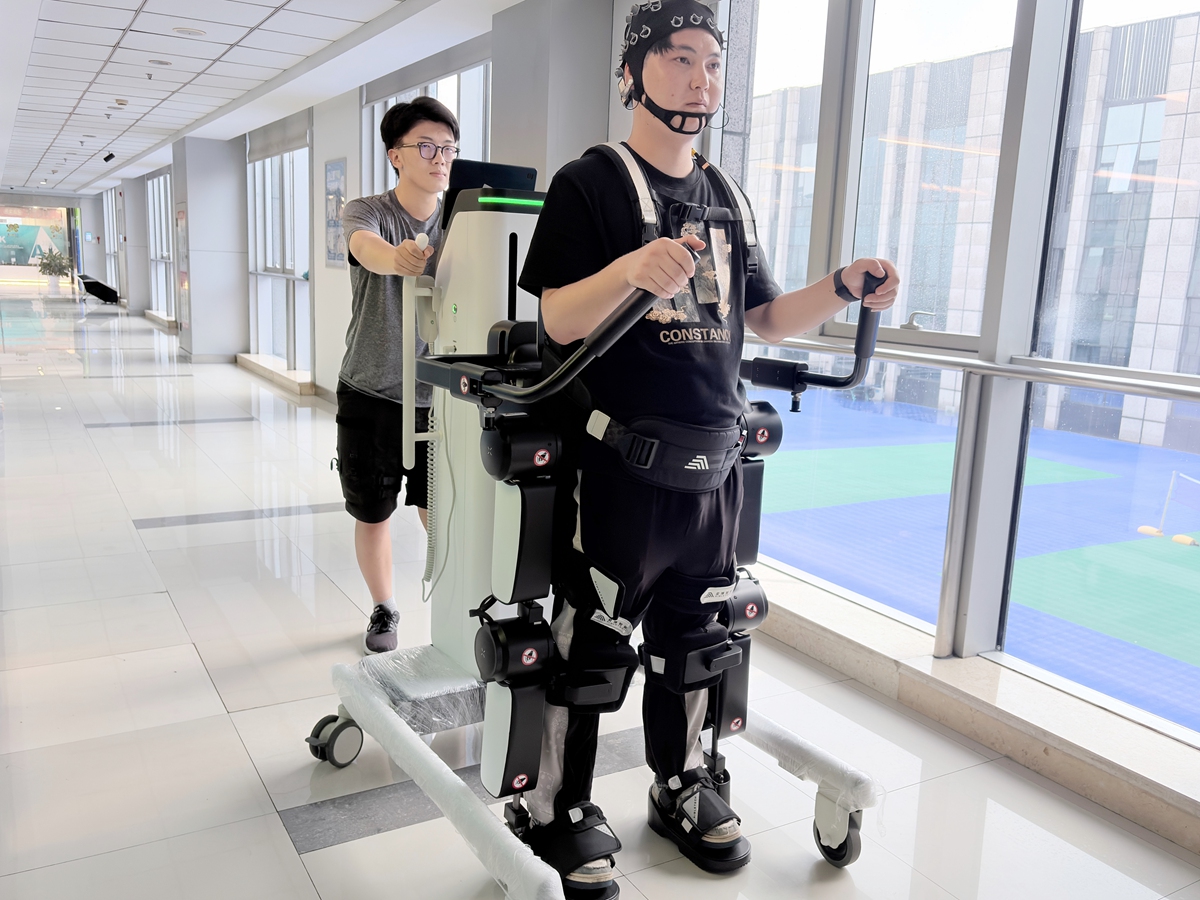
Two staff members demonstrate rehabilitation exoskeleton robot with brain-computer interface. (Photo: Courtesy of Joint Laboratory for Universal AI in Disability Support)
Wanting to move but being unable to is the plight of patients with lower-limb mobility impairments. Today, a homegrown cutting-edge technology is working to solve this problem. Recently, at the high-end equipment exhibition area of the Anhui Innovation Pavilion in Hefei, capital of East China's Anhui Province, a brain-computer interface (BCI) rehabilitation exoskeleton robot attracted significant online attention.
Developed by the Joint Laboratory for Universal AI in Disability Support established by the China Disabled Persons' Federation and Chinese tech company iFLYTEK, this robot integrates non-invasive electroencephalogram (EEG) signal acquisition, deep learning algorithms, and neuroplasticity principles. Featuring a bionic structure that mimics human hip and knee joints, the system offers three core capabilities: direct brain-machine connectivity, adaptive bionic gait, and multi-level assistive training, Anhui Aible Intelligent Technology Co, the executive company of the lab, told the Global Times in a statement on Wednesday.
Based on the motor imagery paradigm, the system utilizes high-precision EEG sensing and self-developed EEG decoding technology to capture and interpret brain signals. By translating motor imagery into movement commands, it enables precise, coordinated control of the exoskeleton - such as initiating steps and executing various movements - thereby establishing a direct link between brain signals and the exoskeleton device, the company said.
Currently, the BCI device remains in the research and development stage. It is being trialed in over a dozen hospitals across China and has entered into a project partnership with a provincial hospital in Anhui, it said.
Designated as a future industry in this year's Government Work Report and included in the 15th Five-Year Plan (2026-30), the BCI sector in China is accelerating its transition from the laboratory to industrialization, making steady progress through the commercialization of related products.
"As the global BCI industry enters a golden era of development, China is rapidly shifting from catching up to competing alongside and even leading in certain areas. Notably, China's BCI sector is advancing toward industrialization at a particularly fast pace," Liu Gang, chief economist at the Chinese Institute of New Generation Artificial Intelligence Development Strategies, told the Global Times on Wednesday.
China's BCI market is projected to be valued at 6.14 billion yuan ($910 million) by 2028, with a compound annual growth rate of 17.7 percent from 2024 to 2028, according to CCID consulting under China's Ministry of Industry and Information Technology.
In March, the National Medical Products Administration approved the registration application for an Implantable BCI for Hand Motor Augmentation, developed by Neuracle Technology (Shanghai) Co, marking the world's first market launch of an invasive BCI medical device.
"However, we must remain sober-minded. While the concept of brain-computer interfaces is overheated by hype across the world, there is still a long way to go before large-scale commercialization is achieved. Moving forward, we must strengthen basic scientific research and drive both technological advancement and industrial application," Liu said.