


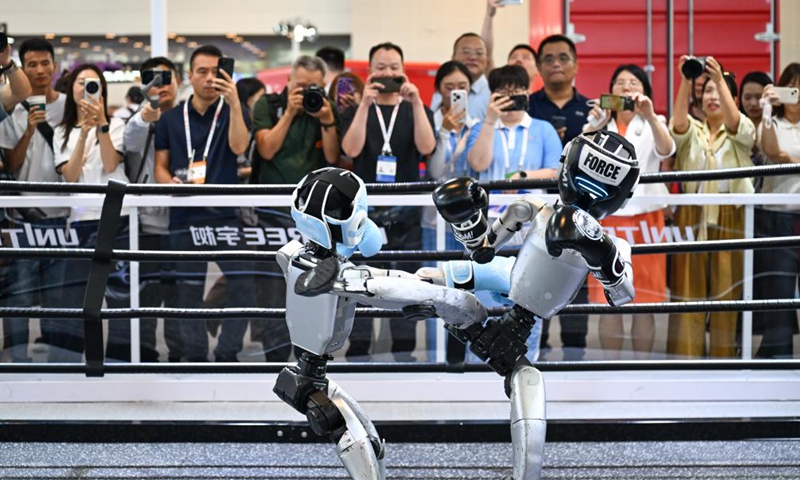
People watch humanoid robots of Unitree Robotics boxing at the World Intelligence Expo 2026 in Tianjin, North China, on May 28, 2026. The expo brings together over 700 exhibitors to showcase cutting-edge technologies, products and application scenarios in the field of artificial intelligence. (Photo: Xinhua)
Chinese robot company Unitree Robotics held an online investor meeting on Friday for its initial public offering (IPO) on the Shanghai Stock Exchange's STAR Market, with Unitree founder Wang Xingxing saying the firm will continue to advance key software and hardware technologies and explore a broader range of product forms and models.
The company is set to become China's first publicly listed humanoid robot maker, representing an important milestone not only for Unitree itself but also for China's booming robotics industry. Greater access to capital will further accelerate technological innovation and promote the high-quality development of the robotics industry, an expert noted.
Speaking at the online investor meeting, Unitree founder Wang Xingxing said the firm will continue to advance key software and hardware technologies, including embodied AI foundation models, scenario-based data collection and analysis, reinforcement learning, embodied robot models, in-house development of core components, and high-performance actuators.
Wang revealed that the company is also actively exploring a broader range of product forms and models, including humanoid robots, quadruped robots and mecha robots, with the aim of enabling robots to take on physically demanding and high-risk tasks, freeing up human creativity and advancing robotics technology for the benefit of society.
Talking about the potential for the robotics industry, Wang said multiple factors are driving market demand, including an aging population, rising labor costs and growing demand for higher productivity and a better quality of life.
Against this backdrop, high-performance general-purpose robots capable of assisting humans with a wide range of tasks are emerging as an important solution to labor shortages and productivity bottlenecks, pointing to vast market potential, Wang noted.
Since its establishment, Unitree has focused on the research, development, production and sales of high-performance general-purpose humanoid robots, quadruped robots, robotic components and embodied AI models.
Reviewing the company's performance, Wang said his company has recorded steady growth in recent years. In 2025, while its net profit excluding non-recurring items grew rapidly, the company also ranked first globally in humanoid robot shipments.
Ahead of the roadshow, Unitree unveiled the pricing of its IPO and the results of its strategic placement. The company announced on Thursday that its IPO on the STAR Market was priced at 150.80 yuan per share.
Unitree will issue about 40.45 million shares, accounting for 10 percent of its total shares after the offering. The IPO is expected to raise about 6.1 billion yuan, exceeding its previously planned fundraising target of 4.2 billion yuan.
Unitree has attracted significant market attention and is expected to become the first humanoid robot company listed on China's A-share market, Liu Dingding, a veteran industry analyst, told the Global Times on Friday, noting that the company's upcoming listing would mark an important milestone not only for the company but also for China's robotics industry, which is accelerating its commercialization and market-oriented development.
More importantly, for Unitree, tapping the capital market will provide stronger support for sustained R&D investment and capacity expansion, Liu said, adding that "greater access to capital could significantly shorten R&D and market validation cycles that might otherwise take three to five years, further enhancing the global competitiveness of China's robotics industry."
The company is well aware that its current achievements are only a starting point, said Wang at Friday's roadshow. The embodied AI industry is still at an early stage of development, similar to the early days of home appliances and personal computers, and further progress will require joint efforts across the industry, he said.
Founded in 2016, Unitree mainly produces humanoid robots and quadruped robots. According to its prospectus, the company shipped more than 5,500 humanoid robots in 2025, ranking first globally. From 2023 to 2025, Unitree sold more than 33,000 quadruped robots, cementing its leading position in the global quadruped robot market.
The rapid growth of China's robotics industry is underpinned by the country's complete industrial chain and production capabilities. China is now home to more than 140 humanoid robot manufacturers, with annual shipments reaching 14,400 units, accounting for 84.7 percent of the global total, CCTV News reported. In other words, roughly eight out of every 10 humanoid robots shipped worldwide come from China.