


SYDNEY, Aug. 15 (Xinhua) -- Researchers in Australia have uncovered a potential source of naturally occurring hydrogen in the state of Western Australia's (WA) vast iron ore deposits, a discovery they say could help unlock a new low-emission energy source.
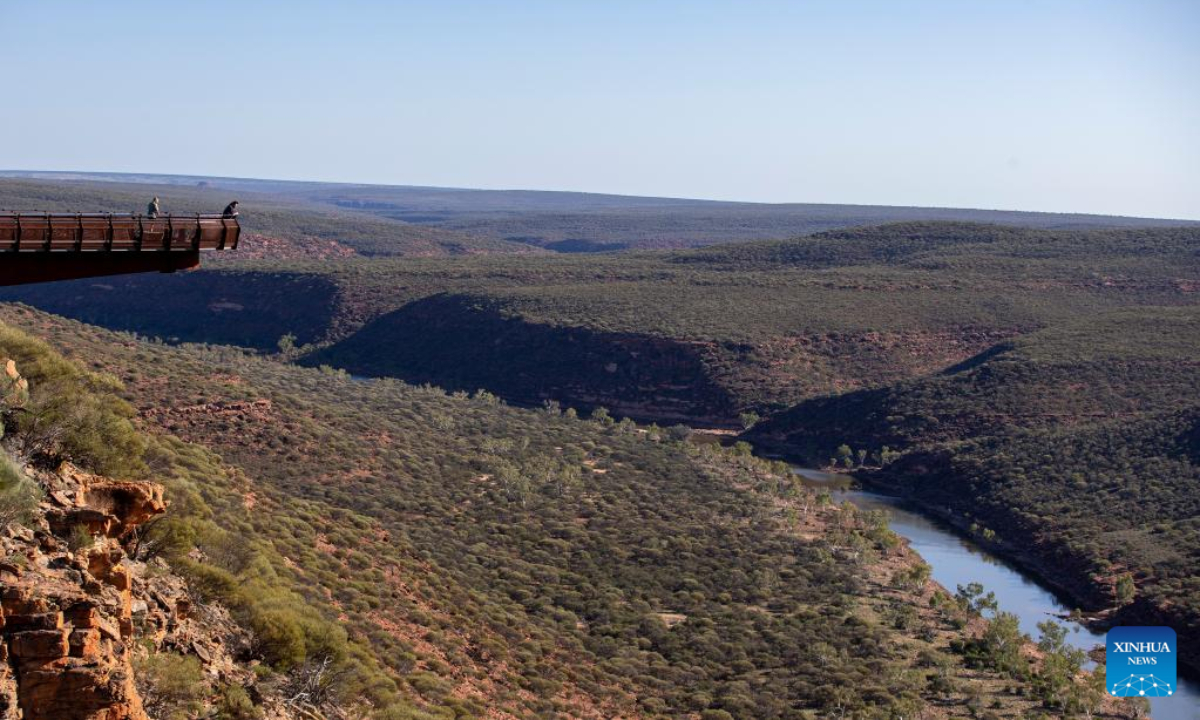
Photo taken on June 14, 2022 shows a view of Kalbarri National Park in Western Australia, Australia. (Photo: Xinhua)
Edith Cowan University (ECU) researchers in WA have found that magnetite, a mineral found beneath the state's red soil, can generate hydrogen gas when it reacts with hot water deep underground, ECU said in a recent statement.
The research provides insights into how natural hydrogen forms underground and the conditions needed to sustain production, the statement said.
Researchers from ECU's School of Engineering found that injecting a solution into banded iron formations could significantly increase hydrogen production, noting that WA has some of the world's largest such formations.
To test the theory, the team exposed magnetite samples to water at temperatures of 200 degrees Celsius and under high pressure for 60 days, replicating the environment deep beneath the Earth's surface.
The study, published in the International Journal of Hydrogen Energy, found that hydrogen production depends not only on the amount of magnetite present, but also on how easily water can access fresh mineral surfaces through fractures, pores and permeable pathways.