


China carries out world's first congenital heart surgery guided by AI-powered ultrasound robot
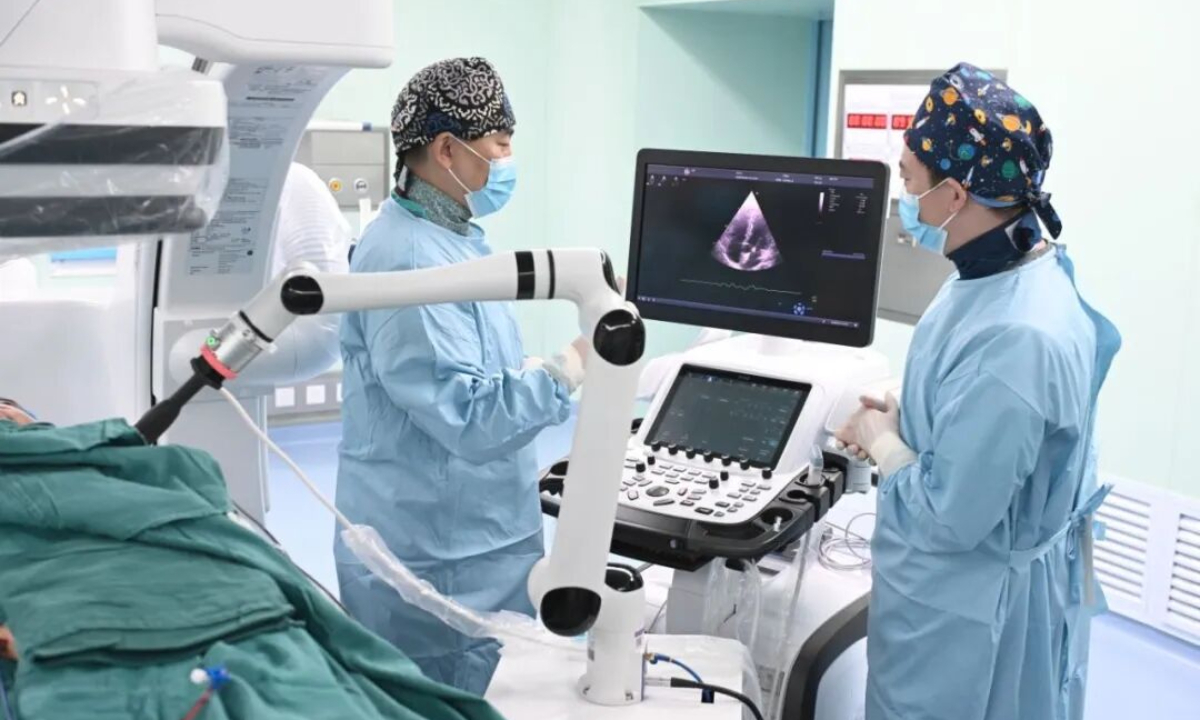
Photo: Sixth Medical Center of Chinese PLA General Hospital
In a world first, a Chinese medical team performed an AI-powered, ultrasound robot-guided transcatheter closure procedure for congenital heart disease on a 48-year-old man on Saturday, according to a novelty search conducted by an authoritative institution.
The surgery was carried out by the Senior Department of Cardiology at the Sixth Medical Center of Chinese PLA General Hospital, marking a breakthrough in the use of intelligent imaging robots in minimally invasive interventions for structural heart disease, according to an official post on the hospital’s WeChat account.
The AI-powered ultrasound robotic system used in the surgery goes beyond conventional interventional robots, which are largely limited to device delivery, by enabling two-way intelligent coordination between image recognition and surgical manipulation.
During the procedure, the robot autonomously carried out image acquisition, lesion localization and real-time navigation throughout the operation, helping the medical team select and accurately deploy the occlude. The system reduced the risks of human error, significantly improved the precision and safety of complex congenital heart disease interventions, streamlined the surgical workflow and shortened the procedure time, providing new technical support for highly complex minimally invasive interventions.
The surgery’s success pioneers a new model of cardiovascular intervention that combines artificial intelligence with medical robotics. The technology substantially reduces reliance on physicians’ experience in ultrasound-guided procedures for complex structural heart disease, while improving the safety and scalability of minimally invasive surgery.
The hospital’s post highlighted the technology’s vast potential. Beyond navigation for routine cardiovascular interventions, it could be deployed for rapid diagnosis of battlefield and trauma injuries, remote robotic surgery and medical support for primary-level healthcare institutions.