


30 robot students enroll at Hangzhou Robot School
The Hangzhou Robot School recently welcomed its first 30 robot students from various sectors, including industry, services and security. Small and medium-sized enterprises alongside government agencies sent the machines to the school.
Jointly established by the Zhejiang University Robotics Institute, the Zhejiang Institute of Quality Sciences and leading industry partners, the Hangzhou Robot School aims to equip robots with vocational, practical skills. After earning professional skill certificates, the robots will enter the workforce, transforming from "tech toys" into "practical tools."
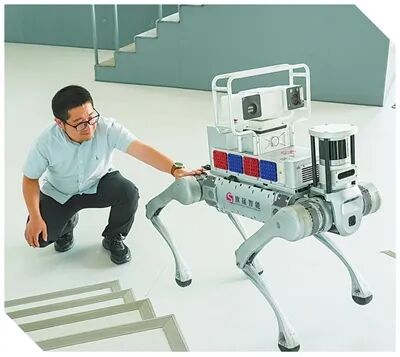
A staff member trains a robot dog at the Hangzhou Robot School in East China's Zhejiang Province. (Photo: Guo Yang)
Before enrollment, every robot must pass a comprehensive check covering hardware performance, functional integrity and algorithm compatibility, Cai Jiandong, vice dean of the Zhejiang University Robotics Institute, said.
Modeled on human vocational education, the school offers four tracks: industrial, healthcare, arts and sports applications. Based on pre-enrollment test results and the actual needs of industrial deployment, the school assigns each robot to a specialized program. The curriculum covers ethics, perception, mobility, aesthetics and practical operations.
Because the school tailors a personalized training plan to every robot, each student has a different schedule. Before graduation, authoritative institutions will assess the robots' competency and issue professional skill certificates. The certification serves as a passport, marking their leap from mere machines to useful products.
Why build a school specifically for robots? Zhu Shiqiang, dean of the Zhejiang University Robotics Institute and the school's founder, answered. Many Chinese startups develop high-quality robots but lack the capacity to train them. Consequently, despite urgent demand across industrial manufacturing, domestic services and medical care, robots still face barriers to large-scale deployment in daily life.
Training robots begins with the "brain." Zhu's team independently developed the WJ-Brain system, which adds logical reasoning to traditional vision-language-action models. The system lets robots better understand unfamiliar situations, plan tasks and make decisions.
"What they gain is not just skill, but the ability to keep learning," Zhu said. More importantly, empowered by the WJ-Brain system and agent integration, the robots can continue learning and refining their capabilities after entering the real world.
(Compiled by intern Heng Shimin and edited by Wang Ruofan)