


Earliest flightless bird discovered in Fujian
Chinese scientists have discovered a remarkably well-preserved, 150-million-year-old bird fossil in Fujian province that challenges the long-held view that early birds evolved mainly to improve their ability to fly. The discovery suggests that early birds explored a wider range of lifestyles and habitats than previously thought, including life on the ground as predators.
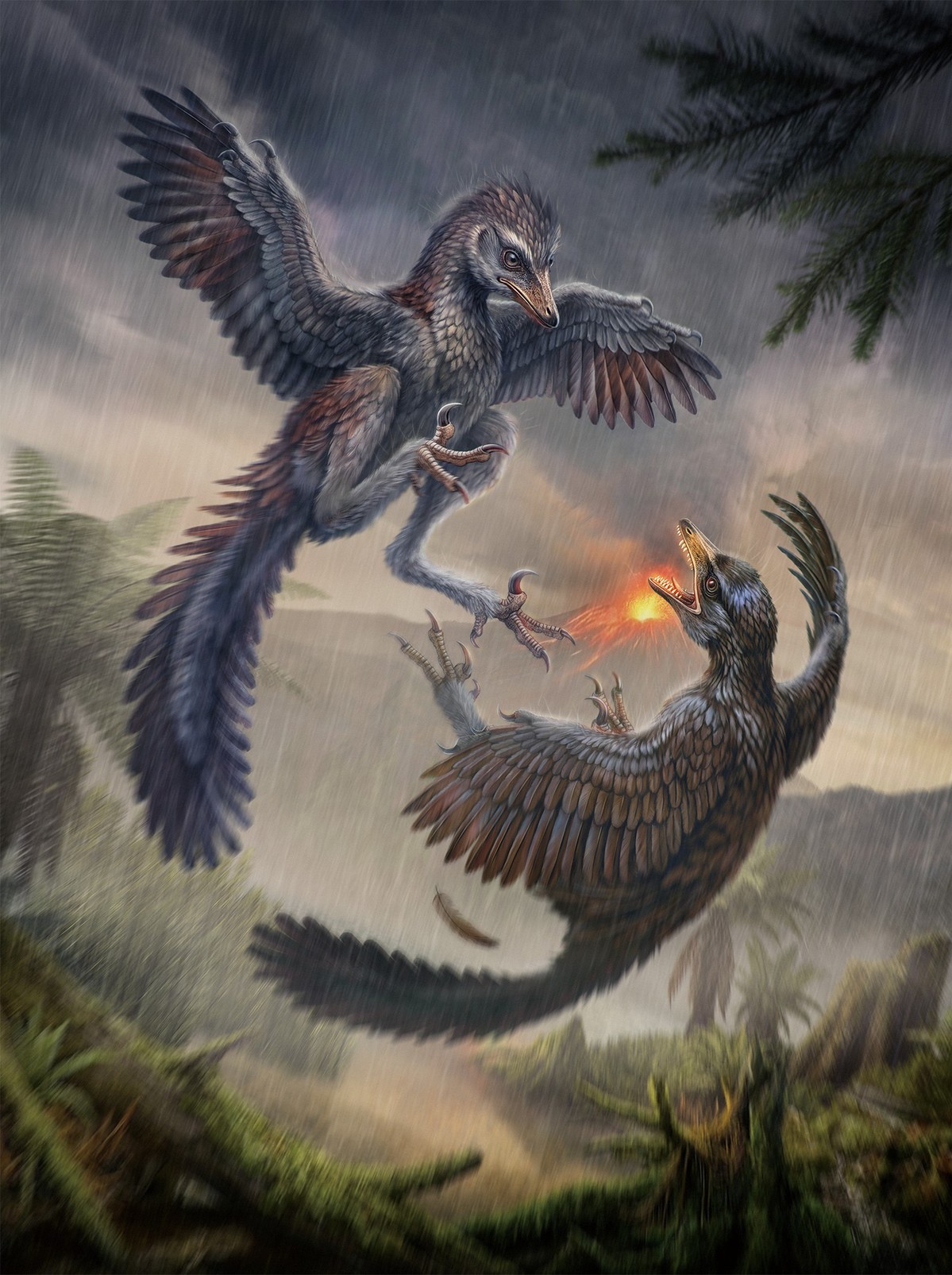
Life reconstruction of the Yuezhuornis yangyuanensis. (Photo: China Daily)
The newly identified species, named Yuezhuornis yangyuanensis, is the earliest known bird in the evolutionary lineage to have lost the ability to fly, according to researchers. About the size of a crow, it lived between 150 million and 148 million years ago, during the Late Jurassic period, a key stage in the transition from dinosaurs to birds.
The study, led by researchers from the Institute of Vertebrate Paleontology and Paleoanthropology of the Chinese Academy of Sciences and the Fujian institute of geological sciences, was published in the journal Nature on Wednesday.
For decades, scientists have generally believed that the evolution of birds was shaped primarily by the demands of flight. However, a lack of fossils from this crucial period has made it difficult to understand how early birds first diversified and adapted to different environments.
To fill this gap, researchers spent more than 440 days conducting field excavations over the past four years. They discovered the fossil in August 2024 at the Zhenghe Fauna site in Nanping, Fujian province. The species' genus name, Yuezhuornis, comes from a mythical bird in ancient Chinese legend, while its species name refers to Yangyuan township, where the fossil site is located.
"When we examined Yuezhuornis, we were struck by its extraordinary mix of features," said Wang Min, the study's corresponding author and a researcher at the IVPP.
Weighing about 821 grams, the bird combined features typical of birds with others inherited from meat-eating dinosaurs, Wang said. Its pelvis and hind limbs resembled those of birds, while its teeth and specialized feet retained characteristics of small predatory dinosaurs.
"It shows us that early bird evolution was far more complicated than we previously realized," Wang said.
One striking feature was its enlarged, sickle-shaped second toe, similar to that of certain predatory dinosaurs. Such a toe was suited to gripping prey and suggested that the animal was capable of running and hunting on the ground. Its forelimbs, however, were unusually short — even shorter than those of some running dinosaurs — making it poorly suited to flight.
Despite this unusual combination of features, several analyses confirmed that Yuezhuornis belonged to the bird lineage, said Zhou Zhonghe, a study author and a member of the CAS who is also a researcher at the institute.
The species is among the most primitive birds known to scientists and is closely related to Zhengheornis, another early bird discovered by the team at the same fossil site in 2024. Zhengheornis had a shortened tail and a small body, according to the researchers.
Together with other fossils from the Zhenghe Fauna, the findings point to considerable diversity among the earliest birds. These include Fujianvenator, an early bird relative with adaptations for running, and Yuezhuornis.
"The discovery of a flightless, running bird in the Late Jurassic challenges the notion that aerodynamic selection was the determining force in structuring early avialan evolution," Zhou said.
Instead, the fossil shows that early birds were already evolving in different directions and adapting to different ecological roles near the beginning of their evolutionary history, he said.