


Charging stations evolving into smart energy hubs
Drivers pulling into a newly upgraded highway service station in Tianjin's Wuqing district can now charge an electric vehicle in the time it takes to grab a quick coffee, tapping into equipment that delivers up to ten times the power of a home charger. But behind the high-voltage plugs lies a far broader overhaul of how China manages peak energy demand along its busiest transit corridors.
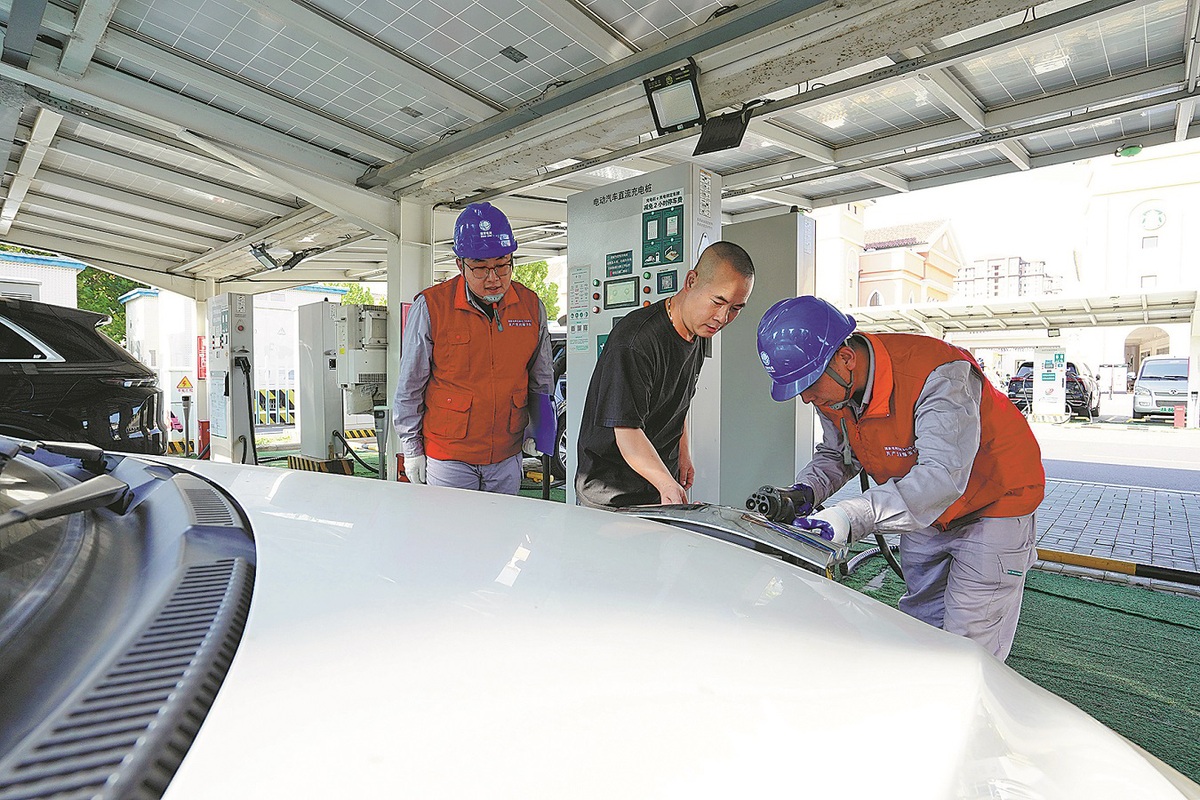
Electrical workers show a driver of a new energy vehicle how to charge his car in Tianjin's Wuqing district. (Photo: China Daily)
Located between Beijing and Tianjin along the heavily traveled Beijing-Shanghai Expressway, the Wuqing demonstration site reflects a structural shift across China's electric vehicle industry. Charging infrastructure is moving beyond simple power delivery to operate as flexible, intelligent hubs capable of managing power distribution, feeding electricity back into the grid, and running entirely on clean energy.
For charging stations, improving the amount of power delivered to each vehicle is only the first step. When many vehicles arrive at once, how limited charging capacity is distributed also affects how quickly the station can serve them.
The Wuqing demonstration station is equipped with three 480-kilowatt flexible charging stacks. Unlike equipment that delivers a fixed amount of power to each charging point, the flexible system adjusts its output according to each vehicle's state of charge, a measure of how much charge remains in the battery. When several vehicles charge simultaneously, the system prioritizes those with lower battery levels, allocating more power to them.
"The direct-current fast chargers can deliver up to 10 times the power of a household charger, allowing vehicles to recharge quickly. Drivers can 'get a full charge while spending a little time shopping,'" said Zhang Haining, a charging infrastructure specialist in the marketing department of State Grid Tianjin's Wuqing branch.
"But high-power chargers alone are not enough," Zhang said. "When several vehicles charge at the same time, power must be allocated according to their different needs. That makes better use of the station's capacity, allows it to serve more vehicles simultaneously and helps ease queues during holidays."
Wangqingtou service area on the Beijing-Shanghai Expressway, near the boundary between Wuqing and Xiqing districts, has undergone several rounds of charging infrastructure upgrades.
In 2015, the service area had four 60-kW DC chargers in each direction and served about 28 vehicle visits per day on average. By 2025, it had upgraded to a 640-kW group charging and control system. The system includes one 400-kW dual-gun DC supercharger and three 240-kW dual-gun DC chargers, enabling each side of the service area to fast-charge eight new energy vehicles simultaneously.
From January through September 2026, the Beijing-bound side handled about 29,400 charging visits, while the Shanghai-bound side recorded about 23,500. The upgrade from 60-kW chargers to a 640-kW system also reflects the changing needs of intercity travel by new energy vehicles.
As the number of new energy vehicles continues to grow, charging infrastructure is taking on a role beyond replenishing vehicle batteries, with increasing attention to interaction between vehicles and the power grid.
In 2023, China's National Development and Reform Commission and other government departments issued guidelines on strengthening the integration of new energy vehicles with the power grid, calling for exploration of applications such as bidirectional charging. In 2024, authorities began soliciting applications for pilot programs to scale up vehicle-grid interaction. The first nine pilot cities and 30 projects were announced in 2025. Tianjin's own implementation plan, issued in 2023, also called for exploring vehicle-to-grid, or V2G, applications and accelerating the development of demonstration charging stations.
At the Wuqing station, the approach is reflected in four bidirectional V2G chargers. In principle, vehicles can draw electricity from the grid and send power back when demand is high. Charging can also be encouraged at night, when electricity demand is lower.
The station is also changing how it meets its own energy needs, alongside its potential role in helping balance the grid.
Seen from outside, solar panels cover the charging canopies and the roof of the station's e-station building, spanning a total of 535 square meters. The system is expected to generate about 98,000 kWh of electricity a year. The roof on the south side of the e-station building uses building-integrated photovoltaic materials, while large windows on the north side bring in natural light, generally eliminating the need for additional indoor lighting during the day.
Solar electricity is used on site first, with surplus power fed back into the grid.
"Solar power is only part of the picture. The station also purchases green electricity generated by solar facilities in other provinces through market-based transactions, ensuring that 100 percent of the station's electricity comes from green sources," Zhang said.
For electric vehicles making frequent trips between Beijing, Tianjin and Hebei province, charging speed, station capacity, power management and energy sources are all becoming important considerations in the development of charging infrastructure.
"People no longer just want a place where they can plug in and charge. During holidays, when many vehicles arrive at once, we need to ensure fast charging while making good use of the station's capacity," Zhang said. "As the number of new energy vehicles grows, ties between charging infrastructure and the power grid will grow stronger. Our work on flexible charging, V2G and green electricity is all aimed in that direction. The next step is to assess the needs of each site and apply the technologies best suited to it."