


Shanghai to expand satellite internet
Shanghai is positioning itself as a globally influential hub for satellite internet innovation, targeting more than 3,000 satellites in orbit and an industry scale exceeding 80 billion yuan ($12 billion) by 2030.
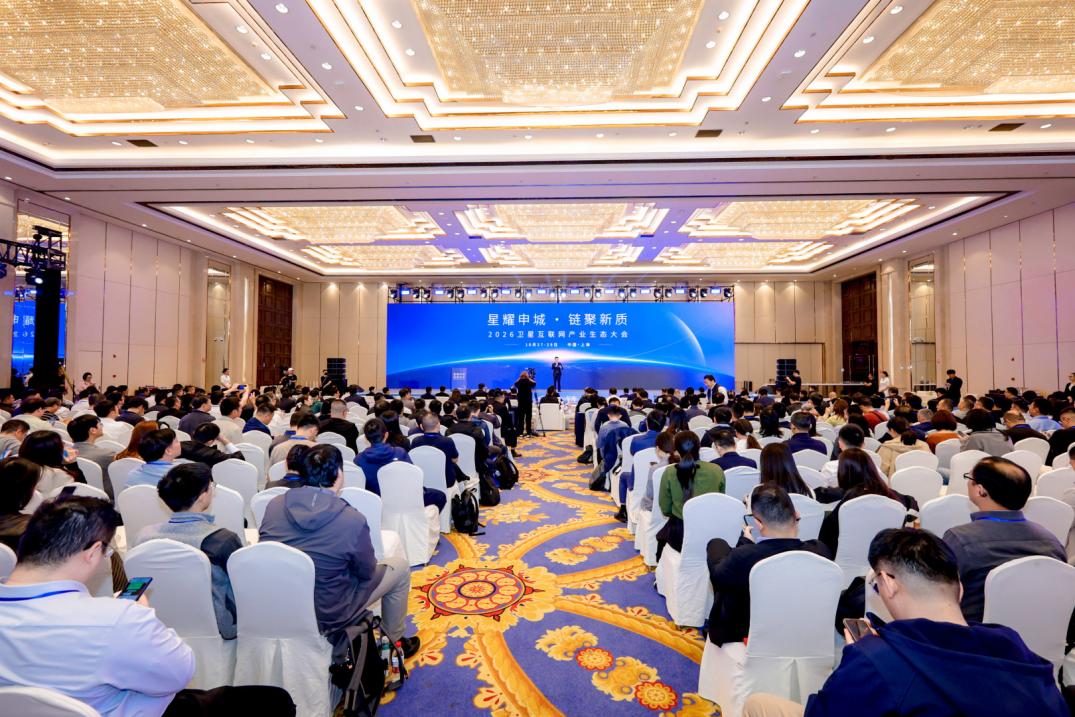
The 2026 satellite internet industry ecosystem conference is held in Shanghai's Songjiang district. (Photo: China Daily)
The Shanghai Municipal Commission of Economy and Informatization unveiled the road map at the 2026 Satellite Internet Industry Ecosystem Conference in Songjiang district on Oct 27.
The officially released and interpreted Shanghai Satellite Internet Industry Innovation and Development Action Plan (2027-2030) outlines four priorities: strengthening technological capabilities, consolidating infrastructure, optimizing industrial clusters and expanding applications. Under the plan, Shanghai aims to commercialize more than 100 research achievements, cultivate over 100 high-quality market entities and establish more than 100 benchmark demonstration projects.
The plan outlines three key initiatives to coordinate the development of space-based networks and ground infrastructure.
First, Shanghai will build a multiorbit constellation system by advancing the deployment of its primary satellite fleet and exploring coordination between medium — and low-Earth orbit networks. By 2030, the city aims to achieve network capacity exceeding 150 terabits per second.
Second, it will upgrade ground-based communications infrastructure by supporting enterprises in deploying gateway stations worldwide and establishing satellite-ground interconnection centers.
Third, Shanghai plans to develop a tracking, telemetry and control system capable of managing 10,000 satellites, as well as a next-generation command center and constellation simulation platform.
"Satellite internet is a vital pillar of future information infrastructure and a core track for cultivating new quality productive forces," said Wang Huajie, Communist Party of China secretary of Songjiang district.
Songjiang has already attracted more than 100 upstream and downstream enterprises in the sector. The district's satellite internet industry reached an industrial scale of 23 billion yuan in 2025, while growth accelerated to 26.2 percent year-on-year in the first eight months of 2026.
Chu Junhao, an academician of the Chinese Academy of Sciences, highlighted the urgency of securing limited near-Earth orbital resources. He outlined a vision of integrated space-ground operations in which information is sensed, data is collected and results are analyzed in orbit before being transmitted to Earth.
"If hazardous features can be detected on-orbit, information can be compressed for easier transmission," Chu said, adding that space-based edge computing could shorten response times for early warnings and emergency relief.
Zhao Houlin, honorary president of the China Institute of Communications, said satellite internet is critical to building integrated space-ground information networks and promoting global digital inclusion.
He called for deeper integration of satellite and terrestrial networks and greater participation by China in international telecommunications governance.
The conference also saw the trial launch of the Shanghai Yangtze River Delta satellite internet industry supply-demand platform, which has aggregated more than 2,000 supply and demand entries and facilitated business connections for over 100 enterprises.
Li Changhao, secretary-general of the Shanghai Yangtze River Delta emerging high-end industry promotion center, said regional industrial development was in full swing, adding that "its maturity may come much faster than we expect".
An accelerator dedicated to the integration of 5G-A intelligent sensing and communications was also established at the conference. In addition, a satellite internet industry fund was launched through cooperation between municipal and district-level investment platforms and private capital.