


As AI moves deeper into scientific research, experts weigh its promise, limits
At Peking University, a research team has succeeded in fabricating 50,000 perovskite solar cell devices under controlled conditions by connecting 11 robotic workstations into an unusual production line.
Throughout automated procedures, an artificial intelligence (AI) model proposes material formulations and process conditions, robots build solar cells, and data flows back into the model to sharpen the next round.
It is one example of how AI is changing scientific research -- moving beyond data analysis to help run experiments and even drive discovery. This shift is drawing growing attention from the global scientific community.
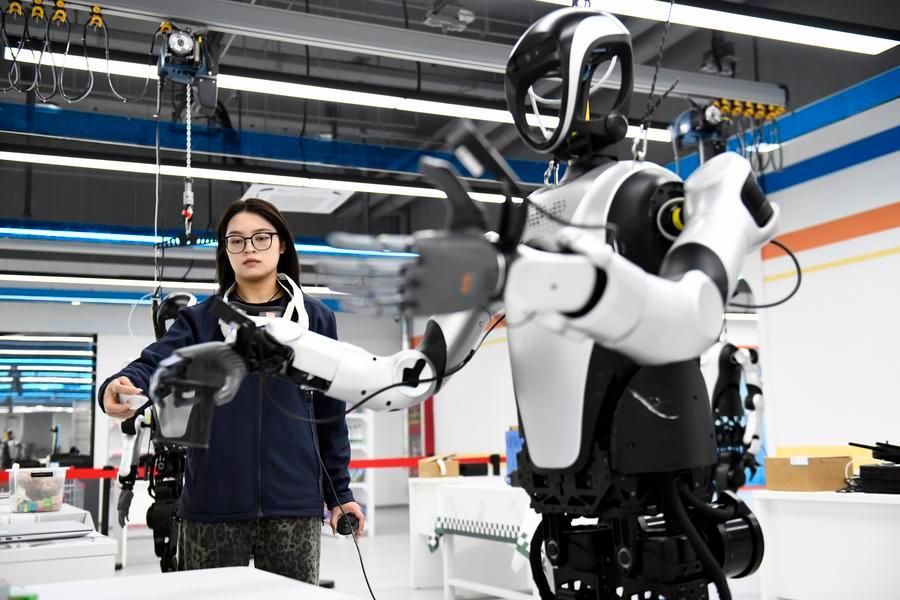
A trainer supervises the training of a humanoid robot in a domestic cleaning scenario at a data training center for embodied AI in Pingyin County, east China's Shandong Province, April 21, 2026. (Photo: Xinhua)
The 2026 World Science and Technology Development Forum, recently held in southwest China's Chongqing Municipality, unveiled its annual list of "Top 10 Science and Technology Foresights," including autonomous research agents for original scientific discovery.
This forum also highlighted AI safety, reflecting both the expectation that AI will expand the frontiers of scientific exploration and a growing focus on how to make AI's participation in research reliable and controllable.
Experts from different countries and disciplines stressed the importance of interdisciplinary collaboration at the forum. Kenneth Grattan, president of the International Measurement Confederation, said tackling shared challenges demands interdisciplinary research by researchers with diverse expertise. AI, he noted, can help researchers integrate knowledge and tools from different fields, bringing previously separate parts of the research process closer together.
Such exploration has already moved into concrete R&D applications in Chongqing. NanoTitan Ultra, a new-materials simulator developed by a team at Shanghai Jiao Tong University's Chongqing Institute of Artificial Intelligence, was released in July.
Powered by AI models, the device can simulate the movement and interaction of atoms in materials, predict how different formulations might perform, and then use AI agents to help screen and optimize candidate designs.
"New material R&D has long been constrained by traditional computing tools, with challenges including low simulation efficiency, long development cycles and high trial-and-error costs," said project lead Zhao Teng.
Work that once required repeated calculations and constant experimentation can now be handed to AI for large-scale simulation, helping researchers more quickly identify directions worth experimental validation, Zhao said.
Similar efforts are taking shape across China. The Shanghai Artificial Intelligence Laboratory, together with the Yazhouwan National Laboratory in south China's Hainan Province and China Agricultural University, has launched GeneScientist, an autonomous scientific discovery system for biological breeding. This system has identified and validated dozens of previously unreported gene functions in staple crops such as rice and maize.
Meanwhile, Beijing University of Chemical Technology has partnered with industry to build an AI-driven autonomous laboratory for electrochemical catalysts, exploring a full workflow that spans AI design, automated experiments, and data feedback and optimization.
Policy support is helping drive the shift. China's State Council issued guidelines in 2025 on implementing the "AI Plus" initiative, calling for advancing the integration of AI with science and technology and accelerating a paradigm shift in scientific research.
The shift is also visible globally. A report on AI for Science innovation, released this year by the Institute of Scientific and Technical Information of China and several other institutions, showed that the number of related papers published globally has more than doubled over the past five years, with fields such as aerospace, quantum technology and materials science growing at an average annual rate of over 30 percent.
But an AI-generated answer does not automatically amount to a scientific discovery. Nils Christian Stenseth, a professor at the University of Oslo in Norway, said human collaboration is crucial to scientific research. Disease specialists, ecologists and epidemiologists need to work together to identify which model and which parameters actually work, rather than leaving such work entirely to AI.
Mo Fanyang, vice dean of the School of AI for Science at Peking University, also noted that at this stage scientists are still needed to pose core scientific questions, set the direction of exploration, and establish mechanisms for human review, verification and risk management.
In scientific exploration, he said, scientific taste, experimental validation and responsible judgment will always remain the core values that only human scientists can uphold. "The relationship between humans and AI should be one of mutual fulfillment," he said.