


Nobel laureate Omar Yaghi urges students to look beyond paper-chasing, says China can lead world science
At least five years before Omar M. Yaghi won the Nobel Prize in Chemistry, one of his students, Han Xing, had already predicted that his mentor would one day receive the honor.
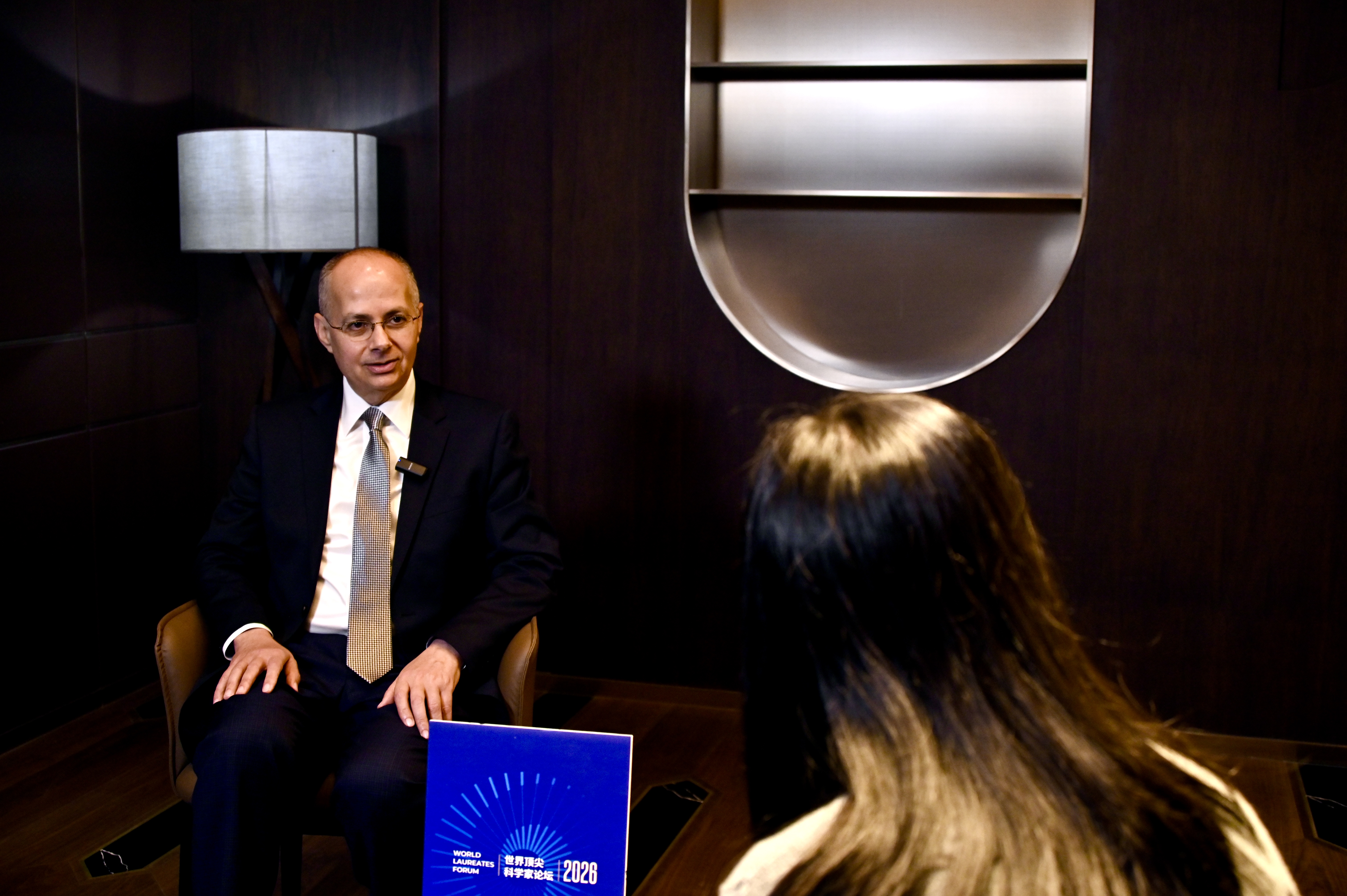
Omar Yaghi is interviewed by the People's Daily. (Photo: Qu Wangye)
Han, now an associate professor at Shanghai Jiao Tong University, had good reason to believe in him.
Three years, two years
Han once worked in Yaghi's laboratory on covalent organic frameworks linked by carbon-carbon bonds, a material notoriously difficult to crystallize.
For the first three years, experiments failed to produce the expected results. Han repeatedly adjusted the conditions, filling notebook after notebook with experimental records. It was not until his 2,840th set of experimental conditions that he finally saw a glimmer of hope.
With his publication record and career prospects at stake, Han even began to worry about whether he could remain in the laboratory. Yaghi, however, told him that if he wanted to continue, he should keep going and that, as his supervisor, he would give him his full support.
Han and his team eventually succeeded in synthesizing the elusive framework crystals, overcoming a major obstacle in their research.
His faith in Yaghi had not been misplaced. Years before the Nobel announcement, Han had already believed his mentor's work could earn him the world's highest scientific honor.
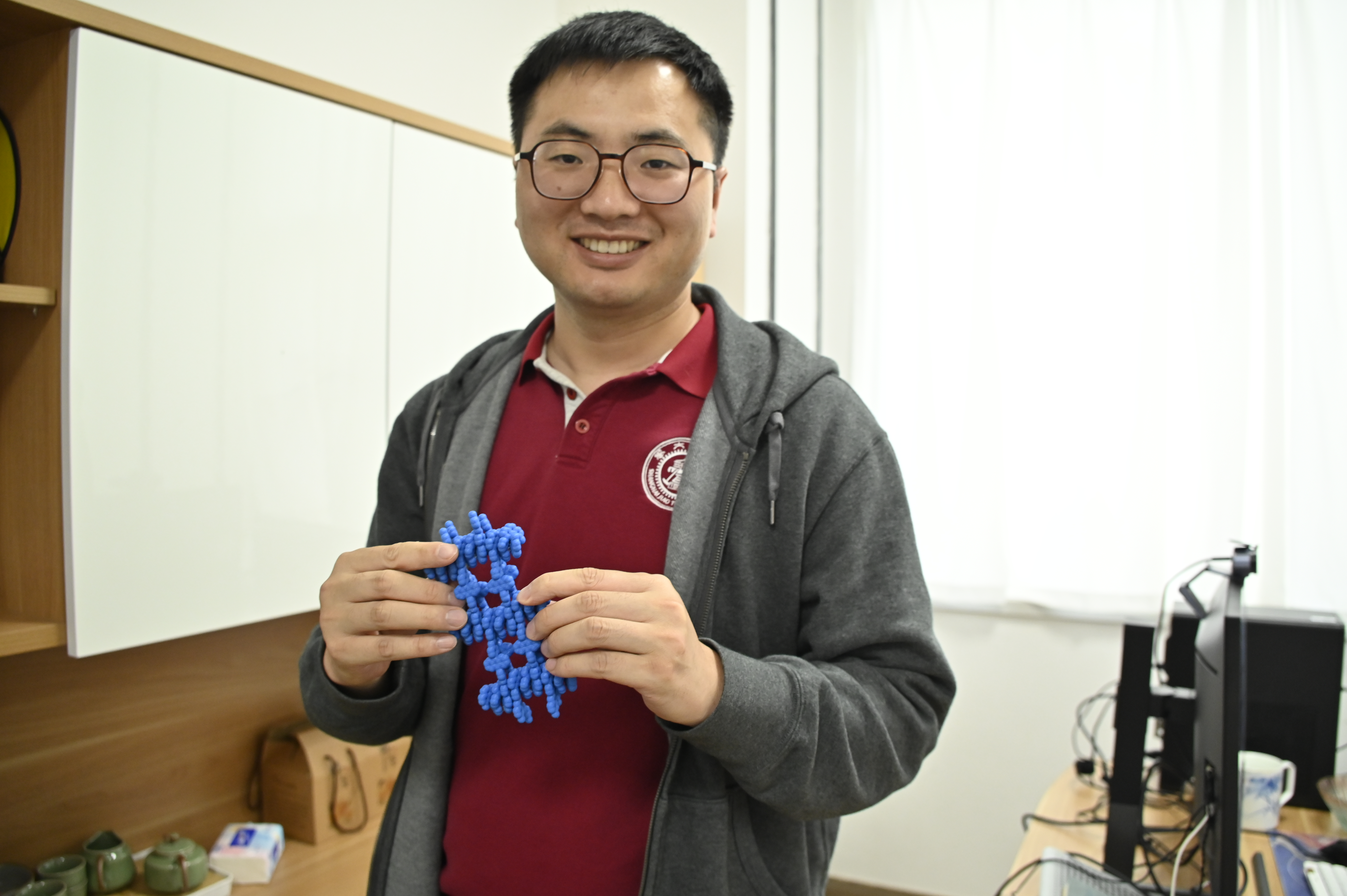
Han Xing receives a 3D-printed molecular model from supervisor Omar Yaghi. (Photo: Qu Wangye)
Yaghi's encouragement of Han contrasts with the advice he gave another student, Zhou Zihui, now an assistant professor at Tsinghua University.
In 2021, shortly after joining Yaghi's laboratory at the University of California, Berkeley, Zhou came up with what he thought was a brilliant research idea. Excited by the prospect, he presented it to Yaghi.
Yaghi scratched his head, pulled out several published papers and suggested that Zhou pursue a different direction.
"But no one has ever done this before!" Zhou countered.
Two years later, a study based on a very similar idea appeared in a prestigious journal. Zhou brought the paper to Yaghi, complaining that it could have been theirs if he had been allowed to pursue the project.
Yaghi saw it differently.
"You were right not to do it. Look at the journal it was published in. If you had worked on this, you would have wasted two years!" he told Zhou.
Yaghi believed Zhou was capable of pursuing questions that could lead to more significant discoveries. Simply extending existing research, even if it produced a respectable paper, was not necessarily a worthwhile use of a young scientist's time.
A new chapter
As a child growing up in Jordan, Yaghi once came across a picture of a molecule in an abandoned library. The image fascinated him, opening up a world he had never imagined.
Born into a Palestinian refugee family in Jordan, Yaghi left home alone at 15 to study in the United States. Decades later, his research has led to the development of intricate molecular structures that enable materials to capture water from the air and absorb carbon dioxide.
The past year has marked a major turning point in Yaghi's career. In 2025, he won the Nobel Prize in Chemistry for his pioneering work on metal-organic frameworks. In July 2026, he joined Tsinghua University full-time, beginning a new chapter in his research.
Yet his path to scientific discovery has not always been smooth. At one point, his research made little progress for an entire year. He began to question whether he was smart enough or even suited to being a chemist.
The experience taught him about the unpredictable nature of scientific discovery. The breakthroughs that eventually emerged from his continued efforts proved more valuable than what he had initially set out to achieve.
"The beauty of science is that you may be in despair over here, feel like a complete failure like I felt. You work hard and then you make something better than you expected. You make a discovery that changes everything," Yaghi said.
At the 2026 World Laureates Forum in Shanghai, he presented his latest work on applying artificial intelligence to materials research. Yet the technology itself is only part of a much bigger question that continues to fascinate him: With seemingly limitless possibilities, how do scientists decide what is truly worth pursuing, and what might be worth devoting their lives to?
Away from the laboratory, Yaghi reveals a more playful side. After last year's Nobel Prize ceremonies, he returned from Sweden with a large bag of gold-colored Nobel chocolates and shared them with his students.
He also keeps in touch with former students long after they graduate. When riding in a car, he sometimes takes out his phone to show photos of their children. On one occasion, a former student brought a child to meet him and taught the youngster to call him "Grandpa Yaghi." He jokingly protested: "I'm so young. How did I become a grandpa?"
Reimagining universities
Even Nobel laureates are turning to AI for help with their academic work.
At an international academic conference, Yaghi noticed that the title of a presentation by his former doctoral student Li Qiaowei, now a professor at Fudan University, could be improved. He turned to AI for suggestions and shared them with Li.
The anecdote points to a broader question about the changing relationship between human intelligence and artificial intelligence. If AI were to carry out most of the work behind a Nobel Prize-worthy discovery, leaving humans only to make the final selection, who should receive the prize?
"LLMs need a smart mind behind them to do smart things," Yaghi said. AI can generate new ideas, but researchers still need the judgment to ask meaningful questions and evaluate the answers.
He is nevertheless impressed by what AI can accomplish. When searching for suitable conditions to crystallize materials, for example, AI can explore combinations that would be difficult for human researchers to test exhaustively.
Yaghi has also been developing a concept he calls "Selection Science," which seeks to bring experimental evidence, scientific predictions and human decision-making together in a more systematic way, helping researchers identify the most promising directions to pursue.
The implications extend beyond the laboratory to higher education itself.
Li recalls that Yaghi once joked, "If Google could also award degrees, universities might have to close down."
With AI making knowledge more accessible than ever, the remark is beginning to sound less like a joke. What, then, should universities offer that students cannot easily obtain elsewhere?
"The university model is in trouble," Yaghi said. "When the students are learning more and faster and better outside universities than in the university, then you have to reimagine what the university should be."
Rather than simply transmitting information, universities need to help students develop the ability to assess it critically. "What is information? What is misinformation? What is fake news?" Yaghi asked.
For the next generation, he believes, distinguishing reliable information from false or misleading claims will be essential. In science, observations cannot be accepted as facts without rigorous and repeated verification.
China needs prestige
Yaghi has a particular appreciation for the contributions of Chinese researchers to his work.
"Look at some of my most important papers. The first authors were all Chinese students," he said.
He admires their strong academic foundations, willingness to engage directly in experiments and readiness to explore new ideas. He goes further, saying he believes the world's best students are in China.
Omar Yaghi is surrounded by students at 2026 World Laureates Forum at Shanghai. (Photo: Wu Jing)
But what does China need most to produce more groundbreaking scientific discoveries?
After a moment's thought, Yaghi offered a one-word answer: "Prestige."
"I think China has done an amazing job at educating researchers how to be great scientists. China has developed capacity very well and miraculously fast," he said.
In his view, China's next step is to open up entirely new fields that attract the attention and efforts of researchers worldwide.
He finds it encouraging that some Chinese institutions are increasing support for basic research without clearly defined practical applications. He hopes such support will continue to expand.
More importantly, he wants to see Chinese scholars ask questions that have never been asked before and develop new research methods that inspire scientists around the world to follow their lead.
Such ambitions, however, cannot be achieved in isolation. Scientific breakthroughs depend on the free exchange of ideas across borders. At a time when international research cooperation faces growing complexities, Yaghi sees science as one of the few common languages capable of bringing people together regardless of their national backgrounds.
"We need to preserve that," he said, emphasizing the importance of maintaining the international mobility of scientists and giving younger generations opportunities to study and exchange ideas in different countries.
"I don't see any cultural or conceptual or intellectual problem preventing China from building the prestige and having the creativity on a large scale that would be needed," he said.