


China unveils 34 new flagship enterprises to accelerate AI-driven transformation
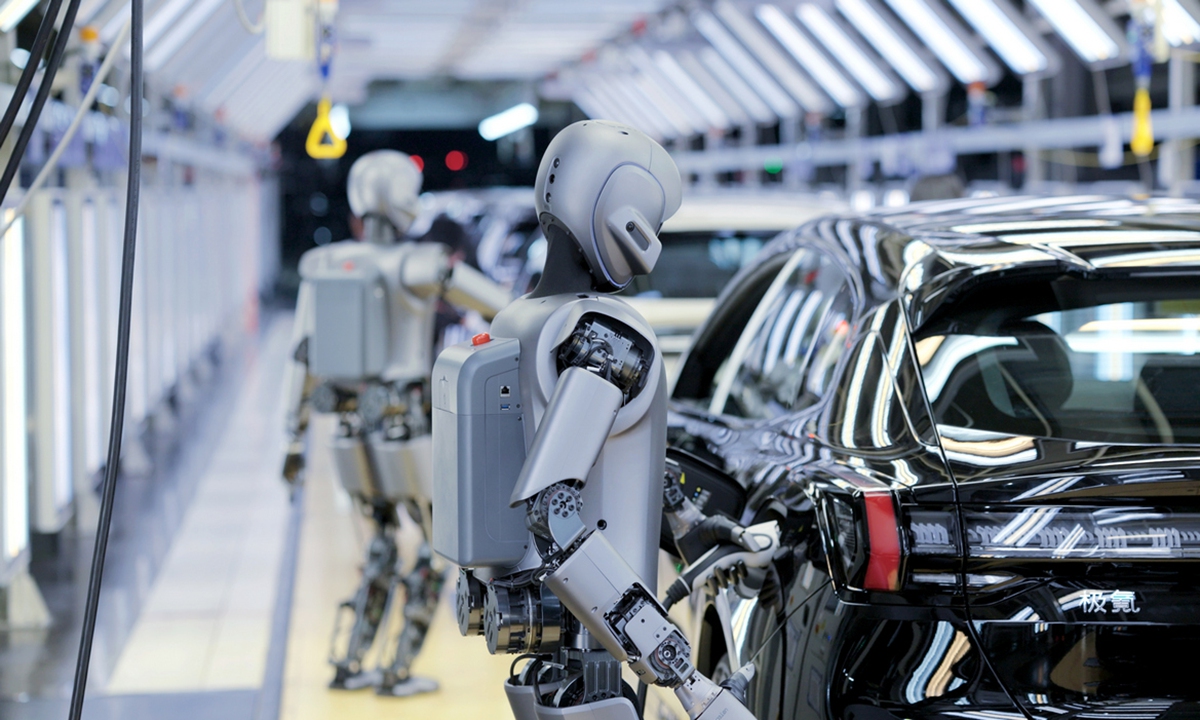
Dozens of UBTECH industrial humanoid robots carry out training tasks at a smart factory in the Qianwan New Area in Ningbo, East China's Zhejiang Province, on March 1, 2025. (Photo: VCG)
China's Ministry of Industry and Information Technology (MIIT) and five other departments released the 2026 flagship smart factory cultivation list, which includes major manufacturers such as Xiaomi Auto, FAW-Volkswagen and Hudong-Zhonghua Shipbuilding. Pharmaceutical and apparel manufacturers were also selected for the first time, highlighting the initiative's widening industry coverage.
As the second batch of flagship smart factories, they have reported an average 34.4 percent increase in labor productivity and a 19.3 percent rise in production efficiency, while helping nearly 4,000 enterprises carry out digital and intelligent transformation in coordination, according to CCTV News.
Notably, industry coverage has further expanded compared with the previous batch. Beyond equipment manufacturing, steel, electronic information and other fields, whilel pharmaceutical and apparel enterprises in the consumer goods sector were included for the first time, according to the list released by the MIIT.
The list includes smart factory projects from leading Chinese manufacturers across the automotive, power equipment and shipbuilding sectors, including Xiaomi Auto, FAW-Volkswagen, Harbin Electric Machinery and Hudong-Zhonghua Shipbuilding, according to the official list.
The notice issued by the six departments calls for supporting flagship smart factories in building high-quality industrial datasets, developing industrial AI agents, exploring advanced manufacturing models and establishing smart supply chains. The requirements highlight a broader shift in smart factory development, from equipment automation toward deeper integration of artificial intelligence, industrial data and supply chain coordination.
Following the MIIT's announcement of 15 candidate factories on November 24, 2025, the latest batch brings the total number of factories included in China's flagship smart factory cultivation program to 49.
China has been accelerating the development of smart manufacturing nationwide. By the end of June 2026, the country had built more than 56,000 basic-level, 9,000 advanced-level and 500 excellence-level smart factories, Xinhua News Agency reported on October 19, highlighting the expanding scale of its manufacturing digitalization drive
The latest move comes as China steps up efforts to integrate AI into industrial production. Under an action plan released in January, the country aims to develop 1,000 high-level industrial AI agents and 100 high-quality industrial datasets by 2027, while promoting AI applications across manufacturing. The expansion of flagship smart factories is expected to help turn technological advances into practical industrial applications and extend productivity gains across supply chains.