


In the first quarter of this year, China's shipbuilding completions, new orders and orders on hand expanded by 34.7 percent, 59 percent and 34.5 percent respectively, year on year, accounting for 53.8 percent, 69.6 percent, and 56.7 percent, respectively, of the world's total in terms of deadweight tons. Since the beginning of this year, China's shipbuilding industry has been operating at total capacity as the country's shipbuilding companies have secured sufficient orders, keeping coastal shipyards busy with production. Notably, new orders received by China represented approximately 70 percent of the world's total, highlighting the competitive advantages of China's shipbuilding industry.
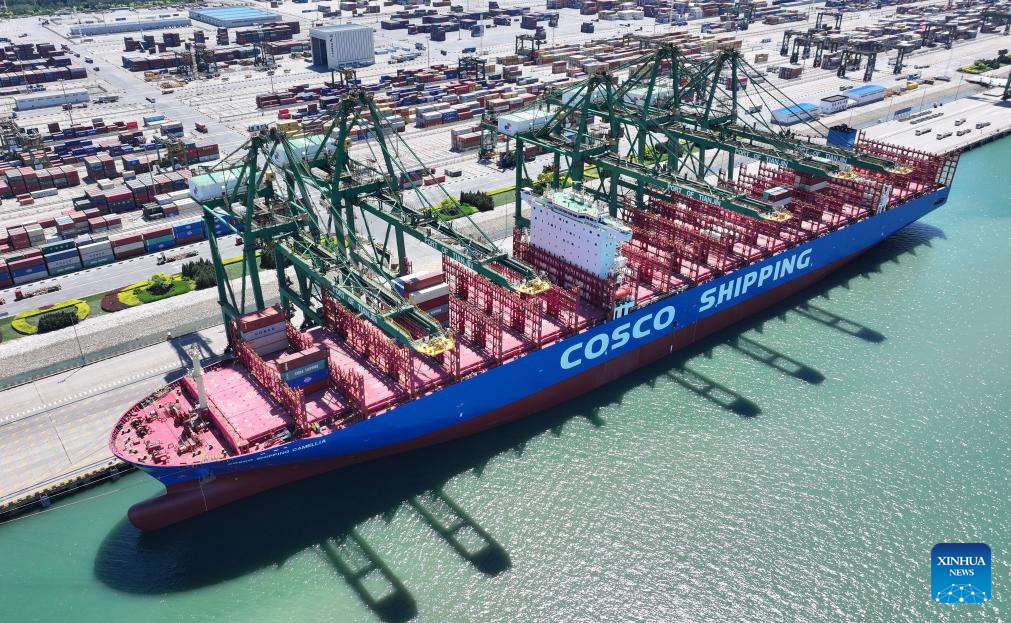
An aerial drone photo taken on May 15, 2024 shows the container ship COSCO Shipping Camellia berthed at the Pacific International Container Terminal of Tianjin Port in north China's Tianjin. (Photo: Xinhua)
The first advantage that China enjoys in shipbuilding is that the country has well-rounded development in this field.
From 20 of the world's largest 24,000 TEU (twenty-foot equivalent units) ultra-large container ships to four large 174,000 cubic meter LNG carriers, including the world's largest shallow water channel 80,000 cubic meter LNG carrier, and a group of high-end marine engineering equipment such as deep-sea large-scale wind power installation ships and floating production storage and offloading oil vessels, China has delivered a large number of giant "Made in China" ships of different categories, models and functions to customers in 2023. These deliveries demonstrate the robust capabilities of Chinese shipbuilding enterprises.
China's first domestically-built large-scale cruise ship, the "Adora Magic City," was delivered in November 2023. The giant cruise ship officially made its commercial maiden voyage on January 1, 2024, marking China's development of a full-spectrum construction capability of final assembly for marine products.
China's shipbuilding industry has significantly enhanced its innovation capabilities and accelerated industrial transformation and upgrading in recent years. These efforts have resulted in multiple breakthroughs in constructing ultra-large container ships, large LNG carriers, high-end offshore engineering equipment and core supporting equipment for ships. Li Yanqing, the secretary-general of the China Association of the National Shipbuilding Industry, has noted that China's research, development and design capabilities in shipbuilding have improved significantly, enabling the country to build all types of major vessels worldwide.
Numbers speak louder than anything: Among all the eighteen major ship types in the world, China's new contracts of fourteen vessel types ranked first worldwide in 2023.
China's emphasis on improving efficiency has been instrumental in its shipbuilding advantages.
From significant shipbuilding enterprises' fundamental realization of using 3D models throughout the design and construction process to the more mature solutions for ship intelligent workshops, China's shipbuilding industry has taken solid transformational steps in intelligent shipbuilding in recent years.
Taking two Chinese shipbuilding companies as examples, we can see how the adoption of digital shipbuilding technology and the advantages of China's complete industrial chain have contributed to their success and efficiency. One such example is Jiangnan Shipyard Group, which used to take an average of 28 months to build a large container ship with a capacity of 20,000 (twenty-foot equivalent unit) TEU. However, with the implementation of digital shipbuilding technology, the construction time has been significantly reduced to an average of 16 months. This technology has helped streamline the design cycle and improve construction efficiency, allowing for faster vessel delivery.
Another example is the Dalian Shipbuilding Industry Company, which now takes 180 days to build a Very Large Crude Carrier, or VLCC, a large tanker ship specially designed to transport crude oil. This impressive performance puts them ahead of their overseas rivals. If we divide the load capacity by the number of workers, the per capita tonnage is between 18 and 20 tons, which is about 20% higher than five years ago. Higher efficiency plus lower costs have enabled Chinese shipbuilding companies to deliver high-quality vessels quickly, and these advancements have solidified China's position as a leading player in the global shipbuilding industry.
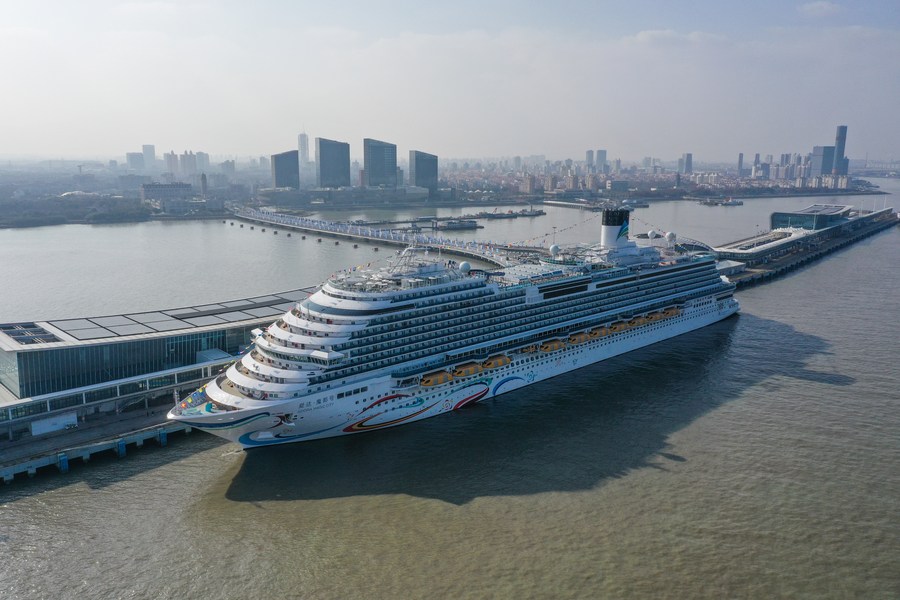
This aerial photo taken on Jan. 1, 2024 shows the large cruise ship Adora Magic City at the Shanghai Wusongkou International Cruise Terminal in east China's Shanghai. (Photo: Xinhua)
China's complete industrial chain also plays a significant role in enhancing its shipbuilding advantages.
Shipbuilding is a massive system project involving numerous parts and components that relies on a complete supply chain and features high industrial correlation. China's complete industrial system, world-leading industrial chain supporting capabilities and manufacturing scale have consistently ranked first globally for many years, providing vital support and instilling sufficient confidence in the equipment manufacturing industry, including shipbuilding.
A higher application rate of domestic ship-supporting equipment and an increasing ability to develop high-end steel for ship use have led to constant improvements in the resilience and safety levels of the shipbuilding industrial chain. The typical progress of the shipbuilding and supporting industries will further enhance these established advantages.
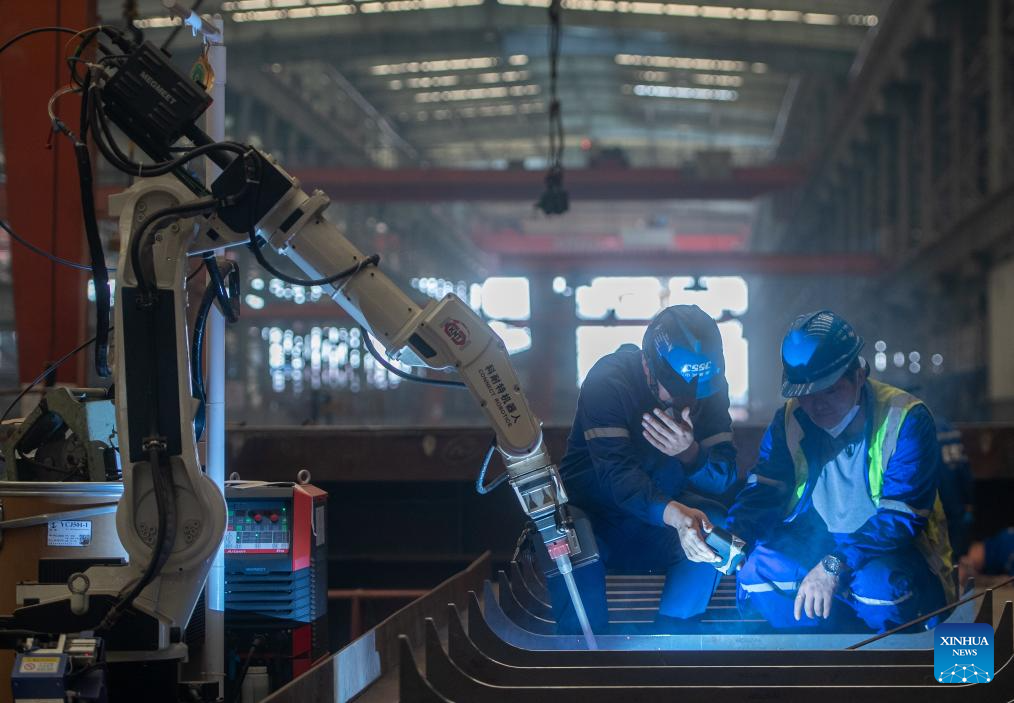
Staff members check the work of a welding robot at a plant of Wuchang Shipbuilding Industry Group Co., Ltd. in Wuhan, central China's Hubei Province, May 16, 2024. (Photo: Xinhua)
The global shipbuilding industry, which once faced sluggish growth, has been on an upward trajectory since 2020. Chinese shipbuilding companies have capitalized on their advantages, explored the global market and secured numerous orders. The holding orders of China's shipbuilding industry have reached a new high since 2014.
China and Qatar reached the world's biggest shipbuilding deal in April. The agreement, signed between the China State Shipbuilding Corporation and QatarEnergy, includes an order for 18 of the world's largest liquefied natural gas (LNG) carriers, each with a capacity of 271,000 cubic meters. This mega deal exemplifies China's growing international influence in ultra-large LNG ship construction.
It is expected that by further consolidating its advantages and accelerating the development of new quality productive forces, the Chinese shipbuilding industry will continue to provide new impetus for the development of the global shipbuilding industry and make significant contributions to the world economy and human welfare.
(Translated by Lu Dong and Li Zhuoman; Edited by Han Xiaomeng)