


On March 18, 2026, President Xi Jinping met with National Leader of the Turkmen People and Chairman of the Halk Maslahaty of Turkmenistan Gurbanguly Berdimuhamedov, who was on a visit to China.
Noting that this year is the Year of the Horse in the Chinese calendar and is also being observed in Turkmenistan under the motto "Independent Neutral Turkmenistan ‒ the Homeland of Purposeful Winged Horses," Xi said he is ready to work with Berdimuhamedov to "advance China-Turkmenistan relations like the Akhal-Teke horse, moving forward without a pause and taking the lead."
Akhal-Teke is nicknamed "blood-sweating horse" in China as it is said the horse sweats a red, blood-like liquid as it gallops, a sign of its extreme vitality.
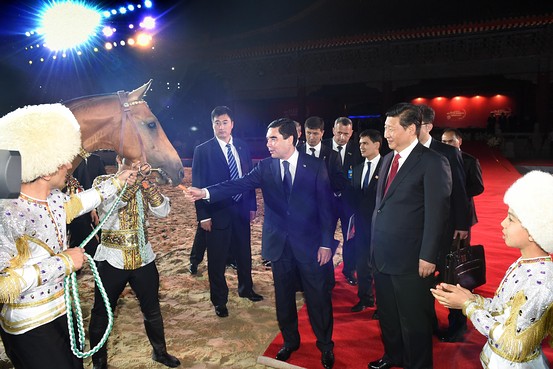
President Xi Jinping (2nd R, front) receives an Akhal-Teke horse presented by his Turkmenistan counterpart Gurbanguly Berdimuhamedov during the opening ceremony of the International Akhal-Teke Horses Association Special Conference and China Horse Culture Festival in Beijing, May 12, 2014. (Photo: Xinhua)
On May 12, 2014, also the Year of the Horse, Xi received an Akhal-Teke horse presented by Berdimuhamedov, then Turkmen president, during the opening ceremony of the International Akhal-Teke Horse Association Special Conference and China Horse Culture Festival in Beijing.
Xi said that as a world-renowned fine breed, the Akhal-Teke horse is the pride and glory of the Turkmen nation. The Chinese people love the Akhal-Teke horse and hail it as a "heavenly horse," he said.
Since the establishment of the diplomatic relationship between China and Turkmenistan, Turkmenistan has presented the Akhal-Teke horse twice as a state gift to China, which has strengthened the affection between the two peoples, Xi said at the ceremony, adding that the horse has become a messenger of China-Turkmenistan friendship and a witness to the ever-lasting friendship between the two peoples.
(Compiled by Huang Jingjing, Li Zhuoman and intern Liu Yunyun)