


Poster: Chu Chu
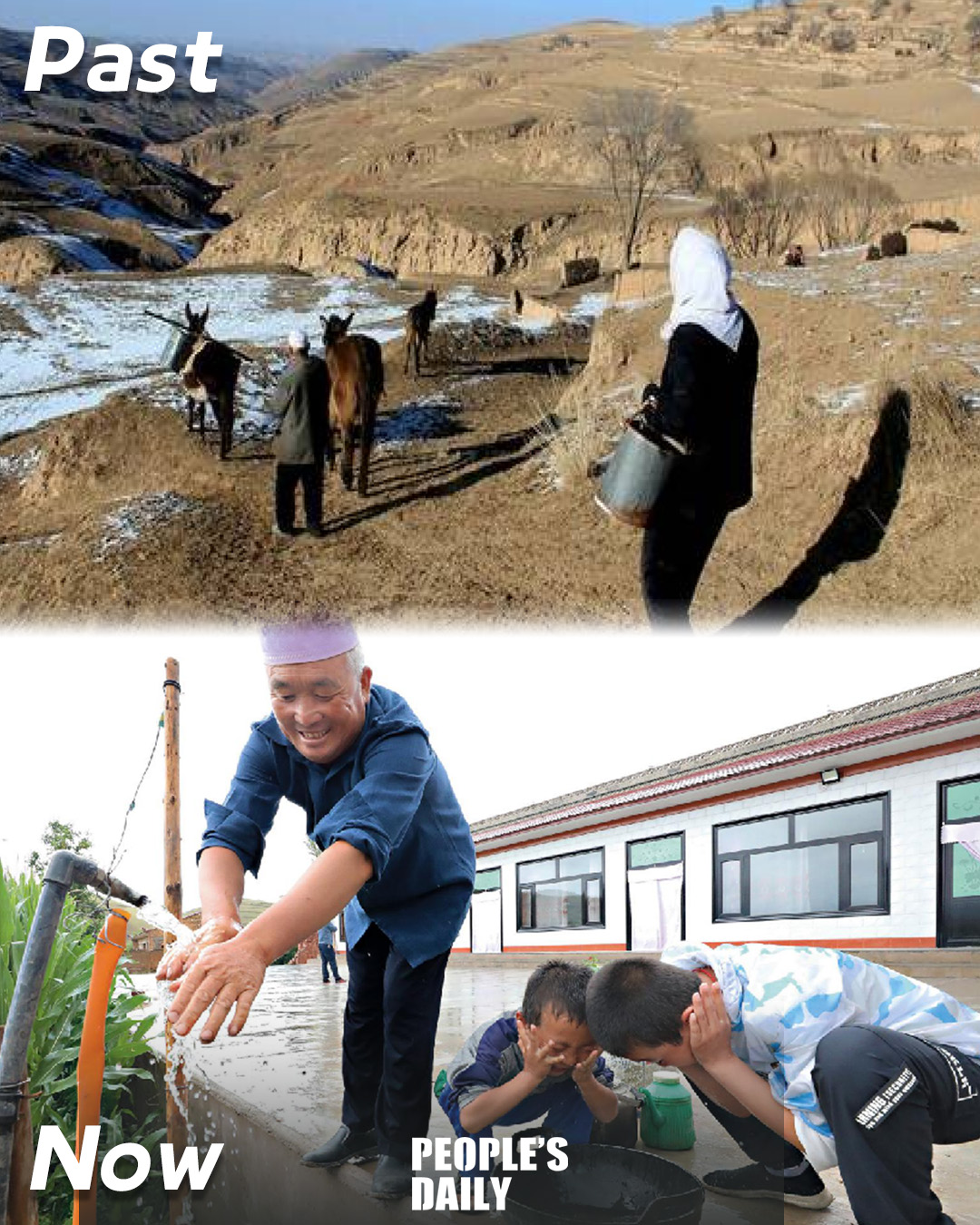
In Xihaigu, Ningxia Hui Autonomous Region, water scarcity was once a major obstacle to survival and development.
In 1997, Xi Jinping, then deputy secretary of the Communist Party of China Fujian Provincial Committee, visited Ningxia as part of the Fujian-Ningxia pairing-up assistance program.
When visiting Jianxin village that year, Xi met villager Ding Guizhi. He learned that her family had no access to clean drinking water, relying instead on bitter, brackish water drawn from an underground cellar. To welcome her guests from Fujian, Ding quietly stirred a spoonful of sugar into a bowl of water, hoping to make it more palatable.
That bowl of bitter water was a microcosm of Xihaigu's harsh reality. The region receives an average of just 300 millimeters of rainfall each year, while annual evaporation exceeds 2,000 millimeters. Xi later recalled: "I had seen and lived in poor places, but seeing that places like this still existed in China in the 1990s came as a great shock."
During that inspection, Xi saw local villagers drawing water from small round wells for irrigation. He said: "The water shortage must be solved. We must adapt to local conditions and make full and effective use of rainwater, surface water and groundwater."
Well and water cellar projects soon became a key part of the Fujian-Ningxia pairing-up assistance program. Over the next three decades, nearly 20,000 wells and cellars were built across Xihaigu, securing reliable drinking water for 300,000 residents.
Today, clean tap water flows directly into Jianxin village. Ding can simply turn on the tap for clean drinking water. Her family now raises more than a dozen cattle, and seven of her grandchildren have gone to university.
When in charge of Fujian's effort to assist Ningxia, Xi proposed a resettlement program under which entire village communities in poorer areas such as Xihaigu would be relocated to more fertile land near the Yellow River.
In 2016, Xi visited Yuanlong village in Minning township, a resettlement community established under the Fujian-Ningxia pairing-up assistance program. He asked Xie Xingchang, then the village Party secretary, how life was going. "Very well indeed!" Xie replied.
Xie recalled that when villagers first relocated to the area in 1997, it was nothing more than a barren stretch of the Gobi Desert. Families lived in dugout shelters and faced severe water shortages. A single bowl of water had to be reused several times. It was used first for washing vegetables, then washing up once the sediment settled before being given to the sheep to drink.
Later, a major Yellow River pumping project lifted water nearly 300 meters, bringing it directly to local households. When the river water first flowed through the canals, many elderly villagers crouched by the banks and wept. For generations, having access to Yellow River water had seemed like an impossible dream.
The water brought the once-barren land to life. Minning has since transformed from a resettlement village of just a few thousand people into a thriving town of more than 60,000 people. Reflecting on these changes, Xie said: "The villagers will never forget the Party's care."
In 2020, Xi visited Hongde village, stopping by the home of Liu Kerui, whose family had successfully risen out of poverty. Xi personally turned on the kitchen tap to see whether the water was running. His concerns were practical: Were the cattle healthy? Were local industries thriving? Did every family have access to clean water?
The tap represented a broader shift in Xihaigu from simply supplying water to managing it efficiently.
Starting in 2016, Ningxia began modernizing its rural water infrastructure with smart digital technology. Automatic monitoring and remote-control systems were installed across water plants, pumping stations, reservoirs and household meters. Villagers can now report faults and pay their water bills using their smartphones, drastically reducing network leaks and water loss.
In 2023, Xihaigu's water management model was presented at the UN General Assembly. Today, this pioneering system, first developed in Ningxia, has benefited more than 62 million rural residents nationwide.
(Translated by Sun Tianren, Wang Xiangyu, Cui Yuxuan and Wang Yijia)