


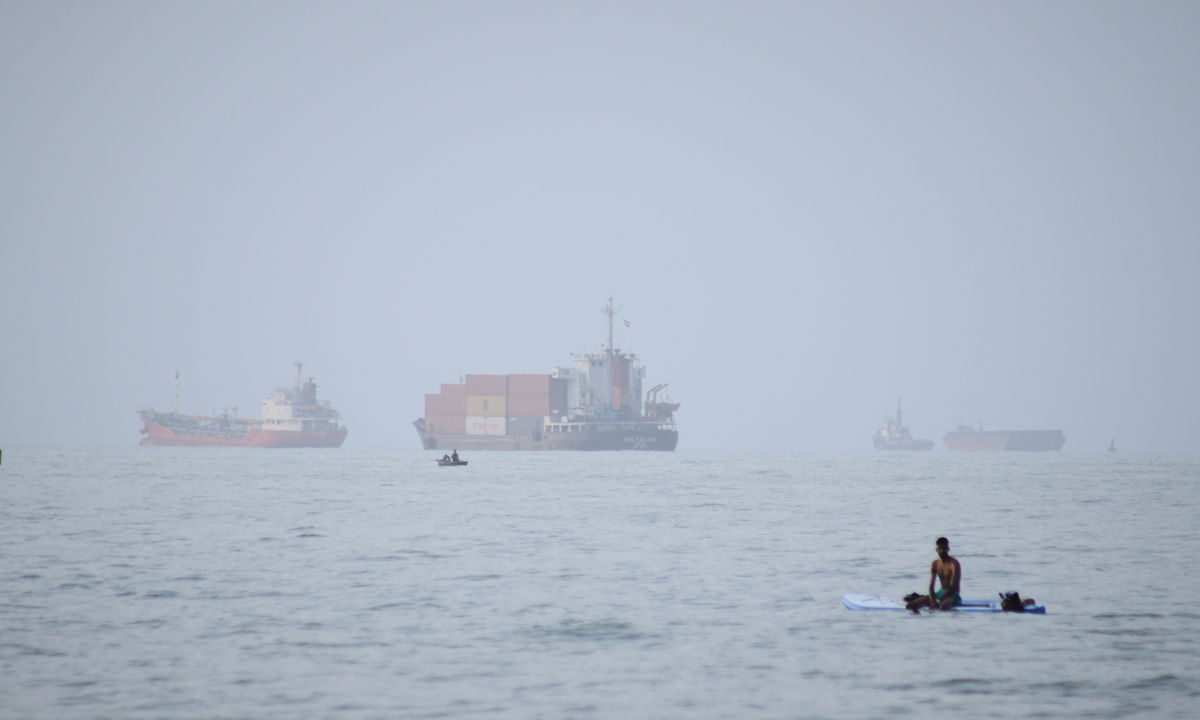
A man sits on a surfboard as a container ship and other commercial vessels appear anchored in the Strait of Hormuz off Bandar Abbas, Iran, July 27, 2026. (Photo:VCG)
US President Donald Trump said on Saturday he had agreed to cancel a planned military strike against Iran, claiming Tehran had requested a pause and that the two sides had agreed on the parameters of a deal, including reopening the Strait of Hormuz and ending Iran's nuclear threat. The announcement came after US officials said Washington and Israel were preparing their harshest bombing campaign yet against Iran's energy infrastructure.
Chinese observers said that as the mismatch between US capabilities and strategic objectives continues to fuel persistent swings in Washington's Middle East policy, with the underlying structural contradictions unlikely to be resolved anytime soon, the trajectory of the standoff will also depend heavily on the US leader's personal judgment.
Trump added on his Truth Social post that Israel, the US partner in the war with Iran, "joins me in this commitment." "Get to work, everybody, and get it DONE," the president said of a possible new agreement.
Earlier on Saturday, the US State Department urged Americans across the Middle East to consider leaving the region or be prepared to depart on short notice. It also warned of flight disruptions and security risks as the conflict with Iran appeared to be escalating, NBC News reported.
"Americans currently in the Middle East should exercise caution and heightened vigilance and should be prepared for flight cancellations, periodic airspace closures, and potential travel disruptions," the State Department said Saturday, per NBC News.
Earlier, Mehr News Agency reported that Iran's Foreign Ministry issued a statement on Saturday affirming Tehran's resolve to continue the path of resistance and steadfastness until the enemies' malice is fully repelled. The ministry accused the US of violating the June 18 memorandum by maintaining a naval blockade on Iranian ports and commercial shipping, launching savage attacks across the country, and intensifying economic pressure and illegal threats.
As a result, the statement said, Iran's armed forces continue their defensive strikes with full force. The ministry described the blockade as an act of aggression under UN General Assembly Resolution 3314 and a violation of the UN Charter, vowing that Iran would use all means to exercise its inherent right of self-defense.
Meanwhile, Israel has stepped up its alert level amid expectations that Washington could soon decide on renewed military action. Israeli media outlet The Jerusalem Post reported that two Israeli sources said Israel believes the US president is close to ordering another, potentially larger-scale, round of strikes against Iran. Israeli officials remain on high alert while awaiting Trump's final decision.
Zhu Yongbiao, director of the Center for Afghanistan Studies at Lanzhou University, told the Global Times that Washington's hesitation over a ceasefire in the Middle East stems from long-standing structural contradictions. While the US believes it has overwhelming military strength, it is unwilling to bear the high costs of a prolonged conflict in terms of time, money and casualties, leaving a widening gap between its capabilities, strategic objectives and actual outcomes.
"Combined with the US president's deal-making approach centered on maximum pressure and continued lobbying by Israel, these factors have deepened policy indecision," he said. Such constraints have persisted across successive US administrations and are unlikely to disappear anytime soon, meaning the trajectory of the crisis may ultimately hinge on Trump's personal judgement.
Zhu said many observers have long misjudged the situation by underestimating Iran's national cohesion, resilience and religious mobilization capacity, while overestimating the effectiveness of external military intervention. The mismatch between Washington's expectations and realities on the battlefield has contributed to the current stalemate.
Commenting on NBC's report that the US State Department had upgraded its travel advisory "reflecting Washington's growing concern that the conflict could widen," Zhu said the move should be viewed from two perspectives. On the one hand, it aligns with Trump's maximum-pressure strategy; on the other, issuing and updating overseas travel advisories is a routine responsibility of the State Department and should not, by itself, be interpreted as a signal of imminent military action.
Zhu added that although Trump holds the final authority over military action, his decision-making remains highly unpredictable. Neither the Pentagon nor the broader US foreign policy establishment can be certain of his intentions.
Given the uncontrollable risks of a prolonged conflict, Trump is reluctant to drag the US into another costly war, a key factor behind his continued hesitation, Zhu said.