


In recent years, artificial intelligence has been playing an important role in driving the transformation of cultural tourism across China, making it more immersive, intelligent and tailored to individual preferences.
At Chuanshan Academy in Hengyang, central China's Hunan Province, visitors wearing augmented reality glasses are transported back in time to interact with Wang Fuzhi (1619-1692), a prominent Chinese philosopher.
Founded in 1878, Chuanshan Academy is dedicated to preserving and promoting Wang's philosophy.
In the past, the academy's static exhibits struggled to fully capture the depth of Wang's ideas for visitors.
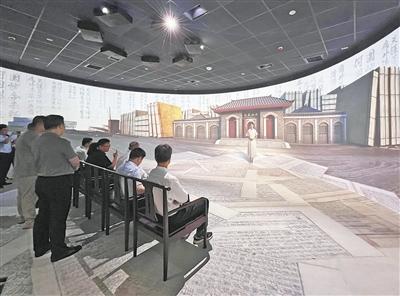
Photo shows a 360-degree immersive panoramic screen at Chuanshan Academy, Hengyang city, central China's Hunan Province. (Photo/Luo Maomeng)
In 2025, the academy launched an AI-powered "digital human" project, which uses AI technology to bring Wang's voice and likeness to life. Visitors can engage in virtual conversations with the philosopher and use gesture-based interactions to access AR annotations of his works.
Data show that in 2025, visits to Chuanshan Academy rose by 110.84 percent year on year, with study tour groups accounting for 59.26 percent of total visitors. Many parents say the immersive, interactive experience has sparked their children's interest in learning.
Flowers are in full bloom at the West Lake scenic area in Hangzhou, east China's Zhejiang Province. At a tourism information kiosk by the lake, visitor Yuan Meng takes out her phone and taps a blue tag on the booth. Instantly, a virtual guide appears on her screen. The AI-powered digital tourism assistant offers real-time guidance, information and travel support.
"Is the Leifeng Pagoda crowded right now?" Yuan asks in a voice message. Within seconds, she receives up-to-date visitor flow data for popular spots around West Lake.
"This is so much easier than searching on my own. It's like having a free personal tour guide," she said.
The digital tourism assistant enables both tourism authorities and businesses to better serve visitors while gaining valuable insights into their preferences, said Bo Wen'gan, deputy director of the city's culture and tourism development center. The data helps enhance service quality and broaden offerings, he said.
Zhou Jiayi, curator of the Workmanship Demonstration Pavilion in Hangzhou, said the pavilion, located near the Hangzhou Arts and Crafts Museum complex, has long faced the challenge of attracting visitors. "Recently, quite a few people told me they found us through the digital tourism assistant," Zhou said.
Authorities in Dalian, northeast China's Liaoning Province, have developed a mini program that uses large AI models to help travelers plan their itineraries.
"It's like a thoughtful travel assistant that saves us from having to switch back and forth between multiple apps to look up transportation, accommodation and dining options," said a tourist named Song Yao. She said the platform can generate a set of recommendations based on her needs. "If something catches my interest, I can then ask follow-up questions."
Song used the platform to quickly settle on the specific places she wanted to visit in Dalian. She then asked it to design a two-day itinerary covering several scenic spots. Within seconds, the platform generated a detailed, personalized itinerary.
The mini program has served nearly 430,000 users to date, according to Shan Meina, director of the Dalian Municipal Bureau of Culture and Tourism.