


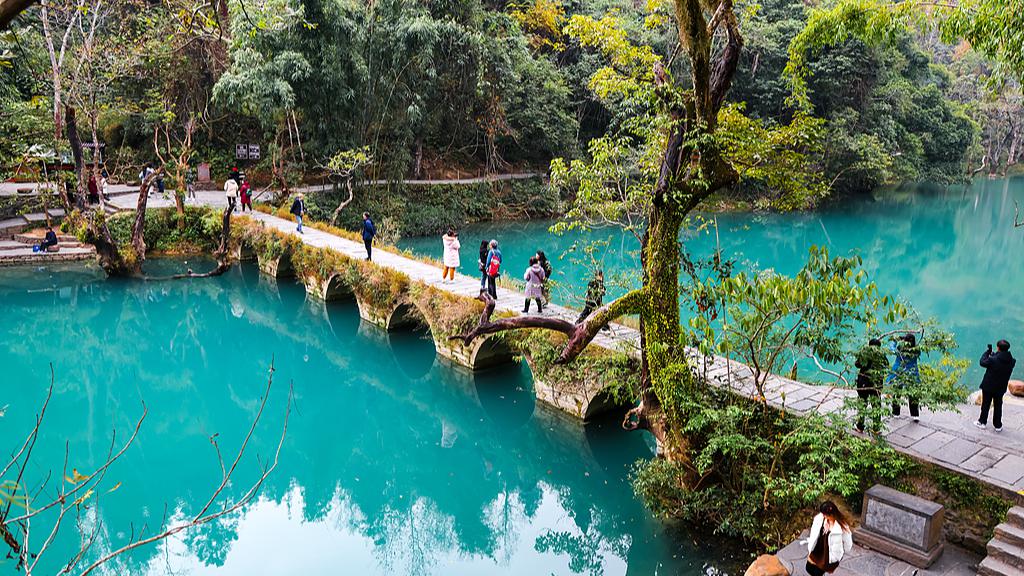
A view of the Xiaoqikong Scenic Area, Libo County, southwest Guizhou Province, January 4, 2025. (Photo: VCG)
As China accelerates its large-scale land greening and ecological restoration, once fragile ecosystems are transforming into vibrant tourism destinations, with forests, wetlands and karst landscapes becoming powerful engines for consumption and employment.
Data released by China's National Forestry and Grassland Administration shows that in 2025, the country completed afforestation of 3.563 million hectares and restoration of 4.927 million hectares of degraded grasslands. China's forest coverage rate has reached 25.09%, with the total output value of the forestry and grassland industry approaching 11 trillion yuan (about $1.6 trillion), directly driving employment for over 60 million people, according to the 2025 China Land Greening Status Bulletin.
This ecological miracle has fueled booming green tourism markets. In Libo County, southwest Guizhou Province, the Xiaoqikong Scenic Area, famous for its world natural heritage karst formations known as the "Green Gem on Earth's Belt," has thrived on the rebound. During the 2025 May Day holiday, single-day visitor numbers exceeded 70,000, setting a new historical record. Hiking, heritage exploration and transparent boating have extended average visitor stays from four-and-a-half to around seven hours, maximizing local consumption, the Xiaoqikong Scenic Area said during the ongoing May Day holidays.
In northeastern Heilongjiang, Yichun City – known as China's "Forest Metropolis" – boasts an 83.8% forest coverage rate across 4 million hectares of lush woodlands. During the 2025 May Day holidays, the city saw a 13.5% year-on-year increase in visitor numbers, with online tourism consumption surging 369.2%, driven largely by "forest-based tourism" and cool summer retreats.
The ecological gains extend deep into rural revitalization. Currently, 19 Chinese villages have been named on the UN Tourism's "Best Tourism Villages" list, the highest in the world.
Officials underscored that the nationwide "beautiful China" initiative has successfully turned lush mountains and lucid waters into invaluable assets, leveraging eco-tourism to build prosperous, sustainable communities.