


China's immersive cultural tourism is gaining momentum as young visitors increasingly gravitate toward business forms that combine rich cultural heritage, hands-on experiences and emotional resonance. Both newly developed attractions and long-established scenic sites are reporting record revenues, with one veteran destination increasing its income roughly 15-fold over the past three years.
This trend reflects the shift of Chinese-style theme parks away from replicating overseas models and toward a development path centered on homegrown intellectual property (IP) and emotion-driven consumption. Supportive policies have also helped foster a more favorable business environment for cultural tourism operators introducing innovative offerings. Fueled by market demand and policy support, Chinese-style theme parks are reaching a critical stage of development.
Leading the trend is "Unique Henan: Land of Dramas," a large-scale cultural complex in central China's Henan Province featuring 21 theaters and nearly 800 minutes of non-repeating performances. Since opening in June 2021, the complex had received more than 58 million tourist visits as of the end of 2025, with 80 percent of visitors coming from outside the province and 85 percent aged between 18 and 35.
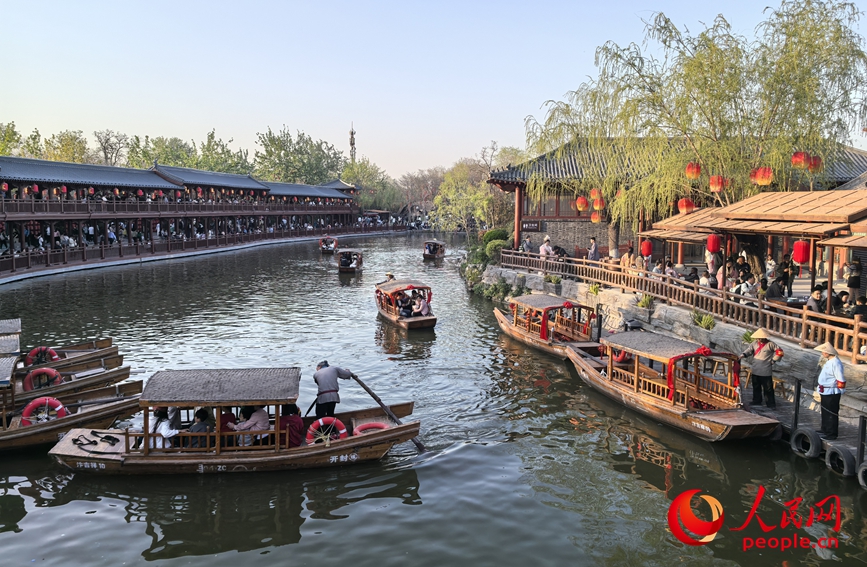
Tourists enjoy boat tours in Qingming Shanghe Garden in Kaifeng, central China's Henan Province, April 6, 2025. (Photo/Wang Pei)
"We have woven together dramas, architecture, intangible cultural heritage (ICH) items, dining and cultural and creative products into an immersive environment, giving audiences a comprehensive, multi-layered encounter with the culture of the Central Plains," said Liu Kaipeng, an executive with the cultural complex's operator.
Similar Chinese-style theme parks are emerging across the country. For instance, Qingming Shanghe Garden in Kaifeng of Henan Province, a cultural theme park inspired by the famous Song Dynasty (960-1279) painting "Along the River During the Qingming Festival" by Zhang Zeduan, has brought the classic artwork to life.
Broader market indicators also point to strong growth. According to the 2024 Global Theme and Amusement Park Attendance Report released last year by the Themed Entertainment Association (TEA), the world's top 10 theme park operators recorded nearly 550 million visits in 2024, while China accounted for half of the 10 most-visited theme parks in the Asia-Pacific region.
Yang Jinsong, director of the International Institute at the China Tourism Academy, said consumers have moved beyond simple sightseeing and are increasingly willing to pay for emotional value, seeking deeper engagement and cultural meaning through immersive experiences.
Chinese-style theme parks are well positioned to meet that demand. Wansuishan Martial Arts City, a theme park featuring non-player-character interactions and performances inspired by the novel "Water Margin," increased its revenue from over 80 million yuan (about $11.79 million) in 2022 to 1.27 billion yuan in 2025, representing a 15-fold increase in three years.
Liu Yuan, general manager of Hunan Minghe Culture and Technology Group Co., Ltd., said China has no shortage of compelling cultural IPs but lacks the intermediate mechanisms needed to transform cultural symbols into scalable commercial products.
To ensure the long-term sustainability of Chinese-style theme parks, industry players should pay close attention to key indicators such as repeat-visit rates and the proportion of non-ticket revenue.
Liu Kaipeng said that during this year's Labor Day holiday, the share of visitors staying for two days or longer and making multiple entries increased significantly at "Unique Henan: Land of Dramas." The complex's repeat-visit rate is currently five times higher than that of conventional theme parks, he said, attributing the result to the extensive integration of ICH elements, which are incorporated into about 60 percent of creative cultural products.
Liu Yuan predicted that over the next three to five years, China's immersive cultural tourism will complete its transition from technology-driven development to a dual-engine model powered by both content and operations.
Cultural IPs have become a key force behind the rise of Chinese-style theme parks. Yang noted that a growing number of cultural tourism projects have shifted their focus to continuous content renewal and the cultivation of local IPs to extend their lifecycle.
Yang called for establishing error-tolerance mechanisms that encourage innovation and developing more flexible financing channels for small and medium-sized cultural tourism enterprises operating in a rapidly evolving market.