


BEIJING, July 12 (Xinhua) -- Amid Beijing's wealth of historic landmarks, an unlikely attraction has captured the imagination of young visitors -- the "ocean" in the Temple of Earth.
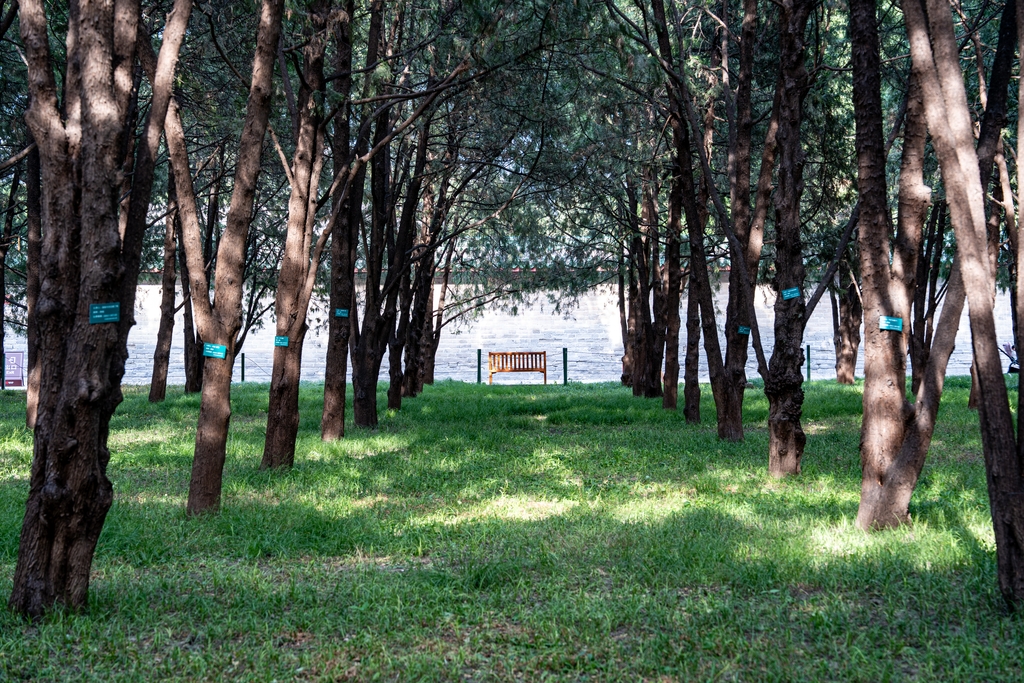
File photo: IC
While it's unclear how the spot went viral, the Temple of Earth has long enjoyed a devoted following thanks to its association with the late Beijing-born writer Shi Tiesheng. In his masterpiece memoir, "The Temple of Earth and Me," Shi traced his emotional journey from despair after losing his legs in his early twenties, to finding solace in the quiet sanctuary of the former imperial park.
Today, the Temple of Earth continues to draw a steady stream of young followers eager to retrace the wheelchair tracks of Shi.
Eager visitors line up to pose on the tree-canopied bench, facing nothing but a wall and pretending to gaze over a stretch of ocean. The "shimmering" blue backdrop in their photos is but a white-painted wall sprinkled with tree-filtered sun rays. As 26-year-old Shao Yang understands it, by sitting on the bench and gazing into the distance, young people are "reuniting" with an old friend in their own way.
Across China, literature-inspired tourism is gaining momentum, with travelers motivated by books, authors and landscapes depicted in literary works.
Behind this trend lies a broader shift in how young people approach travel. Rather than simply seeking out scenic attractions, they are looking for emotional connections and experiences that resonate with them on a deeper level.
A new five-year tourism development plan, approved by the State Council recently, taps into the current trend and highlights the deep integration of culture with tourism to leverage cultural resources and enrich visitors' experiences.
The plan came at a time when the country has already built the world's largest domestic tourism market and emerged as the world's largest source of outbound tourists, as well as a major global tourism destination.
According to the latest industry data, global tourism expanded by 4.1 percent in 2025, while China's tourism economy grew by 9.9 percent, more than double the global average.
FOLLOW FOOTSTEPS OF LITERATI
Winding through Shanghai's plane tree-lined downtown streets, visitors can follow in the footsteps of some of modern China's most celebrated writers.
A resident surnamed Xiong is an avid reader of Lu Xun (pen name), a leading figure of modern Chinese literature whose enlightening novels and essays even feature prominently in Chinese textbooks.
A few years ago, she first followed the bronze-colored "Lu Xun Trail" markers embedded in the pavement, passing the former site of Uchiyama Bookstore frequented by the writer in his later years, and the memorial hall of a writers' league Lu Xun helped found in 1930, before arriving at the writer's former residence.
"The history feels tangible this way," she said.
Since that first visit, Xiong has become a regular on the Lu Xun Trail. Her favorite stop is a memorial cultural venue repurposed from the former Uchiyama Bookstore. "My friends and I come here to catch up, read, and share what we've been reading lately," she said, adding that the place serves as a literary social space just like it once was in Lu Xun's time.
Like the Lu Xun Trail, which was launched in 2019 alongside online versions in English and Japanese, similar "citywalk" routes in Shanghai following footsteps of household writers have gained popularity in recent years.
Young readers today are no longer content with merely reading the books, but eager to step into the worlds they have encountered to relive the characters' joys and sorrows, to reconnect the literature with the real world it is associated with, according to Huo Yan, a researcher at the Institute of Literature of the Chinese Academy of Social Sciences.
Such enthusiasm extends beyond Chinese borders. One of the best-known examples is Cambridge in U.K., where the picturesque riverside setting was immortalized in the celebrated poem about bidding farewell to Cambridge, by modern Chinese poet Xu Zhimo. For generations of Chinese readers, the poem has made Cambridge a place of literary significance. So many Chinese visitors now flock to the city that some punters on the River Cam have learned to recite lines from Xu's poem to their Chinese passengers.
RECONNECT WITH CULTURAL ROOTS
On a deeper level, many young people today are developing a growing appreciation for China's history and cultural heritage. Literature-inspired traveling is not only an aesthetic experience but also a journey to reconnect with their cultural roots, Xia Xuemin, a researcher at the Institute of Public Policy of Zhejiang University, shared his observation.
Macheng Road in the Xihu District of Hangzhou, capital city of east China's Zhejiang Province, was once home to Li Qingzhao, one of China's most celebrated poets from nearly 1,000 years ago. Fang Jiayi, a visitor passionate about classical poetry, said she came all the way to take a look at the road after learning about its history.
"Despite the passage of time, the name Macheng Road has endured," she said. "Walking through a place where Li Qingzhao once lived makes history feel more tangible and alive."
WHEN FICTION BECOMES DESTINATION
Some localities have been quick to tap into the newfound enthusiasm. Even once-obscure towns that rarely featured on tourists' itineraries are now seeing opportunities. Shendang Township in Haiyan County of Zhejiang is a case in point.
"A sputtering boat carried us along an extended river toward the town called Sundang," wrote Yu Hua, a popular contemporary novelist native to Haiyan, in his novel. The fictional town Sundang was inspired by Shendang in the real world.
In recent years, Shendang has launched a "Yu Hua Literary Map" that turns locations from the writer's works into real-world destinations, with re-enacted scenes where visitors can even sit down at the dinner depicted in the novel and order a portion of stir-fried pork liver and yellow rice wine, just like Yu Hua's hero does.
"By giving literary IP a physical presence, our once little-known town has been winning over more and more young visitors," said Pang Weihua, deputy general manager of Haiyan Shendang Brewing Co., Ltd.
Similar destinations include the Changbai Mountain scenic area in China's northeast, which has created themed spaces, concerts and interactive events that allow fans of the Grave Robbers' Chronicles, a contemporary Chinese novel series, to relive key moments from the story.
Changbai Mountain serves as the setting for the story's famous "10-year promise," in which two protagonists agree to reunite there after a decade. Every August, thousands of readers make the pilgrimage to Changbai Mountain to "keep the appointment," turning a fictional promise into a real-world gathering.
As literary tourism continues to gain momentum, Xia believes its long-term success will depend on more than viral attractions and social media buzz. Destinations should take a more systematic approach to uncovering and showcasing their literary resources while cultivating a distinctive cultural identity, allowing literature to become more organically and deeply woven into the fabric of the city, Xia said.