


BEIJING, Aug. 4 (Xinhua) -- Passengers boarding a themed sightseeing train in eastern Chinese city of Fuzhou last week stepped into a carriage that felt more like a classical Chinese garden.
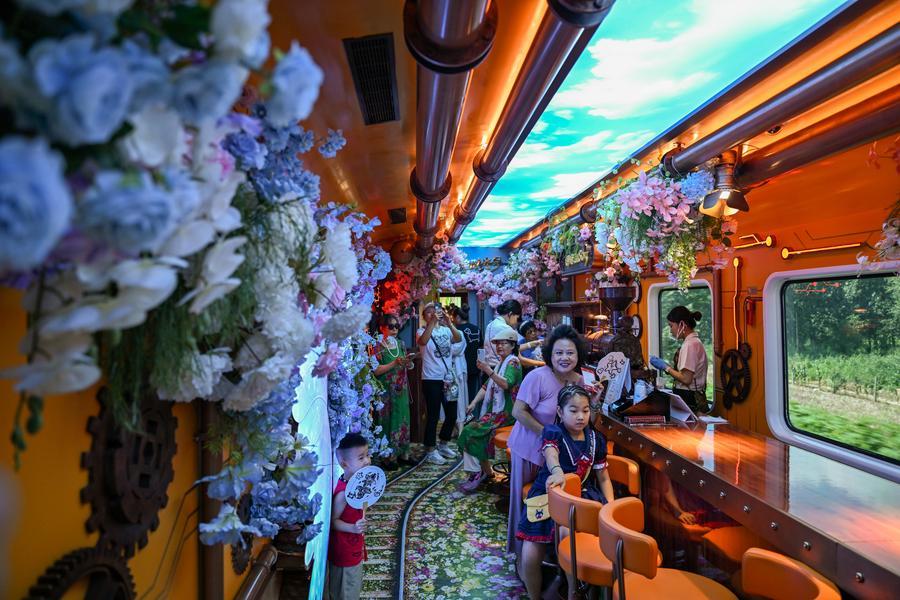
Passengers pose for photos inside a steampunk garden-themed carriage of the Tianjin Fantasy Express, July 29, 2026. (Photo: Xinhua)
Decorated with local bamboo and tea elements and Song Dynasty-inspired interiors, the train running through the Wuyishan National Park turns the journey itself into a unique cultural experience.
This train is part of a broader boom in an emerging train-plus tourism model, in which railway operators combine transportation with sightseeing, cultural experiences and entertainment to meet a growing appetite for immersive, hassle-free vacations.
In Shangrao, east China's Jiangxi Province, a tourist train brings local culture onboard through live performances and interactive theatrical experiences. "Since entering service in late April, the train has maintained an occupancy rate of more than 90 percent," said Qin Zhonghao, head of the operator's sightseeing train business.
Official data supports this trend. China operated 1,797 tourist trains in the first half of the year, nearly doubling the 972 trains during the same period of 2025, according to China State Railway Group Co., Ltd. Railway operators also launched 445 themed trains tailored for concerts, sporting events, exhibitions and other activities.
The rising buzz around tourist trains highlights just how quickly new ways to experience and spend are taking off in China's service sector.
The country's recently released five-year plan for expanding consumption calls for fostering new business models and consumption scenarios centered on improving consumer experiences. In the first half of the year, service retail sales rose 5.3 percent year on year, far outpacing the 1.1-percent growth in goods retail sales.
Against this backdrop, industry experts believe a train ticket is no longer merely a means of transportation. Instead, it is now a gateway to a wider tourism ecosystem, linking travelers to fresh experiences and opening up new opportunities for spending on travel-related services.
When the Northeast China Football League tournament kicked off in May, the local railway operator introduced dedicated fan trains offering one-stop travel packages that combined match tickets with sightseeing opportunities.
"To watch the opening ceremony, three friends and I traveled from Tongliao in Inner Mongolia on a fan train," said Wang Lei, a football fan. "Besides the matches, we also had time to visit the Shenyang Imperial Palace, the Xingshun night market and the Beishichang cultural district, all places I had wanted to explore. The trip was definitely worthwhile."
In northwest China's Shaanxi Province, the local railway operator has launched more than 70 themed tourist trains this year featuring study tours, wellness trips and flower-viewing excursions. Developed jointly with tourism authorities, the travel packages integrate round-trip rail tickets with admission to scenic spots, hotel stays, cruise and cultural performances, shuttle transportation and onboard cultural activities.
"In the past, passengers bought a point-to-point train ticket. Today, they're buying a complete travel experience," said Hui Lixia, deputy director of the passenger transport department at China Railway Xi'an Group Co., Ltd.
By giving transportation an even bigger role in tourism, this trend encourages the development of local tourism resources and helps convert passenger flows into broader consumer spending, said Zhang Linshan, a researcher at the Chinese Academy of Macroeconomic Research under the National Development and Reform Commission.
Looking ahead, policymakers see further room for growth. In June, multiple authorities, including the Ministry of Commerce, the Ministry of Culture and Tourism and China State Railway Group Co., Ltd., jointly issued a guideline to promote the integration of railways and tourism, with the goal of developing more than 160 dedicated tourist train sets nationwide by 2030.
Experts believe the next stage of development will require a wider range of products at different prices to meet increasingly diverse consumer needs.
Wang Jia, an associate professor at the School of Tourism, Nanchang University, called for closer collaboration among rail operators, travel agencies, hotels, scenic attractions and cultural businesses.
With improved themed services and deepened cooperation with the tourism sector, the train-plus tourism model will inject fresh momentum into China's summer economy and its rapidly expanding service consumption, analysts said.