



Russian tourists go sightseeing and take photos in the Xita commercial area in Heping district, Shenyang, northeast China's Liaoning Province. (Photo/Sun Kaifang)
"Be sure to bring an empty suitcase to China!" On social media, shopping in China has become an increasingly popular topic, with must-buy recommendations and departure tax refund guides among the most talked-about posts.
According to the National Bureau of Statistics, in the first half of the year, China recorded around 17.82 million inbound trips under visa-free entry policies, up 30.6 percent year on year. Meanwhile, customs authorities oversaw 19.9 billion yuan (about $2.95 billion) in duty-free sales in south China's Hainan Province, an increase of 18.8 percent. So, what are foreign visitors buying in China?
Smart gadgets are a top draw.
"Smart fans, Bluetooth earphones and power banks are our bestsellers right now. Smart glasses, smartwatches, smartphones and handheld gimbal cameras are also selling well," said Tang Yang, a sales assistant at an electronics store at Silk Street in Beijing.

Foreign tourists go shopping at Yuyuan Garden Mall in Shanghai. (Photo/Wang Chu)
By around 5 p.m., Tang had already served more than a dozen groups of customers, but the busiest part of the day was just beginning. Every afternoon and evening, after wrapping up their sightseeing, foreign tourists flock to the shopping center.
Products with Chinese cultural appeal are also popular.
Blending fine craftsmanship with traditional Chinese aesthetics, porcelain is another favorite among overseas shoppers.
"Just a few days ago, one foreign customer bought more than a dozen sets of porcelain plates in a single purchase," said a staff member at a porcelain store at Silk Street. Although porcelain requires extra care in packaging and shipping, that has not stopped foreign visitors from taking it home.
High-quality products showcasing China's manufacturing strengths are also in demand.
Loris, a visitor from Nigeria, ordered several custom-made outfits in one go, including a suit with a shirt and three dresses. She placed the order one day and picked up the finished garments the next.
For foreign travelers on tight schedules, having clothes custom-made during a trip might once have seemed impossible. But rapid tailoring services have made it a reality. Customers simply choose a style and fabric, have their measurements taken, and return the next day to collect their order—or have it delivered directly to their hotel. High quality, competitive prices and attentive service have made Chinese products increasingly appealing to overseas visitors.
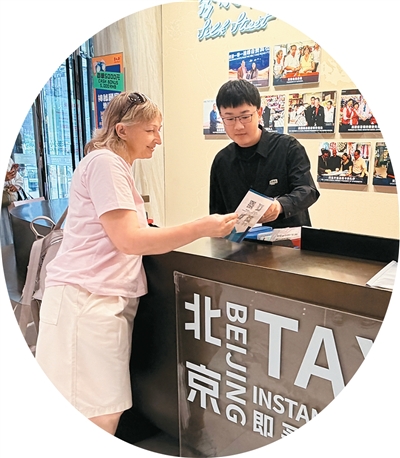
A foreign customer seeks assistance at a service desk at Silk Street in Beijing. (Photo/Han Xiangchun)
From refrigerator magnets, Bluetooth earphones and power banks to porcelain and smart home appliances, foreign visitors are filling their shopping bags with all kinds of treasures. Some of the most popular purchases, however, may come as a surprise, such as bed linens.
The numbers help explain why. China accounts for more than half of the world's textile fiber processing capacity. While Chinese textiles are exported worldwide, many remain highly affordable at home. Against this backdrop, it is easy to understand why foreign visitors choose to buy bedding in China.
Figures from retailers also reflect the strong growth in inbound consumption.
From January to June, Wangfujing Group, a retail enterprise, processed 14,000 departure tax refund transactions.
"Departure tax refund business has maintained strong growth since the beginning of the year," said an executive from the company. Clothing, sportswear, shoes and luggage accounted for the largest share of tax refund purchases, while children's products and items with distinctive Chinese characteristics have also proved popular among foreign visitors.
What happens when stores are crowded and sales assistants are too busy to help every customer?
A smart terminal, called "Meet China," is stepping in across a variety of retail settings. Resembling an ATM, the multilingual smart assistant features multilingual menus, product information with cultural context and integrated payment functions. Without downloading an app, foreign shoppers can quickly understand products, make their selections and complete payment, enjoying a seamless shopping experience from start to finish.
"Making shopping more convenient has always been one of our priorities," said Dong Qing, president of Beijing Silk Street Commercial Management Co., Ltd. As one of the first shopping centers selected for the pilot program, Silk Street believes that offering quality products is only part of the equation. Making it easy for foreign visitors to take their purchases home is just as important. To that end, the shopping center offers international shipping, 18-hour delivery for custom-made clothing and multilingual services throughout the mall.
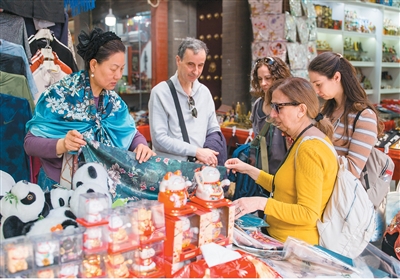
Foreign tourists shop and explore a food and culture street in Xi'an, northwest China's Shaanxi Province. (Photo/Zhang Cheng)
Since July 1, the upgraded departure tax refund policy has been rolled out nationwide, expanding the number of participating stores, shortening customs verification times at ports of departure, enhancing digital processing and improving the instant tax refund service.
According to the State Taxation Administration, in 2025, the number of overseas travelers claiming departure tax refunds rose by 305 percent year on year, while sales of tax-refundable goods increased by 95.9 percent year on year and total tax refunds grew by 95.8 percent year on year.
An executive of Wangfujing Group said the upgraded departure tax refund policy and continued improvements in refund services have effectively boosted inbound consumption. Foreign visitors are spending more enthusiastically and across a wider range of retail settings.