


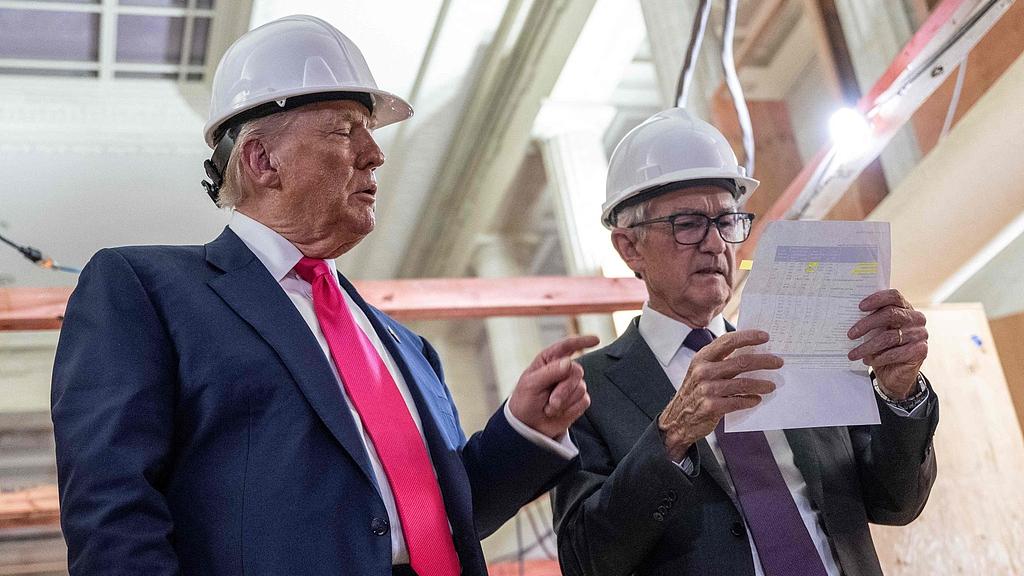
US President Donald Trump points to a cost sheet he had handed to Federal Reserve Chair Jerome Powell during their on-camera visit to the under-renovation Federal Reserve building in Washington, DC, US, on July 24, 2025. (Photo: VCG)
For those who follow central banks, the short, terse and unscheduled video statement by the US Federal Reserve Chair on Sunday must have sounded like emergency sirens wailing in all directions.
That is because central bankers, as we know, are a curious subset of government servants who calibratedly speak in economic jargon & complex riddles, drop tantalizing hints, project confidence and follow patterns. What they do not generally do is eschew monetary policy for politics, air grievances about forces weighing on them, impute motive on other government officials, and gravely suggest their institution faces an existential threat. But then again, the situation encumbering Jerome Powell is both unprecedented and personally dangerous—one that has evoked sympathy, anger, support and solidarity from his peers.
Consequent to his public announcement—tantamount to a SOS—that the Fed had been served grand jury subpoenas and threatened with criminal indictment by the US Department of Justice over his testimony about the $2.5 billion renovation of the institution's historic building, there has been an equally historic near-"unionization" of Powell's fellow governors from across the world. These central bankers have issued a joint statement putting their weight behind the beleaguered Fed Chair.
To be sure, this kind of activism, commentary on happenings in other central bank systems, and writing open-letters is also not generally part of the bankers' job description. However, in all their studied wisdom and exercising their combined judgement, they clearly believe the situation warrants them breaking with tradition—for reasons that span both economics and in terms of principles. And really, who can argue with them?
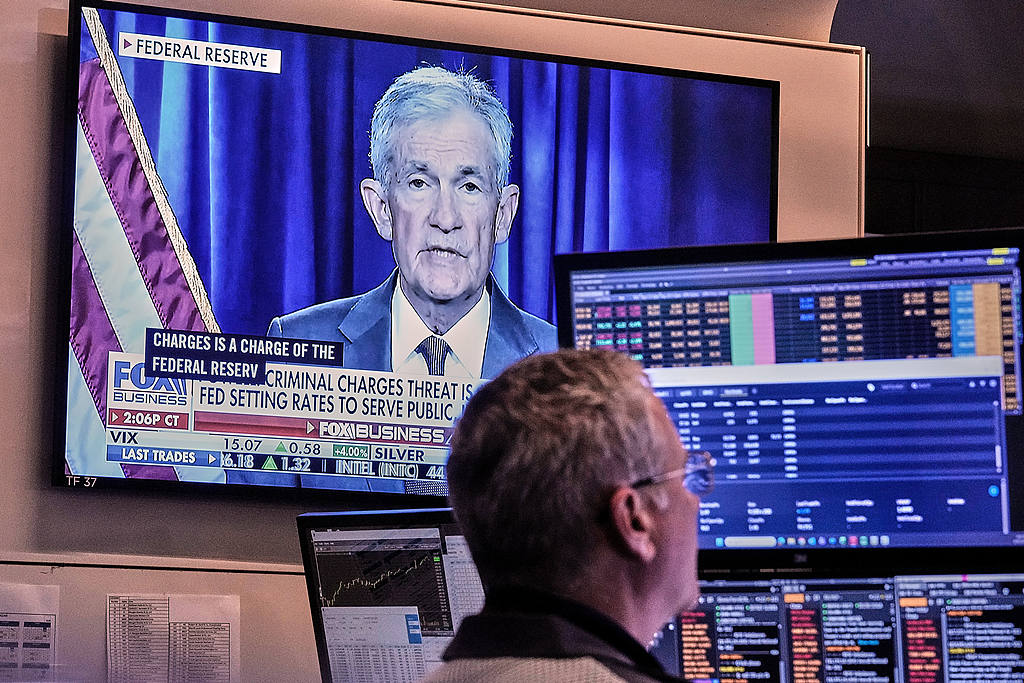
A video of Federal Reserve Chair Jerome Powell making his statement on the DOJ subpoenas plays on a screen on the floor of the New York Stock Exchange, January 12, 2026. All major US markets slid that day at the opening bell, while bond yields edged higher and the value of the US dollar declined. (Photo: VCG)
The baiting of Jerome Powell by US President Donald Trump has at times felt like schoolyard bullying. It began with Trump telling Powell what to do, i.e. drop interest rates. That itself shatters the fundamental tenet of the central bank's independence. Then came the threats. Initially it was the weekly "will he?-won't he?" about firing Powell. That guessing game, which Trump never dismissed despite question-marks over whether or not he has the legal authority, eventually rubbed the markets the wrong way, forcing the President to back off for a time. In the subsequent months it was thought that the White House would simply wait for Powell's chairmanship to end in May 2026 while it used other methods to get its picks on the Fed's board, but with the DOJ now initiating action, the stakes for Powell have dramatically escalated.
The threat of extended legal persecution & harassment against Powell
For his apparent insistence on doing his job as mandated, the Trump administration is effectively threatening criminal legal action that may make Powell miserable well beyond his time at the Fed. And it's over a topic that we know the President has personally and publicly questioned Powell, even going so far as to dramatically pull out a piece of paper from his pocket during a live press conference at the building site to confront him about the ballooning costs. Powell, however, in his Sunday statement, insisted the new threat is not about the renovation, about which the Fed did its best to keep relevant authorities informed. The real reason, he says, is "the Fed setting interest rates based on our best assessment of what will serve the public rather than than following the preferences of the President."
Read more: 'Might is right' is passé. A bright future needs a global governance initiative
Powell characterized this as political pressure and intimidation. Over the course of world history, this type of action has also got another name—vendetta—and its goals in this case are two-fold. The first is that it opens doors to Powell's removal on other grounds. He would then potentially not be able to continue at the Fed as a governor till January 2028 after his chairmanship ends this May. The second is that it sends a chilling message to anyone like Powell who chooses to uphold the responsibilities of his/her office in defiance of the President's whims and fancies.
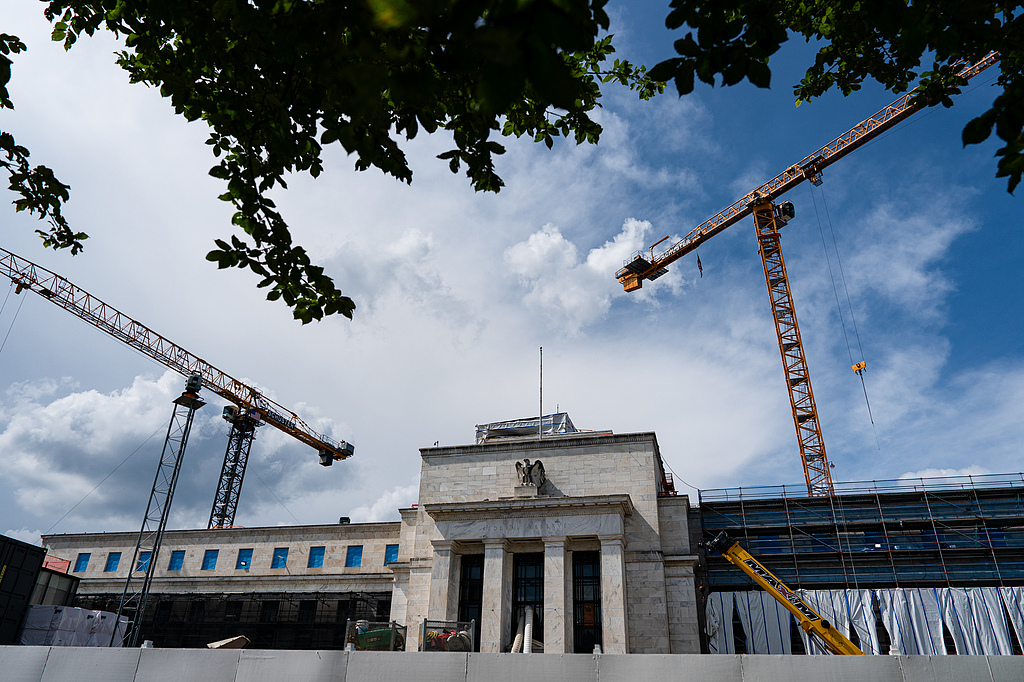
Clouds gather over the under-renovation Marriner S. Eccles Federal Reserve building in Washington, DC, US, July 14, 2025. (Photo: VCG)
In terms of economics, it's a tired old script. The fact that central banks set monetary policy independently of political calculations is by design. For the Fed, it provides the leeway to take often unpopular decisions to fulfil its dual mandate of maximum employment and price stability without falling victim to the kind of short-term economic sugar-high that politicians often crave. In performing such a balancing act, many would agree with Powell's repeated contention that there was too much uncertainty surrounding Trump's tariffs to allow the Fed to cut rates. Yet, when the Fed's FOMC felt sure enough, it did cut rates thrice in the latter months of the year. Trump, however, saw it as too little-too late, in keeping with his nickname for "Too late" Powell. Recently he escalated the rhetoric, even accusing him of gross incompetence.
Why central bankers are speaking up their beleaguered peer
In their joint statement backing Powell, the international central bankers write "the independence of central banks is a cornerstone of price, financial and economic stability in the interest of the citizens that we serve." This is even more true of the US Fed because it is the monetary authority for world's dominant reserve currency—the US Dollar. Its interest rate decisions ripple through financial markets worldwide, giving it an outsized role.
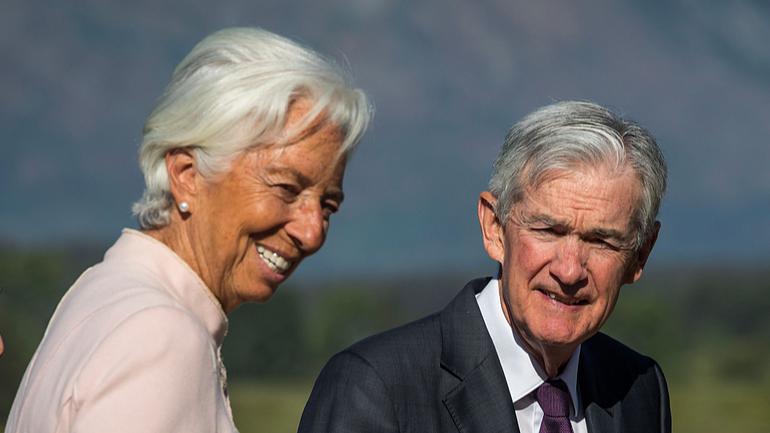
Federal Reserve Chairman Jerome Powell takes a walk outside of Jackson Lake Lodge with European Central Bank President Christine Lagarde during a break at the Jackson Hole Economic Policy Symposium in Moran, Wyoming, US, August 22, 2025. (Photo: VCG)
The first signatory on the extraordinary letter, the European Central Bank's President Christine Lagarde, had already aired her frustration with the uncertainty surrounding the dollar in the standout central banker speech of 2025. Speaking at the Hertie School in Berlin last May, Lagarde had proclaimed the time was ripe for the euro to challenge the dollar—calling it a "golden euro" moment. Her present alarm at such a thinly-veiled set of efforts to capture the Fed comes as no surprise.
Witch-hunt against Fed chair knocks US off global moral high horse
Yet, viewed with a bird's eye, the Fed is only the latest such "sacred cow" that the White House has attempted to browbeat. For example, repeated social media posts by Trump imploring the US Supreme Court to uphold the legality of his tariffs also falls into a similar pattern of pressure tactics and intimidation. Again, the norm is that the political executive stays away from commenting on ongoing legal matters. Before that, official statisticians have faced the President's wrath and lost their jobs for mechanically putting out underwhelming economic data. And despite the administration's sermons to other countries on freedom of expression and rule of law, backdoor legal weaponization has been deployed against critics as well as those involved with earlier probes related to Trump, such as his former NSA John Bolton, former FBI chief James Comey and former CIA director John Brennan. In the latest, the house of a Washington Post journalist was raided and her electronic devices seized, allegedly as part of a probe in which she is not the actual target of investigation.
Clearly, while much has been rightfully made of the US withdrawing from the multilateral order, the ever-expanding list of transgressions mentioned above also marks an abject surrender of the high moral ground it always professed to claim. This virtuous superiority was exercised with regularity by government bodies, leaders, departments, agencies, committees, caucuses, and a supporting ecosystem that would serve up certificates on freedoms, democracy and institutional independence.
This new America, however, no longer wants to be some kind of self-styled "shining city upon a hill." It would rather undertake a vindictive roving-fishing inquiry against the Fed in an effort to capture it—sending a dire message to anyone who doesn't accept its ruler's authority. And that is the true significance of the action against Powell.
Ankit Prasad is a CGTN biz commentator. The article reflects the author's views and not necessarily those of CGTN.