


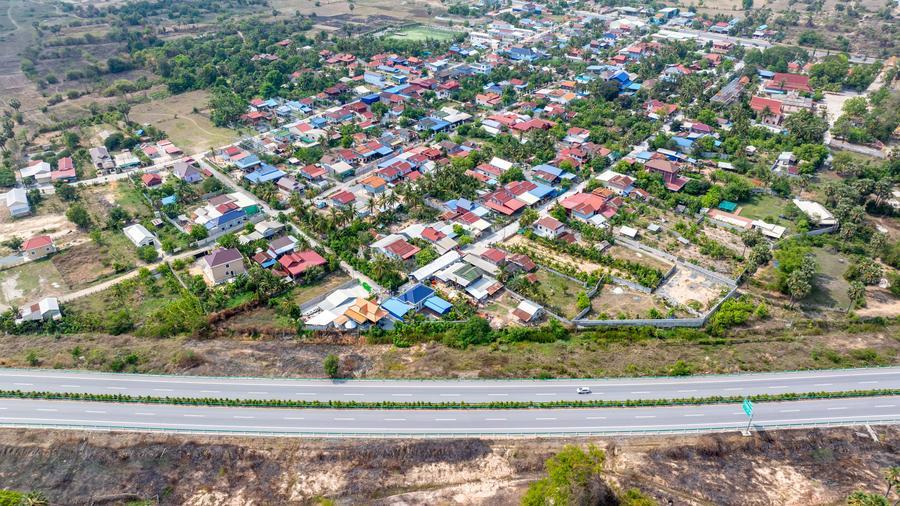
An aerial drone photo taken on March 15, 2025 shows a section of the Phnom Penh-Sihanoukville Expressway in Cambodia. (File photo: Xinhua)
PHNOM PENH, Jan. 17 (Xinhua) -- China's Belt and Road Initiative (BRI), the Regional Comprehensive Economic Partnership (RCEP) and the Cambodia-China Free Trade Agreement (CCFTA) have provided tremendous opportunities for socio-economic development and poverty alleviation in Cambodia, an expert said.
Phy Veasna, a geopolitical and policy analyst at the Royal Academy of Cambodia, said BRI's flagship projects, such as the Sihanoukville Special Economic Zone (SSEZ), the Phnom Penh-Sihanoukville Expressway, and the Siem Reap Angkor International Airport, have played a crucial role in boosting Cambodia's economic and trade growth as well as the development of its tourism sector.
"The SSEZ has helped give a further boost to Cambodia's economic growth, and the expressway has facilitated travel, reducing transportation costs, saving fuel expense, and shortening travel period," Veasna told Xinhua.
As of 2025, the SSEZ accommodated a total of 217 enterprises, generating 35,000 jobs, according to the zone operator.
"The Belt and Road projects have created potential for enhancing relations among Cambodia, China and the Association of Southeast Asian Nations (ASEAN) member states," he said.
He added that Belt and Road projects have also provided convenience and betterment for other countries in their development journey.
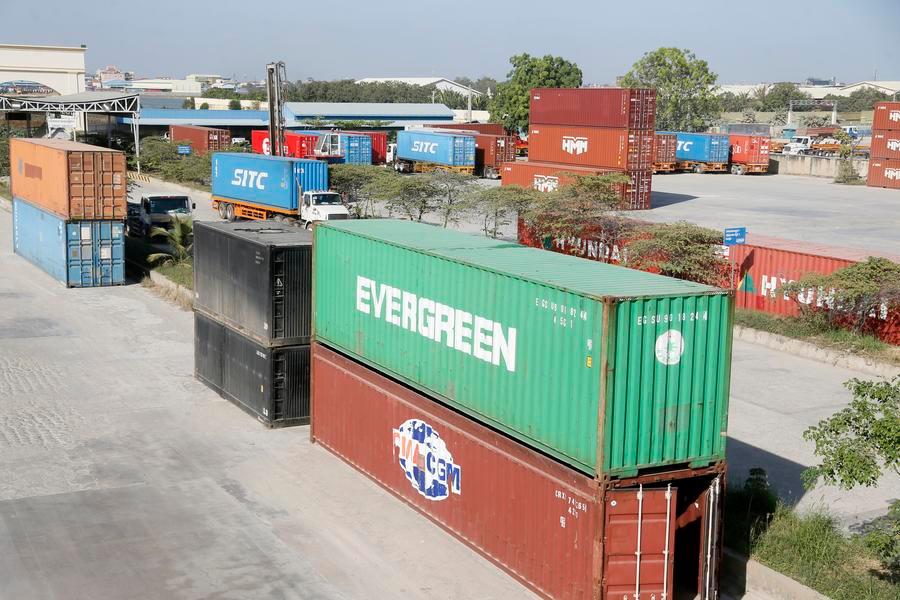
Photo taken on Jan. 13, 2022 shows containers at the Hong Leng Huor Dry Port on the western suburb of Phnom Penh, Cambodia. (Photo by Phearum/Xinhua)
In addition to the BRI, the RCEP and the CCFTA have injected great vitality into Cambodia's economic and trade growth, Veasna said, adding that China ranks as the top investor and the largest trading partner of the country.
According to the Cambodian government's official figures, Cambodia approved fixed-asset investment projects worth 10 billion U.S. dollars in 2025, with China accounting for more than half of the total investment.
In terms of trade, Cambodia's international trade volume reached 65.24 billion U.S. dollars in 2025, and trade with China accounted for nearly one-third of the total.
"RCEP and CCFTA are the main factors in attracting foreign direct investment," he said. "These trade pacts are also a driving force for Cambodia's trade growth with China and other countries."
The RCEP comprises 15 Asia-Pacific countries, including ASEAN member states of Brunei, Cambodia, Indonesia, Laos, Malaysia, Myanmar, the Philippines, Singapore, Thailand and Vietnam, and their five trading partners, namely China, Japan, South Korea, Australia and New Zealand.
Both RCEP and CCFTA entered into force on Jan. 1, 2022.