


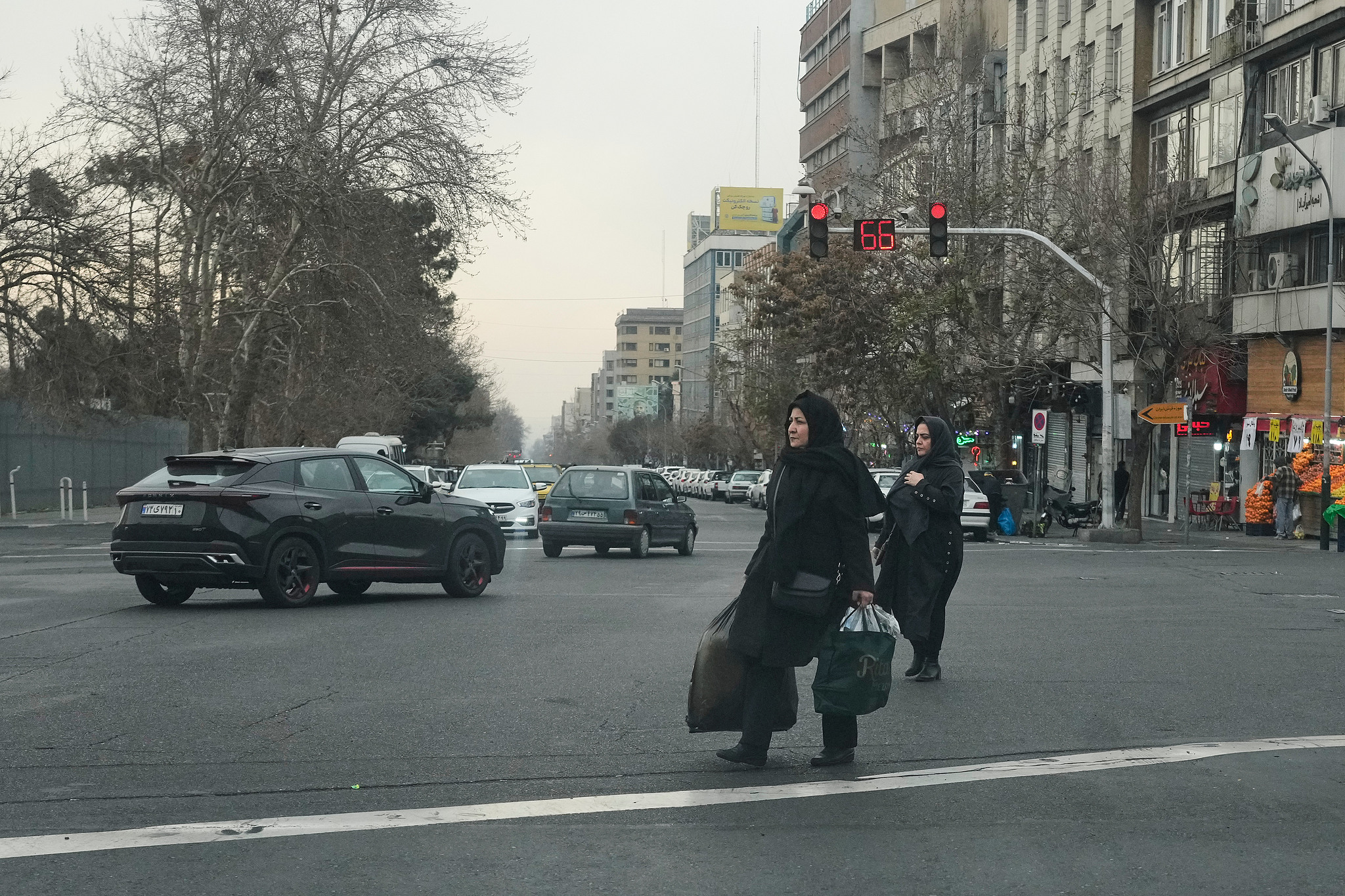
People cross an intersection in downtown Tehran, Iran, January 15, 2026. (Photo: VCG)
Editor's note: Li Haoran is an assistant professor at the School of Applied Economics and the associate director of the Center for Research on Global Energy Strategy at Renmin University of China. Gong Heqiang is deputy general manager (vice president) at China Southern Power Grid. The article reflects the authors' opinions and not necessarily the views of CGTN.
US President Donald Trump's recent warnings toward Iran — threatening military intervention if security forces kill protesters and vowing to take "very strong action" if detained protesters be executed — have been widely framed as moral pressure in defense of human rights. But taken in context, these statements reveal something more fundamental. They are part of a broader strategic doctrine that has increasingly defined Trump's foreign policy: a globalized version of the Monroe Doctrine (so-called "Donroe Doctrine"), one that seeks to subordinate resource sovereignty and global supply chains to US strategic control.
The original Monroe Doctrine was geographically limited, aimed at excluding external powers from the Western Hemisphere. Under Trump, this logic no longer stops at regional boundaries. Instead, it operates wherever strategic resources — especially energy — intersect with US power.
Iran has become one of the most consequential test cases of this doctrine, just as Venezuela has been within the Americas.
At the heart of this approach lies a clear principle: management rights are treated as more important than sovereignty itself. Political independence is tolerated only if it does not interfere with US influence over how resources are produced, traded, and priced. When a country insists on independent control over its strategic assets, pressure escalates — first through sanctions, then through political isolation, and ultimately through the threat or use of force.
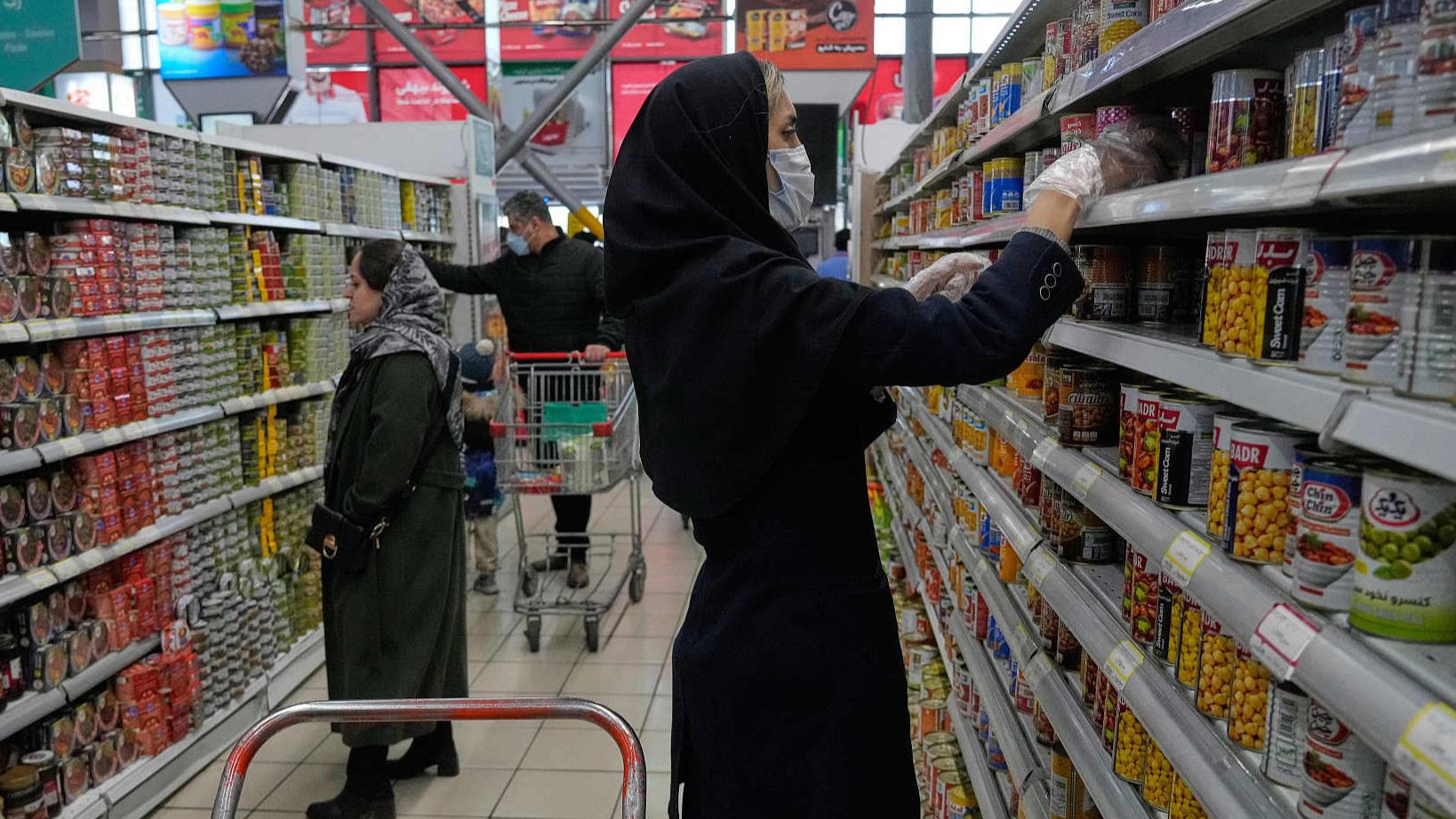
A store clerk adjusts items at a store in Tehran, Iran, January 16, 2026. (Photo: VCG)
Iran illustrates this logic with unusual clarity. Over years of tightening sanctions, the United States has systematically worked to sever Iran from global energy markets and financial systems. Oil exports have been constrained, access to shipping and insurance restricted, and third-party trade deterred through secondary sanctions. These measures are not simply punitive. They are designed to disrupt Iran's role in global supply chains and to turn economic survival into a tool of political leverage.
Trump's latest threats fit squarely within this framework. By explicitly linking potential military intervention to Iran's handling of domestic protests and judicial decisions, Washington lowers the threshold for escalation while cloaking coercion in moral language. Domestic instability is internationalized, and human rights discourse becomes a trigger for external intervention.
The Venezuelan experience offers a revealing comparison. There, years of sanctions hollowed out the oil industry, restricted exports, and weakened state capacity long before any direct intervention occurred. Once economic structures had been sufficiently degraded, the focus shifted to "reconstruction" and "stabilization," creating opportunities for US capital to re-enter and dominate production and pricing.
Iran now faces a similar trajectory, though the consequences would be far more disruptive given its scale and centrality to global energy markets.
In this perspective, Trump's "Donroe Doctrine" is no longer about defending a hemisphere. It is about reshaping global energy and trade pattern. States that resist integration on US terms are isolated, destabilized, and ultimately targeted for restructuring. Sovereignty becomes conditional, and the access to markets becomes a privilege rather than a right.
This strategy also produces immediate domestic benefits for the United States. Persistent regional tensions push allies of US to increase military spending and purchase US weapons, directly benefiting the American military industry. At the same time, sanctions-driven economic collapse abroad can create conditions for post-crisis reorganization, in which US corporations are often well positioned to dominate energy, finance, and infrastructure sectors. Crisis, in this sense, becomes both a geopolitical instrument and an economic opportunity.
The global consequences are increasingly visible. Energy markets become more volatile as supply is deliberately constrained. Prices respond less to fundamentals than to sanctions regimes and geopolitical risk. Trade becomes conditional, with access to finance, insurance, and logistics tied to political alignment rather than market rules. For many countries, participation in global markets begins to more like a strategic vulnerability than a source of stability.
Pressure on Iran has therefore accelerated broader structural shifts. Countries affected by unilateral coercion are seeking alternatives to dollar-based clearing systems, expanding regional trade arrangements, and diversifying energy partnerships. While these efforts reduce exposure to external pressure, they also fragment the global economy and weaken existing governance mechanisms. The result is a more divided and less predictable international system.
Under this expanded Monroe Doctrine, Iran's energy wealth thus becomes more than a national asset, it becomes a lever in sustaining US dominance. Yet the costs of this approach are mounting. The militarization of energy security undermines market confidence, increases the risk of miscalculation, and entrenches confrontation at a time when global cooperation is urgently needed to manage economic slowdown, energy transition, and climate challenges.
Trump's threats toward Iran should not be understood as isolated rhetoric, but as part of a coherent strategic worldview. This world view uses force and pressure to redraw the boundaries of economic sovereignty, prioritizes control over cooperation, and treats global trade as an extension of geopolitical competition. If normalized, this doctrine will further erode global energy sovereignty, destabilize markets, and accelerate the fragmentation of the international economic order.
What the world is witnessing is not a series of disconnected crises, but the consolidation of a global Monroe Doctrine—one enforced not through multilateral consent, but through coercion. Its consequences will extend far beyond Iran, shaping the future of global energy governance and trade in ways that demand serious reflection from the international community.
History suggests that such strategies carry long-term costs. Coercion can disrupt rivals, but it also erodes trust, encourages duplication of systems, and raises the risk of miscalculation. In targeting Iran through overwhelming pressure, Trump has not only reshaped Tehran's options, but also accelerated the breakdown of the global economic order that once amplified US influence.