


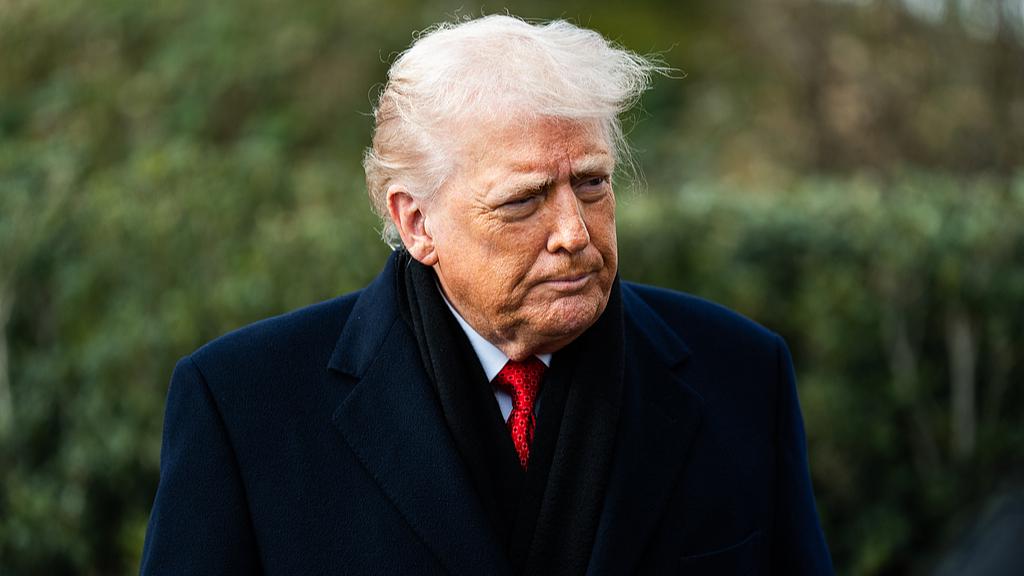
U.S. President Donald Trump speaks to the press on the South Lawn of the White House in the U.S., January 16, 2026. (Photo: VCG)
U.S. President Donald Trump has intensified his push to wrest sovereignty over Greenland from fellow NATO member Denmark, prompting the European Union to weigh hitting back with its own measures.
On Monday, when asked by NBC News whether he would use military force to seize Greenland, Trump responded, "No comment." However, he reaffirmed his intention to impose tariffs on goods arriving in the U.S. from the United Kingdom and seven other NATO allies, stating, "I will, 100 percent."
The U.S. president had announced on Saturday that starting February 1, the U.S. would impose 10 percent tariffs on goods from Denmark, Norway, Sweden, France, Germany, Britain, the Netherlands and Finland. He threatened to increase the tariffs to 25 percent from June 1 unless a deal is struck for what he called the "complete and total purchase" of Greenland.
Greenland, the world's largest island, is a self-governing territory within the Kingdom of Denmark, with Copenhagen retaining control over its defense and foreign policy. The U.S. maintains a military base on the island. Since returning to office in 2025, Trump has repeatedly expressed a desire to "obtain" Greenland. He recently declared that "complete and total control of Greenland" by the U.S. is essential for ensuring global security.
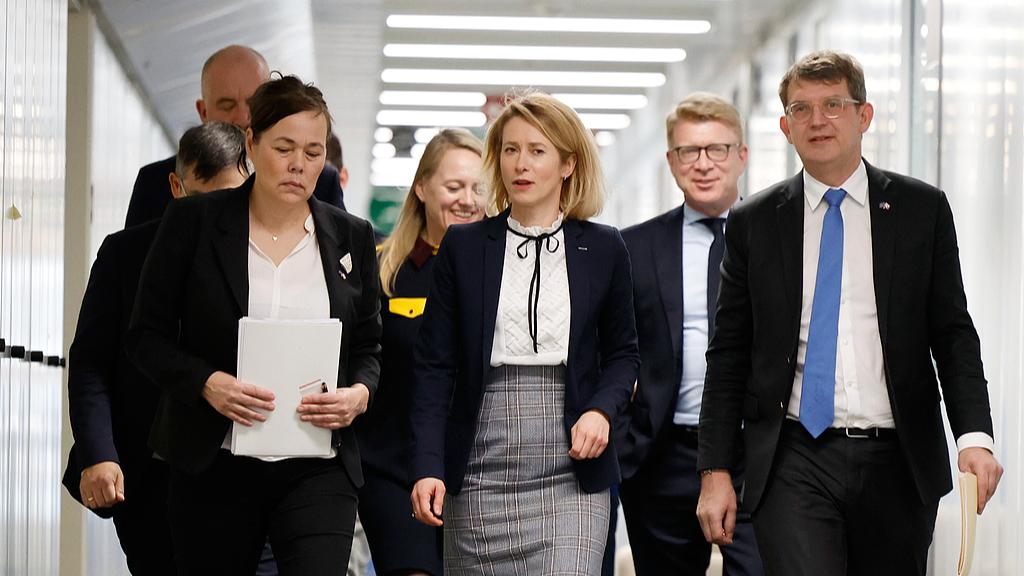
European Union foreign policy chief Kaja Kallas, center, walks with Minister for Foreign Affairs and Research of Greenland Vivian Motzfeldt, front left, and Denmark's Defense Minister Troels Lund Poulsen, front right, prior to a meeting at EU headquarters in Brussels, Belgium, January 19, 2026. (Photo: VCG)
'Sovereignty is not for trade'
European allies have united in support of Greenland's sovereignty, condemning Trump's threats of military force and tariffs.
"We are living in 2026, you can trade with people, but you don't trade people," Denmark's Foreign Minister Lars Lokke Rasmussen said during a visit to London on Monday.
In a Facebook post, Greenland Prime Minister Jens-Frederik Nielsen said the territory should be allowed to decide its own fate.
"We will not let ourselves be pressured. We stand firm on dialogue, on respect and on international law," he said.
European Commission President Ursula von der Leyen said on Monday that the sovereignty of Greenland and the Kingdom of Denmark must be "unequivocally" respected, stressing that the issue is of "utmost importance" to the transatlantic relationship as U.S. tariff threats add fresh strain to ties.
European Union (EU) High Representative for Foreign Affairs and Security Policy Kaja Kallas said on Monday that Arctic security is a shared transatlantic interest and an issue Europe could discuss with the United States. "But tariff threats are not the way to go about this," she said.
"Sovereignty is not for trade," Kallas added, reiterating that Europe has "no interest in picking a fight," but would stand its ground and has "a slate of tools" to safeguard its interests.
German Chancellor Friedrich Merz said he too would try to meet Trump on Wednesday, adding that a trade dispute was not wanted. "But if we are confronted with tariffs that we consider unreasonable, then we are capable of responding," Merz said.
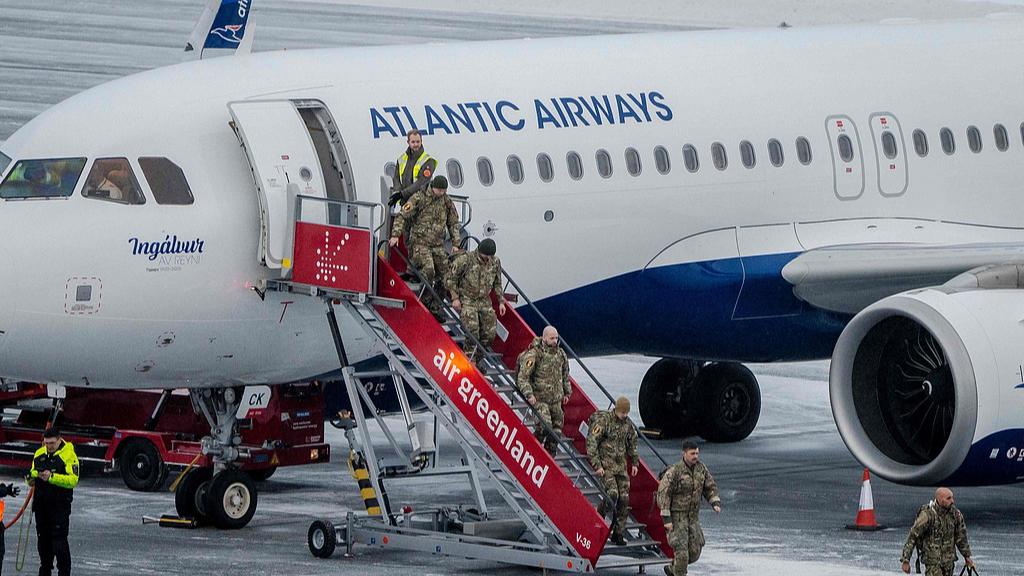
Danish soldiers disembark an airplane at Nuuk airport, Greenland, January 19, 2026. (Photo: VCG)
EU is weighing response
The European Union leaders are set to discuss their response options at an emergency summit in Brussels on Thursday.
One option is a package of tariffs on 93 billion euros ($108 billion) of U.S. imports that could automatically kick in on February 6 after a six-month suspension.
Another option is the "Anti-Coercion Instrument" (ACI), which has never yet been used and which could limit access to public tenders, investments or banking activity or restrict trade in services, in which the U.S. has a surplus with the bloc, including in digital services.
The EU said it was continuing to engage "at all levels" with the U.S. but said the use of its ACI was not off the table.
Noting the EU is enhancing communication and cooperation to respond to the increasing pressure from the U.S., Su Xiaohui, an expert at the China Institute of International Studies, said Europe faces a difficult dilemma in responding to U.S. pressure. She cautioned that retaliatory tariffs could lead to a trade war, which would be damaging to both sides. Europe is concerned that such a conflict would come at significant risk and cost to itself.
Su also pointed out that there are differing opinions within Europe about how to proceed. If the EU's countermeasures are intended to deliver a greater deterrent effect, it could exacerbate internal divisions.
As Europe balances its response to issues like tariffs and military exercises in Greenland, Su emphasized that how to effectively constrain the U.S. remains an open question. The effectiveness of these actions, she concluded, will be closely watched.
(With input from agencies)