


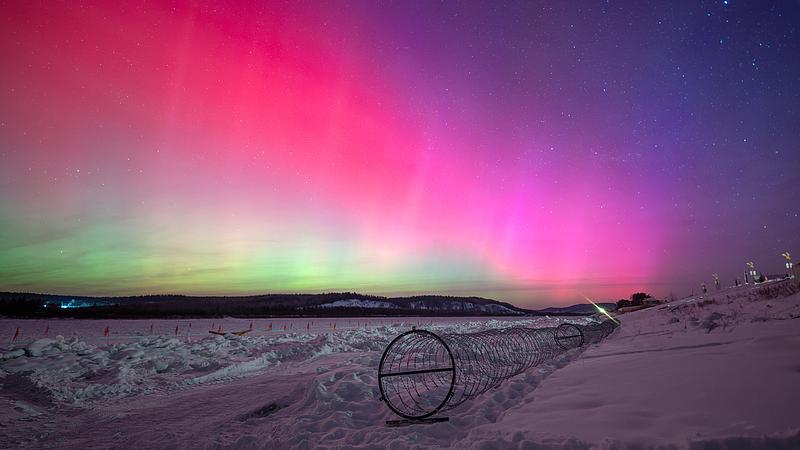
A dazzling and rare aurora appeared over Beiji Town, Mohe City, in the Greater Khingan Range of Heilongjiang Province, northeast China, January 20, 2026. (Photo: VCG)
An intense geomagnetic storm swept across the Earth on Tuesday, triggered by the first X-class solar flare of 2026, which erupted from the sun's active region 14341 at approximately 2:09 a.m. Beijing Time on Monday. Classified as an X1.9 flare – the most powerful category of solar eruptions – the event unleashed a coronal mass ejection (CME) that reached our planet the following day.
From 2:00 a.m. Beijing Time on Tuesday, the Earth's magnetic field began to experience significant disturbances. By 8 p.m. the same day, the storm had included six hours of extreme geomagnetic activity and 6 hours of moderate intensity, according to monitoring data.
Space-based monitoring
China's Fengyun-3E satellite detected the geomagnetic disturbances in space, recording a sharp drop in geomagnetic indices as the storm intensified. Meanwhile, the Fengyun-3H satellite provided a stunning cosmic perspective, capturing images of auroras across the Northern Hemisphere that clearly illustrate the affected regions.
Auroras illuminate sky in northern China
The geomagnetic storm brought a rare celestial spectacle to multiple locations in China. On Tuesday night, vibrant auroras were spotted over Mohe in Heilongjiang Province, treating observers to colorful displays in the night sky. These auroras occur when charged particles from solar eruptions interact with the Earth's magnetic field and upper atmosphere.

A very rare Northern lights are seen on a sky over Rudno, Poland, January 20, 2026. (Photo: VCG)
What causes geomagnetic storms?
As a typical solar eruptive event, a CME hurls billions of tonnes of solar material into space at speeds of hundreds of kilometers per second. This material carries enormous kinetic energy from its mass and velocity, along with the sun's powerful magnetic energy. When these particles collide with the Earth's magnetosphere, they disrupt the planet's magnetic field, resulting in a geomagnetic storm.
Impacts: Minimal risk to humans, concerns for technology and animals
Fortunately, geomagnetic storms pose no direct threat to human health. The magnetic field changes associated with the storm are extremely weak – weaker than the magnetism of everyday household items like refrigerator magnets or magnetic hooks.
However, the storm does affect aerospace and satellite operations. Low-Earth orbit satellites and space stations may experience orbital altitude drops due to increased atmospheric drag, requiring enhanced orbit monitoring and potential adjustments. Satellite navigation systems may see slight increases in positioning errors, though these changes are unlikely to impact public daily use of navigation tools.
Additionally, intense geomagnetic activity can disrupt animal migration and navigation. For example, homing pigeons – which rely on solar and magnetic cues for direction – are significantly affected by such disturbances.