


From 'Global Leader' to 'Isolated Egoist': The Impact of 'Donroe Doctrine' on the International Order
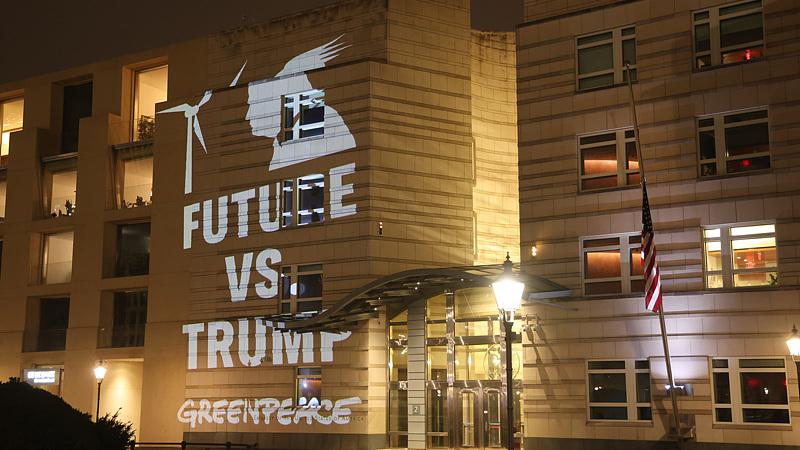
Greenpeace activists project an illumination showing a wind turbine and that reads: "Future vs. Trump" on the facade of the US Embassy to protest against the withdrawal of the United States by newly-inaugurated US President Donald Trump from the Paris Agreement in Berlin, Germany, on January 21, 2025. (Photo: VCG)
Despite a four-year hiatus during the Biden administration, US President Donald Trump wasted no time in reinstating his previous agenda. Immediately upon his second inauguration, he picked up right where he left off by ordering the US to once again withdraw from the WHO and the Paris Agreement.
On Tuesday, the US formally withdrew from the Paris Agreement, pulling the country out of the landmark global climate pact.
On January 22, the US Department of Health and Human Services (HHS) and the US Department of State issued a joint statement announcing the "Termination of US Membership in the World Health Organization." However, the move remains a subject of intense international dispute. The WHO maintains that the withdrawal is legally incomplete until the US settles its outstanding assessed contributions, currently totaling approximately $260 million. In a formal rebuttal on January 24, the organization cautioned that this departure is a decision that makes both the US and the world less safe.
Furthermore, the US continues to expand its so-called "America First" extreme practices, announcing its withdrawal from 66 international organizations or treaties, including the UN Human Rights Council (UNHRC) and the UNFCCC (Climate Convention). In its official fact sheet dated January 7, 2026, the Trump administration asserted that these 66 international organizations have become "captured by the interests of actors advancing their own agendas contrary to our own" and are "redundant, mismanaged, and wasteful." The administration further characterized these entities as a "threat to our nation's sovereignty, freedoms, and general prosperity."
This sweeping withdrawal is not merely a collection of isolated decisions, but a resolute execution of the "America First" doctrine, aimed at ending the flow of American "blood, sweat, and treasure" into "a sprawling architecture of global governance." It profoundly reflects the shift in US diplomatic philosophy from globalism to unilateral self-interest, and has caused structural damage to the international order established by the US after World War II.
I. Strategic core: The self-interesting logic of "America First" and instrumentalized diplomacy
The Trump administration's withdrawal from international agreements is rooted in its cognitive framework of reducing international relations entirely to a transactional game. Within this framework, multilateral organizations and agreements are viewed as business contracts, their value measured solely by short-term, quantifiable American gains. Whether it's the emissions reduction responsibilities required by the Paris Agreement or the WHO's membership fees and coordinating functions, anything deemed an unfair burden or conflicting with domestic political agendas (such as relaxing environmental regulations and evading international accountability for the pandemic) is discarded. This logic essentially negates the mechanism for providing international public goods, artificially pitting national interests against global common interests, and attempting to sever the institutional ties between the US and the global system through a "zero-sum mentality."
More strategically significant is that this withdrawal is not simply isolationism, but a prelude to resource reallocation and selective intervention. The diplomatic resources and economic leverage saved by withdrawing from global multilateral mechanisms are concentrated on regional strategies, particularly strengthening control over Latin America. By employing tariffs (such as imposing tariffs on steel and aluminum in Mexico and Brazil) and aid pressure (such as threatening Central American countries with aid cuts to restrict immigration), the US intends to force Latin American countries to become more economically and politically dependent on the US, weakening their cooperation with "external powers" such as China and Russia, thereby consolidating its dominance in the Western Hemisphere's backyard. This strategy demonstrates that "America First" is not a comprehensive retreat, but rather a reshaping of the geopolitical landscape to suit its exclusive interests through more blatant power politics and bilateral coercion.
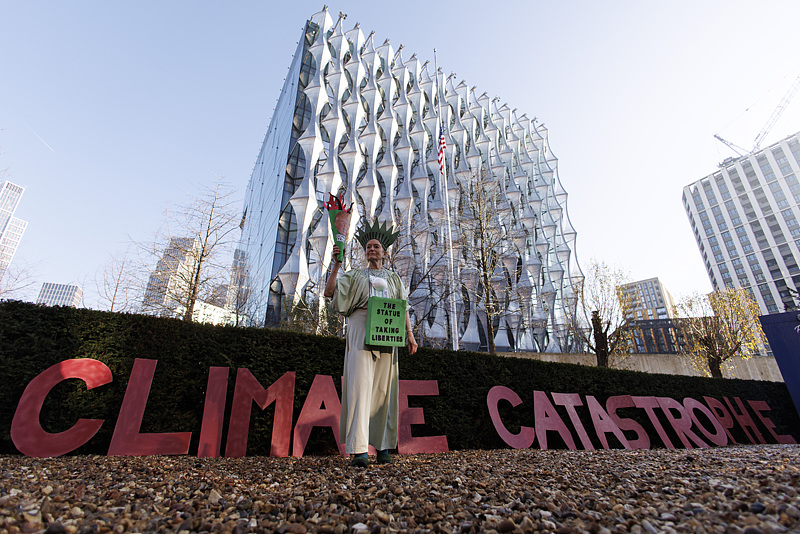
An activist dressed as the Statue of Liberty poses for members of the media at a protest against US president-elect Donald Trump's climate policies outside the US embassy in London, UK, January 11, 2025. (Photo: VCG)
II. Global impact: A crisis of trust and a vacuum in multilateralism
The Trump administration's withdrawal from international agreements has had a significant impact on the global governance system. It has severely weakened the effectiveness and authority of key global governance mechanisms. The US withdrawal, as one of the largest donors and most influential members, has left mechanisms such as the WHO and climate change response facing funding shortages, leadership vacuums, and reduced effectiveness. Secondly, this move has triggered a widespread crisis of trust in multilateralism. As a major architect and maintainer of post-World War II international rules, the US's unilateral breach of agreements has shaken countries' basic expectations of the stability and reliability of the international system. This has encouraged more countries to adopt short-sighted speculative strategies or seek regional or bloc alternatives, accelerating the fragmentation of the global system. At worst, it has created a dangerous "example effect." The US's actions have provided other major powers with an excuse to evade international responsibilities, eroding the universal binding force of international law. The global order is partially regressing from a "rules-based system" to a "power-based jungle."
III. Historical position: Strategic shortsightedness and self-destruction of hegemony
In the long run, Trump's withdrawal from international agreements reflects profound strategic shortsightedness. While international institutions certainly have their flaws, they are indispensable platforms for reducing transaction costs, managing conflicts, and coordinating responses to transnational challenges. By dominating these platforms, the US has long enjoyed rule-making power, discursive dominance, and alliance leadership—one of the core pillars of its global hegemony. Destroying these institutional strongholds for short-term gains is essentially discarding strategic assets as costs, weakening its own long-term influence and legitimacy. The international community has clearly recognized that US policy can swing dramatically with changes in government, significantly diminishing the reliability of its commitments. This forces allies and partners to seek strategic autonomy and diversify risks, fundamentally undermining the cohesion of the US alliance system.
Conclusion:
The Trump administration's "America First" policy, in effect a series of withdrawals from international agreements and organizations, marks a significant paradigm shift in US diplomacy: from providing public goods to maintain systemic leadership to relying on unilateral coercion to extract immediate benefits. While this shift has demonstrated a tough negotiating stance in the short term and achieved some regional coercive goals, it has come at the cost of eroding the foundations of global multilateral cooperation, damaging the international credibility of the US as a reliable partner, and accelerating the disintegration of the US-centric international order. History shows that no great power can maintain its leadership position through self-isolation and continuous undermining of common rules. Trump's diplomatic legacy may be a glimpse into how a hegemon, in its pursuit of absolute self-interest, depletes its most important strategic resource—trust and institutional authority. The future of the global order will depend on whether and how other actors can fill the governance vacuum left by the US withdrawal and build a more resilient and inclusive new framework for cooperation.
Tang Jie is a researcher at the Chinese Academy of International Trade and Economic Cooperation under the Chinese Ministry of Commerce.