


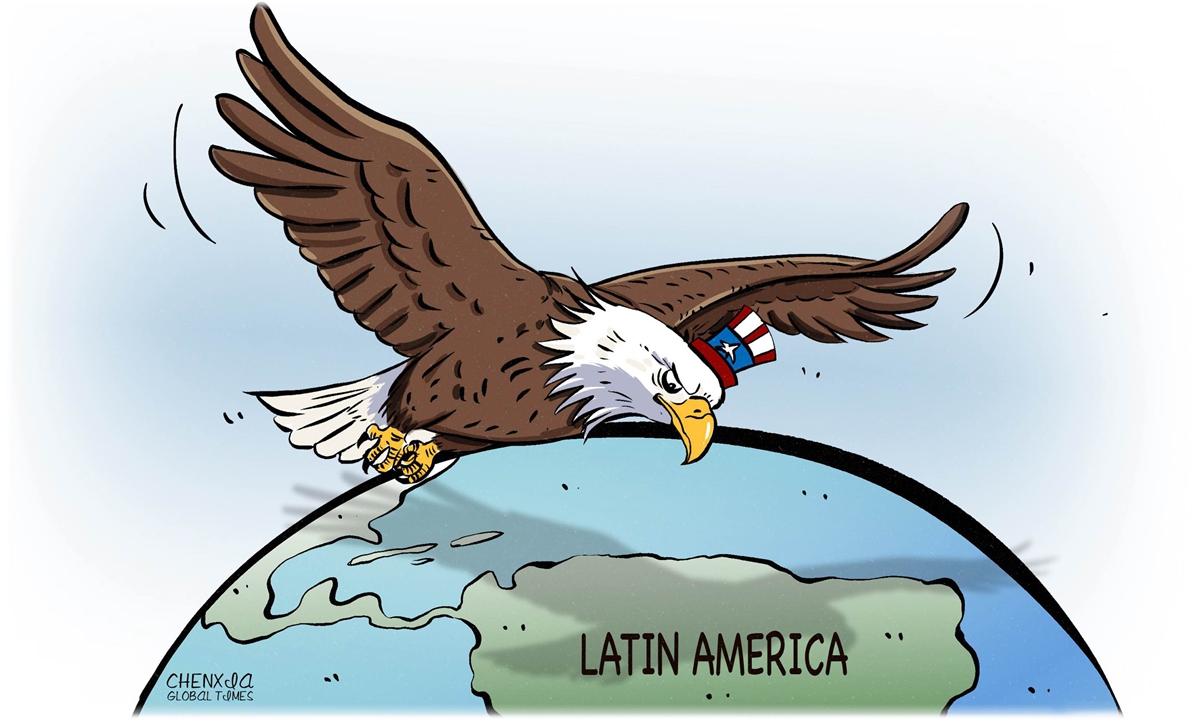
Illustration: Chen Xia/GT
The recent executive order by the Trump administration, which designates Cuba as "a threat to US national security," introduces tariffs on any country that supplies oil to the Caribbean nation. This represents a new tightening of the economic, commercial and financial embargo that Washington has enforced for more than 65 years and that has brought it international discredit and isolation.
One of the greatest strategic mistakes of the North American country has been to once again underestimate the determination of the Cuban people and to assume that economic pressure can generate instability and a change in the political system.
History has shown the opposite. Sanctions tend to further consolidate internal unity and, the greater the external pressure, the stronger the population's will around the government to defend its national sovereignty and dignity.
The US government has for years maintained that the embargo against Cuba does not really exist, arguing that it is merely a justification used by the Cuban government in the face of poor administration. With this executive order, not only is its the existence implicitly acknowledged, but its extraterritorial nature is also reinforced.
Another US mistake lies in ignoring the majority will of the international community, which in successive UN votes since 1992 has rejected the US embargo on Cuba.
The isolation of the US becomes more evident in an international scenario where the voices of the countries of the Global South carry increasing weight in global governance.
Washington considers this a favorable moment to try to advance its aspirations for regime change in a country that has been a reference point for anti-imperialist resistance for more than six decades and has served as a guide for leftist or progressive forces worldwide. The US has just approved its controversial national security strategy, reinterpreting and updating a doctrine that is more than 200 years old (the Monroe Doctrine, 1823) and the principle of "America for the Americans."
Furthermore, recent military actions against Venezuela marked a turning point in the international system that emerged after World War II, as they revealed the erosion of the principles of sovereignty, legality and multilateralism.
What Washington has designed for Venezuela, Cuba, and Latin America and the Caribbean (LAC) as a whole is a dynamic of dependence and subordination of a neocolonial nature.
This is also taking place amid deep regional fragmentation, with the rise of right-wing forces and growing US interference in the internal affairs of several nations.
The pressures that the US has exerted against Venezuela and Cuba, clearly show the persistence of a geopolitical vision associated with the "Monroeist" ideology and the profound crisis of the postwar international order.
All of the above is already having a deeply negative impact on relations between Washington and LAC, a region that carries a long history of interventions, coups d'état and US operations.
Both left- and right-wing governments in the region perceive that, for Washington, the area continues to be considered its "backyard" and, in this sense, any country could become a target of pressure as long as it does not align with the interests of the US.
Under the logic of hegemonic power, Latin America and the Caribbean are conceived as its natural sphere of influence; therefore, the main objective is to cut the region's growing ties with external actors such as Russia and China.
The new executive measure cannot be analyzed as an isolated event, but rather as part of a strategy of systematic pressure that combines economic, political and symbolic instruments with the aim of redefining correlations of power both at the bilateral and regional levels.
Far from bringing about a solution, this approach tends to deepen confrontation, erode norms of international law related to sovereignty and non-interference, and widen geopolitical fractures in the hemisphere.
In a context of regional fragmentation and weakening multilateralism, these actions by the US are pushing LAC to confront the historic challenge of articulating a common strategy, establishing points of convergence and coordination, and shaping a unified long-term vision, despite the ideological differences among their respective governments.
At the same time, these US actions are also prompting the international community to raise its voice and seek collective responses grounded in international law and integration mechanisms, aimed at upholding respect for established norms and preserving the international order.
Multilateral coordination and legal frameworks emerge as essential tools to prevent the further weakening of the rules-based international system.
The author is chief correspondent of the China Bureau of the Latin American News Agency Prensa Latina. opinion@globaltimes.com.cn