


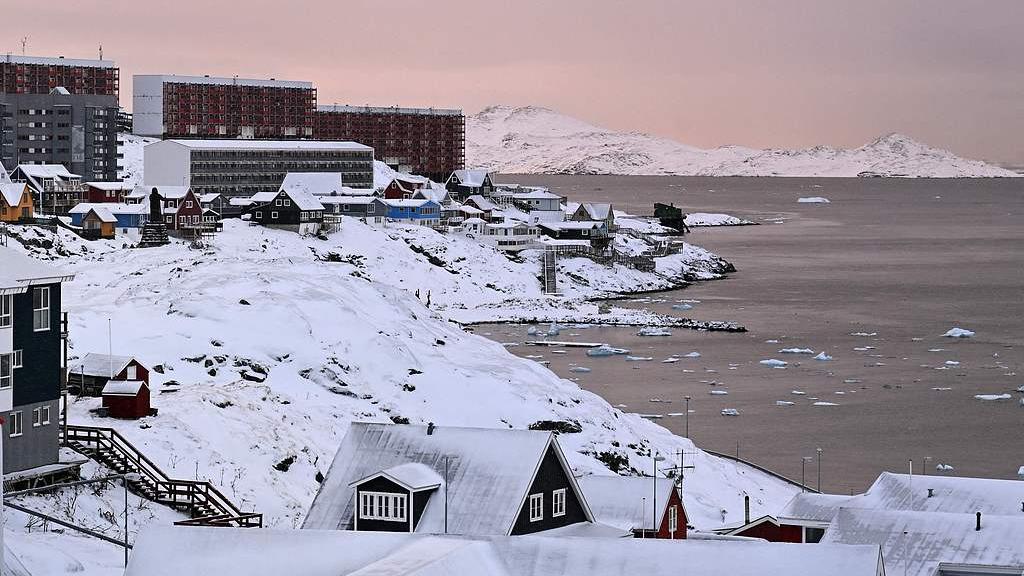
Picture of apartment buildings at the coastline in Nuuk, western Greenland, February 4, 2026. /VCG
Canada and France, which both adamantly oppose Donald Trump's wish to acquire Greenland, will open consulates in the self-governing Danish territory's capital Nuuk on Friday.
The strong show of support follows a persistent U.S. pursuit of control over the strategic, mineral-rich Arctic Island, which resumed with Trump's return to office on the stated grounds of national security.
President Trump last month backed off his threats to seize Greenland after saying he had struck a "framework" deal with NATO chief Mark Rutte to ensure greater American influence.
Resultantly, a U.S.-Denmark-Greenland working group has been established to discuss ways to meet Washington's security concerns in the Arctic, but the details of the talks have not been made public.
While Denmark and Greenland have said they share Trump's security concerns, they have insisted that sovereignty and territorial integrity are a "red line" in the discussions.
"In a sense, it's a victory for Greenlanders to see two allies opening diplomatic representations in Nuuk," said Jeppe Strandsbjerg, a political scientist at the University of Greenland.
"There is great appreciation for the support against what Trump has said."
French President Emmanuel Macron announced Paris's plans to open a consulate during a visit to Nuuk in June, where he expressed Europe's "solidarity" with Greenland and criticized Trump's ambitions.
The newly-appointed French consul, Jean-Noel Poirier, has previously served as ambassador to Vietnam.
Canada meanwhile announced in late 2024 that it would open a consulate in Greenland to boost cooperation.
'Global consequences'
The opening of the consulates is "a way of telling Donald Trump that his aggression against Greenland and Denmark is not a question for Greenland and Denmark alone, it's also a question for European allies and also for Canada as an ally, as a friend of Greenland and the European allies also," Ulrik Pram Gad, Arctic expert at the Danish Institute of International Studies said.
"It's a small step, part of a strategy where we are making this problem European," said Christine Nissen, security and defense analyst at the Europa think tank.
"The consequences are obviously not just Danish. It's European and global."
According to Strandsbjerg, the two consulates, which will be attached to the French and Canadian embassies in Copenhagen, will give Greenland an opportunity to "practice" at being independent, as the island has long dreamt of cutting its ties to Denmark one day.