


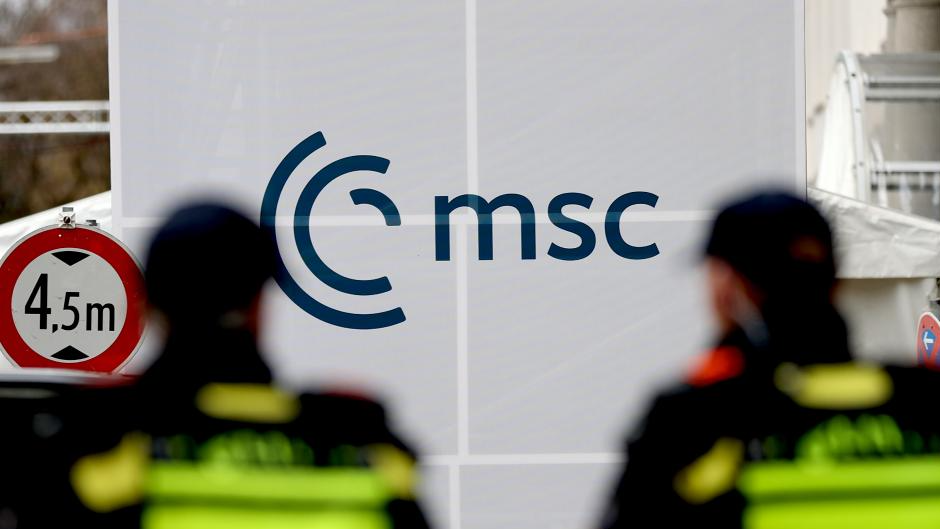
Police officers are on duty near the venue for the opening ceremony of the 62nd Munich Security Conference (MSC) in Munich, Germany, February 13, 2026. (Photo: Xinhua)
European leaders on Friday pushed back on U.S. President Donald Trump's America First policy as they met at a top security conference in Munich.
German Chancellor Friedrich Merz urged "a new transatlantic partnership" and French President Emmanuel Macron called for "a strong Europe" as more than 60 leaders gathered for the annual Munich Security Conference.
British Prime Minister Keir Starmer will meanwhile tell the conference Saturday that Europe is "a sleeping giant" and must rely less on the United States for its defence, his office said in a preview of his remarks.
This year's conference comes at a time of strained ties between Europe and the United States, after Trump threatened to take over Greenland and criticised "decaying" and "weak" European nations.
Efforts by European NATO members to raise their defence budgets are high on the agenda, which came amid Trump's demands that Europe must take responsibility for its own security.
European leaders at the gathering defended their security commitments and the NATO alliance, which Trump's rhetoric has rattled.
"Being a part of NATO is not only Europe's competitive advantage. It's also the United States' competitive advantage. So let's repair and revive transatlantic trust together," Merz said.
"In the era of great-power rivalry, even the United States will not be powerful enough to go it alone," he said, as he switched to English in what appears to be an attempt to address the Americans.
Merz also stressed a divide that "has opened up between Europe and the United States," saying that U.S. Vice President JD Vance "was right" in pointing it out a year ago.
"We do not believe in tariffs and protectionism, but in free trade. We stick to climate agreements and the World Health Organization because we're convinced that global challenges can only be solved together," Merz added, referencing Trump's policies.
The gathering comes a year after Vance used the conference's stage to attack European policies on immigration and free speech, shocking allies on the continent.
Macron emphatically defended Europe in his speech, saying "everyone should take their cue from us, instead of criticising us."
There had been a tendency "to overlook Europe, and sometimes, to criticise it outright", to vilify it "as an aging, slow, fragmented construct", as "a society prey to barbaric migrations," and even "as a repressive continent where speech would not be free," he said.
Instead, "Europe is a radically original political construction of free sovereign states" that gave up centuries of rivalry and war "to institutionalise peace through economic interdependence."
Now, "Europe has to learn to become a geopolitical power," he added.
Starmer's office said his speech would call for "a vision of European security and greater European autonomy that does not herald U.S. withdrawal but answers the call for more burden sharing in full and remakes the ties that have served us so well."